Explainer
What data does a robot vacuum collect when it maps your home?
Floor geometry and room layouts, cleaning schedules and usage patterns, obstacle photos on camera models, plus navigation and telemetry data, much of it stored in vendor clouds. On Level III robots this collection is architecturally tied to navigation, so disabling it degrades core features rather than being a clean opt-out.
On this page7 sections
A robot vacuum navigating autonomously at Level III is, by architecture, a sensor platform. LiDAR pulses or camera frames build a floor map. That map gets stored. Cleaning schedules get logged. Obstacle photos, in some designs, get transmitted to remote servers for training. The navigation capability that owners pay for and the data collection they may not know about are the same system.
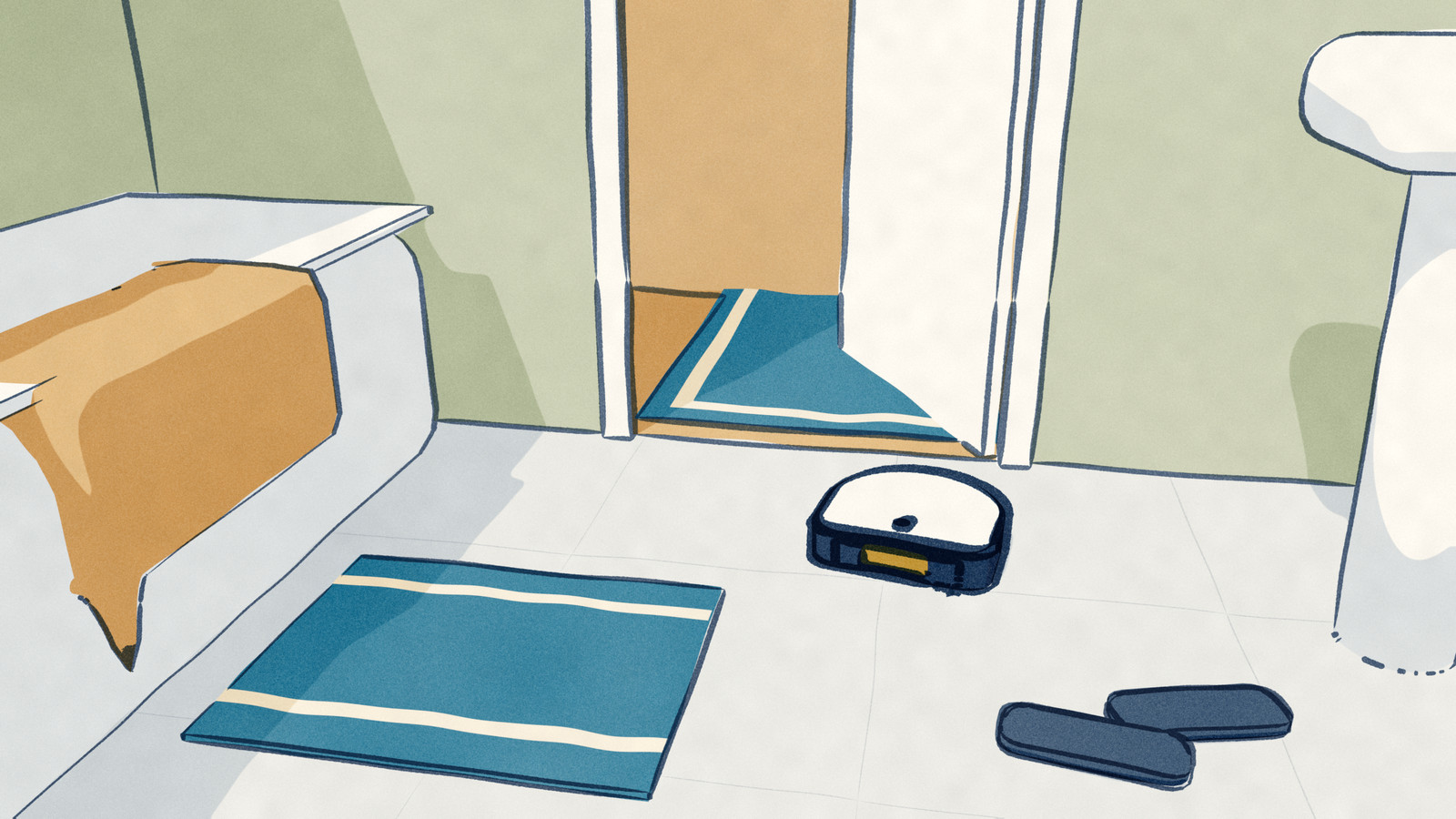
Two documented incidents make the structural question concrete. In December 2022, MIT Technology Review reported that images captured by iRobot development-unit Roombas had appeared on Scale AI’s data labeling platform, surfacing in a private Facebook group. The images included adults in intimate situations and a child on a toilet. iRobot confirmed the units were in a limited beta program with participants who had consented to data collection for AI training.
The consent existed; the distribution did not match what participants understood they had agreed to. In October 2024, The Verge reported that attackers had remotely accessed Ecovacs Deebot X2 Omni units via a Bluetooth vulnerability, using the live camera feed and speaker to chase pets and direct racial slurs at owners. Ecovacs confirmed the vulnerability and issued a firmware patch.
What the robot collects and where it goesThe data architecture most owners don’t see
Most Level III robot vacuums in the current market follow the same pattern. LiDAR or camera-based navigation requires a floor map. That map is stored in the cloud so it persists across app reinstalls, device reboots, and multiple users. Cleaning histories, zone usage, and scheduling patterns are logged for personalization features.
Obstacle photos, in camera-equipped systems, may be transmitted for AI model improvement. The user-facing benefit is a robot that remembers your home. The consequence is that your home’s geometry, room labels, and cleaning behavior exist on a vendor server.
The iRobot Roomba j7+’s privacy policy documents that camera, motion, and location data transmit to iRobot servers for mapping, obstacle detection training, and service diagnostics. Users can opt out of camera processing for training purposes, per iRobot’s documentation, but cannot disable the map transmission required for app features. The iRobot Roomba j7+ carries a privacy score of 48 in the Robovations classification. Local processing is not available.
The Ecovacs Deebot X2 Omni operates on cloud-dependent infrastructure for map storage, scheduling, and voice commands. Ecovacs collects usage telemetry and map geometry on their servers. The X2 Omni carries a privacy score of 56 in the classification.
The October 2024 incident was not a flaw in the map-transmission pipeline itself but in a Bluetooth authentication gap that gave attackers control of the camera and speaker. Both failure surfaces, the cloud transmission and the local wireless interface, exist because the robot is a networked sensor device.
Data architecture, current-generation Level III vacuums
Where your floor map actually lives
- Stays putMap and compute are hardware you own, so the same three streams never leave the building.
- Room layoutCrosses the wall. Anything over this line is held on a vendor server, under their retention policy rather than yours, for as long as they choose.
- Object photosCrosses the same wall to the same server.
- Run historyCrosses the same wall to the same server.
Robovations database
Where iRobot Roomba j7+ sits
Measured against every published robot in robot vacuums
full rangemiddle halfmedianthis robot
- List price217 in robot vacuums$800med $800
- Suction210 in robot vacuums1,700med 10,000
- Runtime187 in robot vacuums75med 180
- Five-year cost173 in robot vacuums$1,200med $1,400
Privacy scores across four Level III robotsSame autonomy ceiling, different data practices
Four robots classified at Level III illustrate how data practices vary within the same autonomy tier. All four require cloud connectivity for full feature access. None offers a documented fully-local mode. The differences are in what each manufacturer discloses, what data leaves the home, and whether any processing stays on-device.
Robovations classification data
Privacy scores at Level III
| Robot | Navigation | Privacy Score | Local Processing |
|---|---|---|---|
| iRobot Roomba j7+ | vSLAM camera | 48 | No |
| iRobot Roomba Combo j9+ | vSLAM camera | 50 | No |
| Ecovacs Deebot T30 Pro Omni | LiDAR + camera | 48 | No |
| Ecovacs Deebot X2 Omni | LiDAR + AI | 56 | No |
| Samsung Bespoke Jet Bot Combo AI | LiDAR + camera | 62 | Limited |
What the incidents actually showTwo failures, one structural condition
The 2022 iRobot incident and the 2024 Ecovacs incident are different failure types. The iRobot case was a consent and data-handling failure at the beta program level: images moved to a third-party labeling contractor in a way that participants did not expect.
iRobot’s privacy policy permitted the data use; the distribution path was not what users understood. The Ecovacs case was a security vulnerability: a Bluetooth authentication gap allowed unauthenticated remote access to the camera feed and speaker on affected units.
What the two cases share is the precondition. A robot that cannot store its floor map and operate its camera without cloud or wireless infrastructure is a robot that cannot fail securely. The iRobot development units sent images off-device because that was the architecture.
The Ecovacs units had a remotely exploitable live camera because that was the architecture. Owners who purchase Level III capability acquire the data footprint that makes Level III possible.
A security researcher found the Deebot X2 Omni had a Bluetooth vulnerability that allowed someone to send commands from nearby without authentication, and that the vulnerability persisted even after Ecovacs said they would fix it.
Reported by TechCrunch, August 2024; ABC News Australia, October 2024
The Ecovacs patch timeline is relevant context. The Verge’s reporting noted that the vulnerability had been disclosed to Ecovacs months before the October 2024 incidents, and that a fix had been promised but not yet deployed at the time owners were affected. The gap between disclosure and patch is not unique to Ecovacs.
Security researchers have documented similar lag patterns across the consumer IoT category. A camera-equipped robot vacuum is an IoT device with a camera, a microphone in some models, a persistent network connection, and a detailed map of its owner’s home. The attack surface is proportional to the capability.
Data retention and ownership transferA stored map does not delete when the home is sold
Floor maps stored on vendor servers do not automatically delete when an owner sells their home, replaces their robot, or cancels their account. Each manufacturer documents a different retention policy.
iRobot’s privacy documentation states that account data is retained until the account is deleted, and that users can request deletion. Ecovacs’s privacy policy permits retention of anonymized data after account closure. Samsung’s SmartThings terms describe retention periods tied to service operation requirements.
The ownership-transfer scenario deserves specific attention. A robot vacuum sold on a secondary market retains, until explicitly factory-reset and deregistered, the previous owner’s floor map and account association. A robot delivered to a new address may still have the prior home’s layout in the vendor’s system under the original account.
This is not a theoretical edge case: owner forums document instances where resale units arrived pre-mapped and pre-associated with a prior account. The remedy is straightforward, a factory reset and proper deregistration, but the default state creates a handoff window.
Corporate acquisition adds another dimension. Amazon’s acquisition of iRobot, which received regulatory scrutiny before being abandoned in January 2024, raised questions about what floor-plan data at scale would mean in the hands of a retail and logistics conglomerate. The deal did not close, so no data transfer occurred. The episode surfaced a concern the industry has not fully resolved: floor maps are valuable training data, and manufacturers can be acquired.
What owners can actually controlThe levers that exist and the ones that don’t
Owners have limited structural options. Disabling WiFi on a Level III robot that requires cloud map storage for full functionality degrades the core feature set. Opting out of camera data submission for AI training, where that option exists, affects one transmission path but does not affect map storage or firmware update delivery.
Firmware updates themselves often require cloud connectivity, creating a dependency loop: staying current on security patches requires maintaining the connectivity that creates the data footprint.
Some specific levers do exist. iRobot’s privacy settings allow opting out of camera frame submission for AI training, documented in the iRobot privacy portal. Samsung’s SmartThings infrastructure provides account-level privacy controls.
None of these resolves the structural dependency on cloud map storage. The practical question for owners is not whether to accept any data transmission, which Level III navigation makes unavoidable, but which specific practices each manufacturer applies to what they collect.
Robovations tracker
What has actually changed
5 recorded updates for iRobot Roomba j7+
- Amazon acquisition of iRobot collapses, triggering going-concern disclosure
Amazon terminated its $1.7 billion acquisition of iRobot in January 2024 following European Commission opposition, triggering an immediate going-concern disclosure and workforce reduction of approximately 31 percent at iRobot. The j7+ continued to ship and receive firmware support, but the corporate instability introduced documented uncertainty about the product's long-term update roadmap and manufacturer warranty backstop. Watch iRobot's firmware update cadence and parts supply continuity over the following 12 months as the indicator of operational stability.
Setback - MIT Technology Review reports leaked Roomba J-series test images from data labelers
MIT Technology Review reported in December 2022 that contracted Scale AI data-labeling workers shared images captured by pre-production Roomba J-series test robots, including one photo taken in a bathroom. iRobot said the images came from development hardware in its data-collection program, not retail j7+ units, and terminated its relationship with Scale AI. Watch for how iRobot documents safeguards on any future in-home data collection.
Setback - iRobot expands PrecisionVision object library via OTA firmware update
iRobot pushed OTA firmware updates across 2022 that expanded PrecisionVision's recognized object library and improved avoidance reliability on dark and partially obscured obstacles, two categories that drew critical early reviews at launch. Owner forums and iRobot's published changelog documented fewer false-stops and missed detections compared to the launch firmware. Watch for whether the expanded training set materially reduces the documented failure rate on transparent or very-low-contrast obstacles, which firmware notes did not specifically address.
Incremental - iRobot Roomba j7+ Pet Owner Official Promise launched
iRobot announced the Roomba j7+ Pet Owner Official Promise, a guarantee replacing any j7-series robot failing to detect and avoid pet waste on first encounter.
Lateral - iRobot Roomba j7+ enters retail with PrecisionVision obstacle avoidance
iRobot commercially released the Roomba j7+ in September 2021 at an MSRP of $849, pairing the Genius 3.0 Home Intelligence platform with a new RGB camera-based obstacle detection system called PrecisionVision. The launch moved camera-trained object avoidance from lab demonstration to a shipping consumer product, the first in iRobot's lineup at scale. Watch whether subsequent firmware updates expand the recognized object library beyond the initial training set.
Incremental
Regulatory coverage as of 2024A patchwork of rules, not a standard
Consumer IoT privacy in the United States is covered by a patchwork of state and federal rules rather than a single framework. The FTC’s data security authority under Section 5 applies to deceptive or unfair data practices.
Several states, including California under the CCPA and its amendments, give residents rights to access and request deletion of personal data held by covered businesses. These frameworks reach robot vacuum manufacturers operating at commercial scale. They do not require local processing, restrict the scope of data collection, or mandate specific retention limits for floor-map geometry.
The UK’s Product Security and Telecommunications Infrastructure Act, which came into force in April 2024, sets minimum security requirements for consumer IoT products sold in that market, including mandatory vulnerability disclosure policies and prohibitions on default universal passwords. This is a security framework rather than a data-minimization one.
It addresses the Ecovacs-type attack surface more directly than the iRobot-type consent surface. Neither type of framework fully maps to the structural condition these incidents expose: that Level III navigation capability is architecturally coupled to off-device data storage in the current product generation.
Owners who want local-first operation have a narrow set of options in the current market. Valetudo, an open-source firmware replacement for certain robot vacuums, enables local map storage and control without cloud dependency. Valetudo is community-maintained, voids manufacturer warranties, and supports a limited set of models. It is the only documented path to genuinely local Level III operation on current consumer hardware for the robots it supports.
Lowest privacy score in this analysis
48
The iRobot Roomba j7+ and Ecovacs Deebot T30 Pro Omni both score 48 on the Robovations privacy dimension, reflecting cloud-dependent map storage, no documented local processing option, and limited owner control over data transmission.
Classification implicationsLevel III requires persistent awareness
Level III conditional autonomy requires persistent environmental awareness. A robot that forgets your floor plan between sessions, or that cannot transmit obstacle data for model training, is a robot operating at a lower effective capability. This is not a trade-off that manufacturers invented arbitrarily. The navigation architecture that produces Level III behavior is, in current consumer hardware, inseparable from the data collection architecture that concerns owners.
Level IV environmental autonomy, which would require robust real-time generalization rather than map-dependent operation, does not currently appear in any classified consumer robot in this analysis. If and when it does, it will not reduce the data footprint.
More capable navigation requires richer sensor data. The question of what data leaves the home when a robot operates is not a transitional concern of early-generation hardware. It is a property of the category.
The pattern across both incidents is the same: the data practices were lawful, disclosed somewhere in a policy document, and still surprising to the people whose homes appeared in them.
The capability and the data collection are the same system. Level III navigation requires the sensor architecture that produces the privacy footprint, and the incidents document what happens when that architecture fails at either the security or consent layer.