Skip to content
Saved

Analysis

How well do robot vacuums recognize objects with their cameras?

Reliably but narrowly. Onboard classifiers identify five to ten fixed hazard categories like cords, socks, and pet waste well enough for practical use, yet cannot generalize to novel objects. The taxonomy is set at release, misclassification is tolerated, and this keeps recognition inside a Level III ceiling.

By Robovations··9 min read·Updated

For the last five years, consumer robots have operated on binary spatial models. A vacuum sees a room as navigable or not. A mower sees terrain as cuttable or not. An arm sees reachable space or not. The environmental data driving these decisions came from LiDAR, ultrasonic, or visual SLAM: maps of space, not maps of things.

That constraint is eroding. Roborock, Samsung, and a handful of second-tier manufacturers are now embedding visual recognition pipelines that identify specific object categories, socks, cords, pet waste, small toys, items worth picking up, and classify them in real time.

This is not general object detection. It is narrow, trained on specific problem categories per product line. It represents a pivot in how robots determine their own task boundaries. A robot that can see and name what it cannot handle is doing work that navigation geometry alone cannot do.

Concept: two-layer sensing

Visual SLAM vs. object recognition

123
  • Tracked pointsSpecks of texture the camera can find again from somewhere else. Two sight lines to the same speck fix the robot's position.
  • Blank wallA clean painted surface offers nothing to lock onto, and low light removes what little there is. This is where visual navigation drifts.
  • Two positionsThe camera looks forward, not all round, so the overlap between one view and the next is what it has to work with.
Navigation SLAM (left) tracks feature points to build a geometric map. Object recognition (right) identifies object categories within camera frames. The two pipelines run concurrently; the recognition layer queries the geometry map to localize what it names.

Recognition vs mappingGeometry stops being enough at the object level

Navigation systems, even sophisticated ones with LiDAR SLAM or dense vSLAM, see the world as obstacles and open space. They excel at constructing room-scale maps and finding shortest paths through them. A navigation map is not an object taxonomy. It tells a robot that there is something at coordinates (3.2, 5.1) but not what that something is.

A collision between a socket cord and a vacuum motor, or between a small toy and a gripper arm, happens because the robot saw space it could move through, not because it lacked navigation data. A Level III robot with perfect SLAM can still fail at the task because it cannot distinguish hazards from navigable clutter.

Visual recognition layers sit on top of navigation. A video feed (usually a front-facing RGB camera) is processed in real time against a trained model to label incoming frames. The model is small enough to run on-device, typically deployed as a quantized deep learning classifier or via edge inference on a mobile GPU. The robot’s navigation stack queries these classifications: is that obstacle a sock or a wall?

Is that small object worth investigating or a dust shadow? The recognition layer does not replace the geometry map; it queries it. The robot still uses SLAM for localization. It now also uses vision for semantic decision-making within the navigated space.

Roborock’s T20S Pro Omni, released in early 2025, ships with an object-recognition module trained on a curated set of hazard categories: fabric items, hairballs, small toys, pet mess. The module runs on an embedded processor during navigation cycles.

When the robot encounters an object, it classifies the image frame and returns a binary decision: navigate around it, flag it as a potential hazard for manual handling, or, if a manipulator arm is equipped, attempt to pick it up.

This is not perfect. The model misclassifies at rates that would be unacceptable in medical imaging or autonomous vehicles yet are acceptable here because the cost of a false negative is a choked vacuum brush, not a collision. The system explicitly does not attempt general-purpose recognition. It recognizes its problem set.

The narrowness is deliberate. A classifier that attempts to recognize every possible household object will perform less reliably on any given category than one trained deeply on five. Roborock’s engineering choice, confirmed in manufacturer disclosures, is to own a narrow problem set rather than approximate a broad one.

That trade-off shows up in deployed performance: the robot handles its trained categories at rates owner reports describe as useful, and fails on objects outside the training set in ways the user can predict.

Where geometry runs out

What each sensor can actually reach

LIDAR TURRETCAMERA (VSLAM)CableSockChair legThe one plane it sweepsWhat the lens reaches
  • In the datathe sensor returns something for it
  • Not in the datano return at all — not a low-confidence one
Same room, same three things on the floor. A LiDAR turret measures one horizontal plane at turret height, so the cable and the sock are not low-confidence detections — they are not in the data at all, and only the chair leg crosses the beam. A camera reaches the floor ahead and sees all three, and stops seeing any of them when the room is dark. Both architectures build a map good enough for the same rung; what differs is which failure you get.

Hazard avoidance boundariesFive recognised categories is still a cap

A robot that can identify five problem categories is more autonomous than one that cannot. The Roborock T20S avoids obstacles it cannot name by simple heuristic: if the classifier is uncertain, treat it as a hazard. The behavior looks like higher autonomy, the robot operates longer without human intervention, and the ceiling remains Level III.

The constraint is the closed-loop. A Level III robot can complete tasks within its design domain without human intervention. Its design domain is defined by what it can reliably handle autonomously.

If the robot encounters an object it cannot classify with high confidence, it flags it and stops work. If it encounters an object it misclassifies as safe but is actually hazardous, it fails. Recognition layers shrink the failure band without eliminating it.

Level IV autonomy would require a robot to recognize a novel object category it has never trained on, infer the proper handling, and execute the task. That inference-on-novel-inputs loop is not present in current consumer vision systems. The models are statically trained. The robot’s task envelope does not expand after deployment; it only shrinks when it encounters something it cannot classify.

The Roborock system is designed to expand its handling set within its trained categories. A newer firmware deployment can incorporate a broader dataset of the same problem types. The taxonomy, the set of things it attempts to recognize, is fixed at release.

That immobility is the autonomy cap. Navigation geometry can improve incrementally with better sensors and SLAM refinements. A recognition taxonomy cannot grow without a deliberate model update shipped from the manufacturer.

Trained recognition set

5categories

Roborock T20S Pro Omni targets five hazard categories at launch; all classification decisions outside this set default to the obstacle-avoidance heuristic.

The gating of recognition features to subscription tiers is itself a constraint on real-world autonomy. A robot with object recognition available only via a paid feature tier is a Level III robot for users who pay and a Level II robot for those who don’t.

The autonomy classification branches on ownership tier, not capability. This creates an odd situation where the hardware is capable of higher autonomy while the business model caps it.

That distinction matters for how Robovations classifies these products. The autonomy level assigned reflects hardware capability in fully-enabled configuration. A separate assessment notes when features require a subscription, because the reader who does not pay is operating a different functional robot than the spec sheet describes.

Where it stops

The points an ordinary home puts in the way

1234
  • ThresholdTaller than the machine can climb. The far side of it is a room that never gets cleaned, and no coverage figure mentions it.
  • SockAnything soft left on the floor is pulled into the brush and jams it. The run ends wherever that happened, and clearing it means turning the machine over.
  • Dark rugAbsorbs the cliff sensor pulse instead of returning it, so it reads as a drop and the machine refuses to cross.
  • Shut doorNo fault at all. The room behind it is simply not in the run, and the machine has no way to say so.
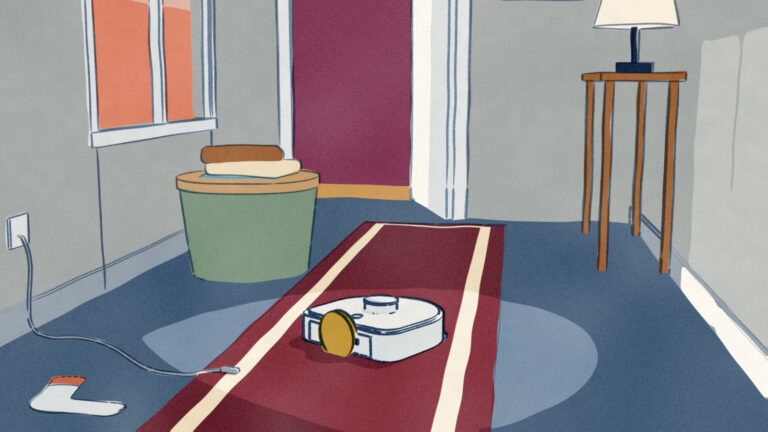
None of these is a fault. They are a threshold, a sock, a dark rug and a shut door, and each one is enough to end an unattended run, which is why the same machine classifies differently in two homes.

Vision plus manipulationThe pick-up frontier

The more ambitious application of object recognition is in manipulation. A robot that can identify a small toy, localize it in 3D space, and execute a grasp sequence is doing closed-loop object handling. Roborock’s equipment-variant T20S comes with a three-DOF arm that can perform suction-based manipulation; the recognition module identifies candidates worth attempting to pick up.

The arm itself is not novel. Suction-based grasping of rigid objects at fixed sizes is a solved problem. What recognition changes is the candidate selection. Without vision, the arm would operate on spatial heuristics: is there an obstacle within reach?

Can I remove it? With vision, the heuristic is narrower: is there a toy-shaped object within reach that I am trained to pick up? The selection is more conservative, and the success rate on actual pickups is higher.

Samsung’s Jet Bot AI Plus includes a small camera for real-time scene understanding alongside its vacuum module. The published use case is hazard detection: the camera flags the presence of pet mess, liquid spills, or small objects during navigation. The robot pauses cleaning when certain object types are detected. It does not attempt manipulation. The recognition module is a decision gate, not an action trigger.

The constraint is hardware and real-time inference cost. Running a full vision pipeline (detection, segmentation, pose estimation, grasp planning) on a mobile robot’s thermal budget is expensive. Most current consumer systems run lightweight classifiers (small CNN backbones or quantized models) that answer binary questions fast enough for navigation-loop timing.

They do not run the full perception stack required for reliable manipulation. The pick-up attempts succeed often enough to be useful; failure rates are high enough that a robot relying purely on vision-directed grasping would lose objects and get stuck.

For the T20S Pro Omni, manufacturer documentation describes a retry protocol: if a grasp attempt fails, the arm retracts and the object is flagged for the user. The robot does not attempt a second grasp strategy with a different approach angle. One attempt per object per session.

That conservative protocol prevents cascading failures, and it also marks the boundary of what the manipulation system is designed to do. A robot that retries with different strategies would be approaching Level IV behavior in manipulation. One-attempt-and-flag is Level III.

What it has to tell apart

The classes an obstacle model has to separate

1Chair legavoidedShoeavoidedSockdriven intoCabledriven intoPet wastedriven into
  • The thresholdThe smallest height the sensor resolves. Everything below this line is driven over rather than avoided, whatever the obstacle is.
  • Avoidedtall enough to register before contact
  • Driven intobelow the sensor floor, whatever the marketing says
Obstacle avoidance is a height threshold, not a promise about objects. Anything flatter than the sensor can resolve is not avoided badly, it is not seen at all, which is why cables and pet waste remain the two failures owners actually report.

Training data captureThe evidence floor

Object-recognition systems in consumer robots are trained on datasets that are narrow by design. Roborock’s hazard classifier is trained on photographs of the five problem categories it attempts to recognize: actual fabric items collected from user homes, hairballs, small toys from common brands, pet-waste photographs, and dust-shadow false positives. The dataset is curated for the product’s market.

This curation is essential and limiting. A classifier trained on US household hazards will misclassify hazards common in another region. A classifier trained on rigid, small toys will fail on soft or large objects. Manufacturer disclosures confirm these constraints without quantifying actual misclassification rates on deployed robots.

Owner reports from r/robotics and subreddit forums tracking Roborock variants describe false-positive behavior (the classifier flags a safe object as hazardous, causing unnecessary pauses) and false-negative behavior (a hazardous object is not detected, and the robot navigates into it). These are acceptable for a Level III use case because the human remains the ultimate decision-maker on what gets picked up. The robot flags; the owner verifies.

What is not yet visible in consumer systems is continuous retraining from deployment data. Apple’s on-device machine learning often involves local model adaptation (the device learns the user’s preferences over time). Consumer robots could theoretically accumulate false-positive examples and retrain to reduce them. No major vendor has published such a pipeline. The models are statically deployed. Recognition accuracy is frozen at launch.

Closed taxonomy, open questionsThe architecture plateaus at one question

The current generation of consumer vision systems answers one question well: is this specific thing something I was trained to handle? It does not generalize. A robot trained on sock-shaped fabric items will misidentify a crumpled paper bag as a hazard or miss an unusual sock as safe. The recognition is as narrow as the training set, and the training set is as narrow as the manufacturer’s deployment decision.

That ceiling will shift as embedded compute improves and on-device inference becomes cheaper. Foundation models for visual recognition (large pretrained networks that generalize across categories) are running on mobile hardware in 2025 and 2026, per third-party ML benchmarks.

They are not yet deployed in consumer robots at the inference speed and power envelope the platform requires. A robot vacuum runs its vision pipeline across tens of thousands of frames per cleaning session. Even a small latency increase per frame adds up to meaningful power draw and heat.

The path from closed-taxonomy classifiers to open-vocabulary recognition is not blocked by algorithm availability. It is paced by the thermal and power constraints of a $1,000 consumer device running eight hours between charges.

When those constraints ease, either through better hardware efficiency or through smaller inference models that generalize more broadly, the autonomy ceiling for object recognition will rise. Level IV behavior in manipulation, handling a novel object category never seen in training, would require exactly that shift.

Until then, what manufacturers can deliver is a well-curated closed set: five to ten object categories recognized reliably enough to matter, with conservative failure modes that hand control back to the user rather than attempting to improvise. That is a meaningful gain over pure geometry navigation. It is also a clearly bounded one. The robot sees what it was trained to see, and handles what it can name.

Consumer robots are shifting from space-aware to thing-aware. Both operate within fixed envelopes and carry the same Level III ceiling. A robot that names what it cannot handle is more useful than one that only maps where it can go. The taxonomy is closed, and the robot cannot learn new categories after deployment: that boundary is where recognition ends and the next generation of consumer autonomy will begin.

Published June 11, 2026 · Updated September 5, 2026 · 2,169 wordsHave evidence that could change a classification?