What data does a robot vacuum send out of your home?
Your robot vacuum knows the floor plan, what you named each room and the Wi-Fi password. The company holding that copy can change hands, and the robot can be hijacked.
On this page4 sections
The photographs were taken from low angles inside people’s homes. They showed furniture, a child lying on the floor and a woman sitting on a toilet. Robot vacuums shot all 15 between June and November 2020, and in December 2022 a technology publication reported that it had obtained them.
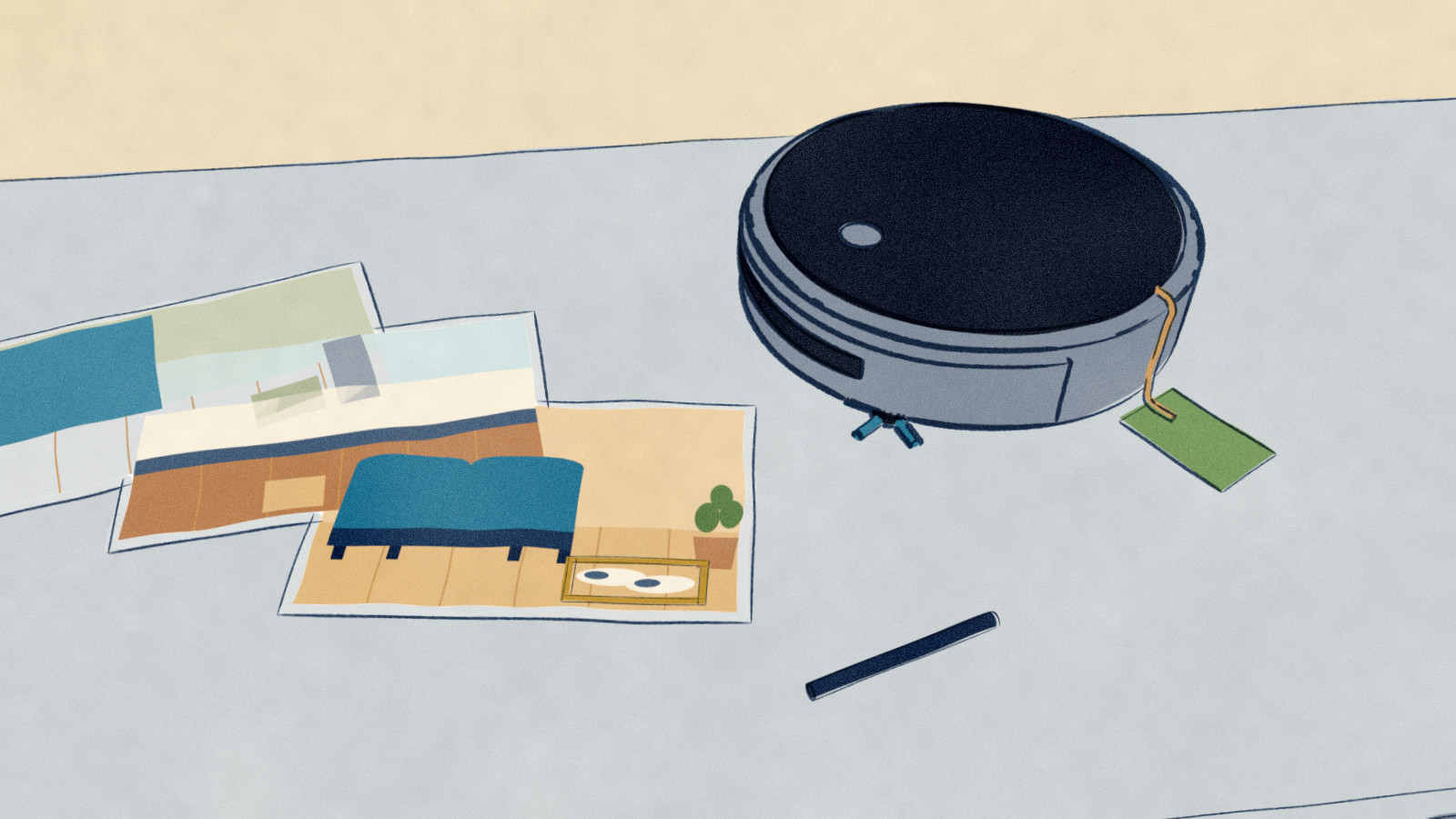
The robots were development versions of iRobot’s Roomba J7 series, placed with paid testers and employees who had signed agreements allowing their data, video streams included, to be collected. The images went to Scale AI, a company that labels data for machine-learning training, and gig workers in Venezuela doing that labeling posted some of them to groups on Facebook, Discord and elsewhere.
iRobot said the pictures came from “special development robots” with modifications that “are not and never were present on iRobot consumer products for purchase.” Those robots wore “a bright green sticker that read ‘video recording in progress.’” It was up to the testers, the company said, to “remove anything they deem sensitive from any space the robot operates in, including children.”
Your own robot is not a development unit. So what does a vacuum bought in a store send out of your home, and who ends up holding it? The maker’s privacy policy and the settings in your app set the terms, and the policies of iRobot, Roborock and Ecovacs are precise about some kinds of data and vague about others.
What a robot records on an ordinary run
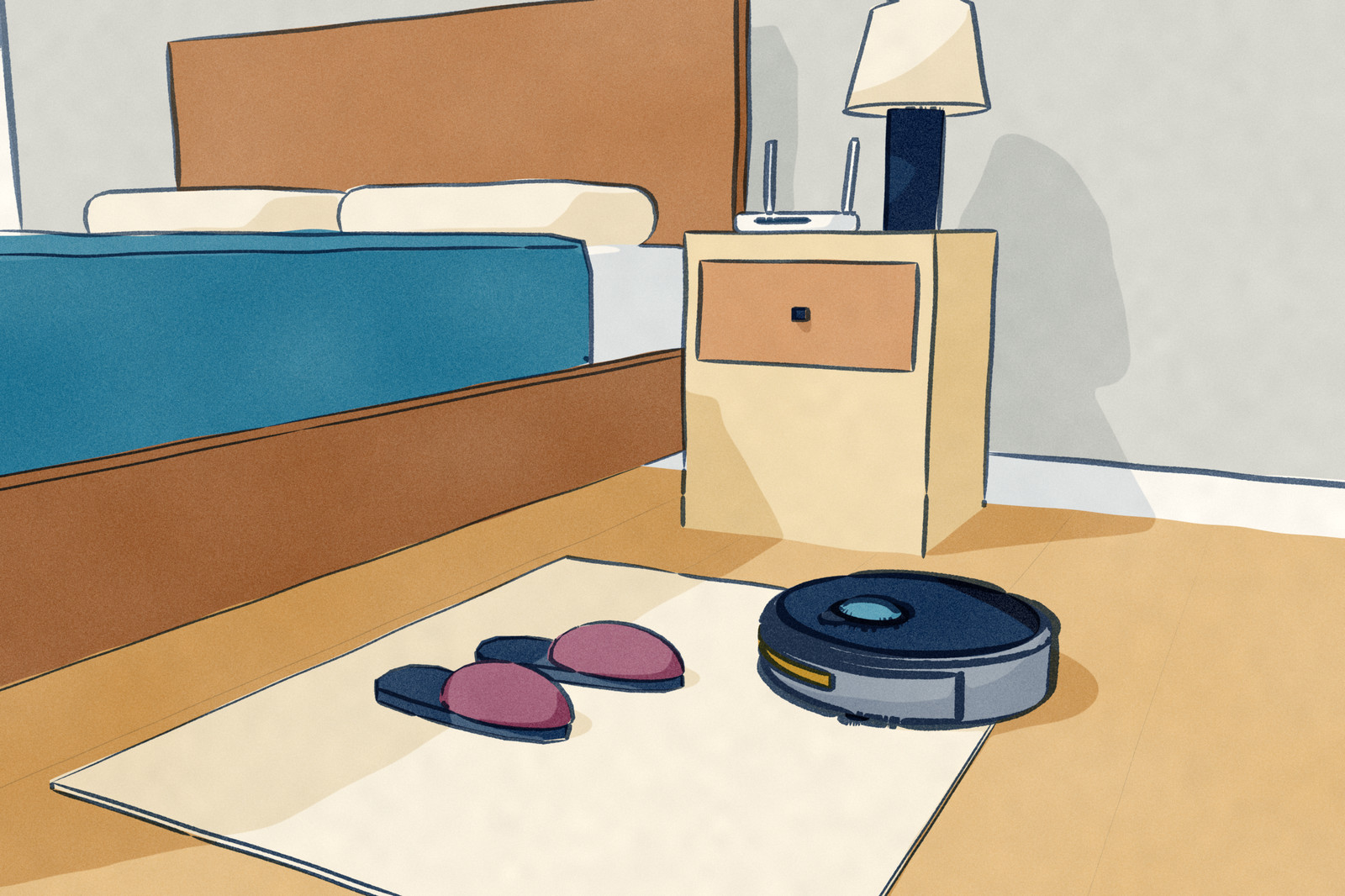
A mapping robot has to know where it is, so it builds a map as it drives. Models that navigate by camera do this with visual SLAM, matching features across successive frames to place themselves in the room. Many use the same forward camera to recognize a sock or a charging cable in their path.
The robot also joins your Wi-Fi network, which is how it reaches its maker’s servers and your phone. Alongside battery life and “mission information,” iRobot collects what it calls the robot’s “device environment”: “level of dirt, Wi-Fi name/credentials/signal strength, robot movement, floorplan and room names, existence and type of objects, floor type.”
Read that list the way a stranger would. A floor plan with rooms named by the people who live there describes a home’s layout without any photograph. The Wi-Fi credentials beside it are the way onto the network inside that home.
Photographs need a separate yes. Opt in to image collection and the robot’s images are collected, but under iRobot’s policy they “will not be viewable by us unless and until you opt in both to image collection and to sharing each image with iRobot.”
So a Roomba owner flips two switches before anyone at iRobot sees a picture. In the app, the second one works one image at a time: you choose which obstacle photos to share, and iRobot said in 2022 that those are the only images it receives.
Roborock’s collection covers “map data, device status, and anonymized usage information.” A photo one of its robots takes of an obstacle “is saved on the robot in an encrypted format rather than as a standard image file,” and remote video is “off by default and requires physical confirmation to activate.”
Term
Anonymized dataInformation stripped of names, account details and other identifiers, so that on its own it does not point to a particular person or household.When a video call ends, Roborock says, the stream “is immediately cleared, leaving no video data stored on the robot or in the app.” Its voice model was trained on data collected in its labs: “Roborock’s AI training uses only data from simulated home environment, not real users.”
Where the data goes, and how long it stays
Roborock stores your data at whichever of its data centers is nearest the website you log into, and those centers are “in China, Germany and the United States.” The company’s Trust Center describes the same arrangement, with each user’s data kept according to their registered region.
Ecovacs keeps personal information “stored in our servers located in the United States,” though the same passage names China, where its affiliates are registered, and service providers in customers’ own jurisdictions. What its robots and app collect falls under a separate policy, for the Ecovacs Home app.
So how long does your floor plan stay on those servers? None of the three policies gives a period. iRobot keeps information “for as long as we need it to do the activities we told you about or if we have a valid reason to keep it.”
Roborock and Ecovacs tie retention to what is “necessary” for their stated purposes, or to what the law requires or permits. In each case, the company decides what is necessary.
You can ask for deletion, though. iRobot’s app takes the request from its account menu, and California’s Consumer Privacy Act lets residents ask a covered business to delete personal information collected from them, “subject to certain exceptions.” The law reaches companies with more than $25 million in annual revenue, and smaller ones that trade heavily in Californians’ data.
Figure
What crosses the wall of the house
- Stays putMap and compute are hardware you own, so the same three streams never leave the building.
- Floor planCrosses the wall. Anything over this line is held on a vendor server, under their retention policy rather than yours, for as long as they choose.
- Room namesCrosses the same wall to the same server.
- Wi-Fi detailsCrosses the same wall to the same server.
Keeping data inside the house takes a different kind of connection. The Connectivity Standards Alliance added robot vacuums to Matter, its smart-home standard, in October 2023. A Matter hub can start a run, set a cleaning mode, and report progress, errors, brush condition and charging.
Those commands can travel over your own network, since “local connectivity” is one of Matter’s listed features. The maker’s own app, if you keep it installed, still runs under the maker’s policy.
Some owners cut the maker out entirely with Valetudo, an open-source “cloud replacement for vacuum robots enabling local-only operation.” It runs on the robot alongside the maker’s software, only on the models it supports, and keeps data at home “through not sharing it with anyone by being fully local.”
The catch comes at install. Valetudo is, in the project’s words, “a permanent change. There is no way back,” and the maker’s own app stops working once it is on.
When the robot itself is the leak
A privacy policy covers what a company does with the data it receives. It can’t stop a stranger who gets into the robot itself. In August 2024, ahead of a talk at the Def Con hacking conference, security researchers told reporters that a Bluetooth flaw let them take over Ecovacs robots from as far as 450 feet (about 130 meters) away.
Once in, they could reach the cameras and microphones, the saved maps and the Wi-Fi credentials. The affected list ran from the Deebot 900 series to the Deebot X2, and included the Goat G1 mower and several Airbot models. Some models play an audio file every five minutes to say the camera is on, and one researcher said an intruder could delete or overwrite it.
Their security was really, really, really, really bad.
An Ecovacs spokesperson said the company would not fix the flaws, adding that “users can rest assured that they do not need to worry excessively about this.” Two months later, reports surfaced that Deebot X2 robots in several US cities had been taken over in May 2024.
In Minnesota, Daniel Swenson heard what “sounded like a broken-up radio signal or something” from his robot before it shouted racial slurs at his family. In Los Angeles a robot was steered to chase a dog, and one in El Paso yelled slurs until its owner unplugged it.
Ecovacs told Swenson, “Your Ecovacs account and its password have been acquired by an unauthorised person,” and said it would “issue a security upgrade for owners of its X2 series in November.” But the researchers had already found that the four-digit PIN guarding the X2’s camera was checked only by the app. Anyone who went around the app went around the check.
They also found a problem for anyone buying one secondhand. Deleting an Ecovacs account left its data on the company’s servers, and the authentication token with it. A seller who wiped the account before a sale could keep access to the robot and “potentially” spy “on the person who may have purchased the robot secondhand.”
So can you tell, before you buy, whether a robot’s security holds up? A certificate is one clue. At CES in January 2024, TÜV Rheinland certified four Roborock models, among them the Qrevo MaxV and S8 MaxV Ultra, against ETSI EN 303 645, a European standard for connected consumer devices that covers both cybersecurity and data privacy.
Britain sets a floor by law. Its product security regime for connectable products, in force since April 29, 2024, requires passwords that are “unique per product” or set by the user, a way for buyers to report security issues, and published minimum security update periods.
When the company changes hands
The last route out of the house needs no hacker. iRobot’s policy has a clause for it: “We may share your personal information in connection with a transaction, like the sale of company assets or shares, or acquisition.”
Amazon’s planned purchase of iRobot would have been such a transaction. It ended on January 29, 2024, when the two companies called it off. The deal had “no path to regulatory approval in the European Union.”
The change of owner that did happen went to a company iRobot already knew well. On December 14, 2025, iRobot announced a pre-packaged Chapter 11 process in Delaware. Under it, Shenzhen Picea Robotics, its contract manufacturer and a lender to the company, would receive 100 percent of iRobot’s equity. iRobot said there would be “no anticipated disruption to its app functionality.”
Term
Pre-packaged Chapter 11A U.S. bankruptcy reorganization in which the company agrees on its restructuring plan with its main creditors before it files, so the court’s job is mostly to approve a deal already struck. The business keeps operating through the case, and the plan can hand the company to a new owner.The deal was complete by January 23, 2026. It came with a new US subsidiary, iRobot Safe Corp., “responsible for the protection of U.S. consumer data.” Safe Corp. answers to an independent board of US citizens and an independent US-based data security officer, and is meant to keep “a clear separation between iRobot’s Chinese ownership and its U.S. and other global consumer data.”
Put together, a mapped home sends out its floor plan, the names you gave its rooms, the Wi-Fi network and its credentials, and what lies on the floor, plus photographs if you opt in. The maker picks where that record is kept and decides how long it needs it, and iRobot’s policy lets it go along when the company is sold.
The policy on iRobot’s website, the one listing floor plans, room names and Wi-Fi details among what a Roomba collects, still carries a last-updated date of November 6, 2024, thirteen months before the sale was announced.