How do robot pool cleaners navigate: random drift, gyroscopes, or mapping?
Some pool robots wander, some drive lanes, and some promise a map of your pool. From the deck, the three can be hard to tell apart.
On this page4 sections
A pool robot is meant to take a chore off your hands. Yet one reviewer found that the Polaris 9650iQ Sport“seemed to miss areas or clean the same spots repeatedly,” and so did several reviewers on Amazon. Poor navigation like that, he wrote, can leave an owner having to “babysit it while it cleans.”
So how does a robot find its way around a pool at all? It works underwater, out of reach of satellite positioning, on a floor that curves up into walls, steps and a tile line. You can’t judge its route from a spec sheet, and you probably won’t be standing at the edge to watch it.
Makers take three broad approaches. The simplest robots wander until the floor has probably been covered. Others carry a gyroscope, which lets them hold a heading and drive deliberate lanes. A third group promises a model of the pool’s shape and a route planned against it. Which kind you own decides which corners get missed, and how often you check.
Wandering until the floor is covered
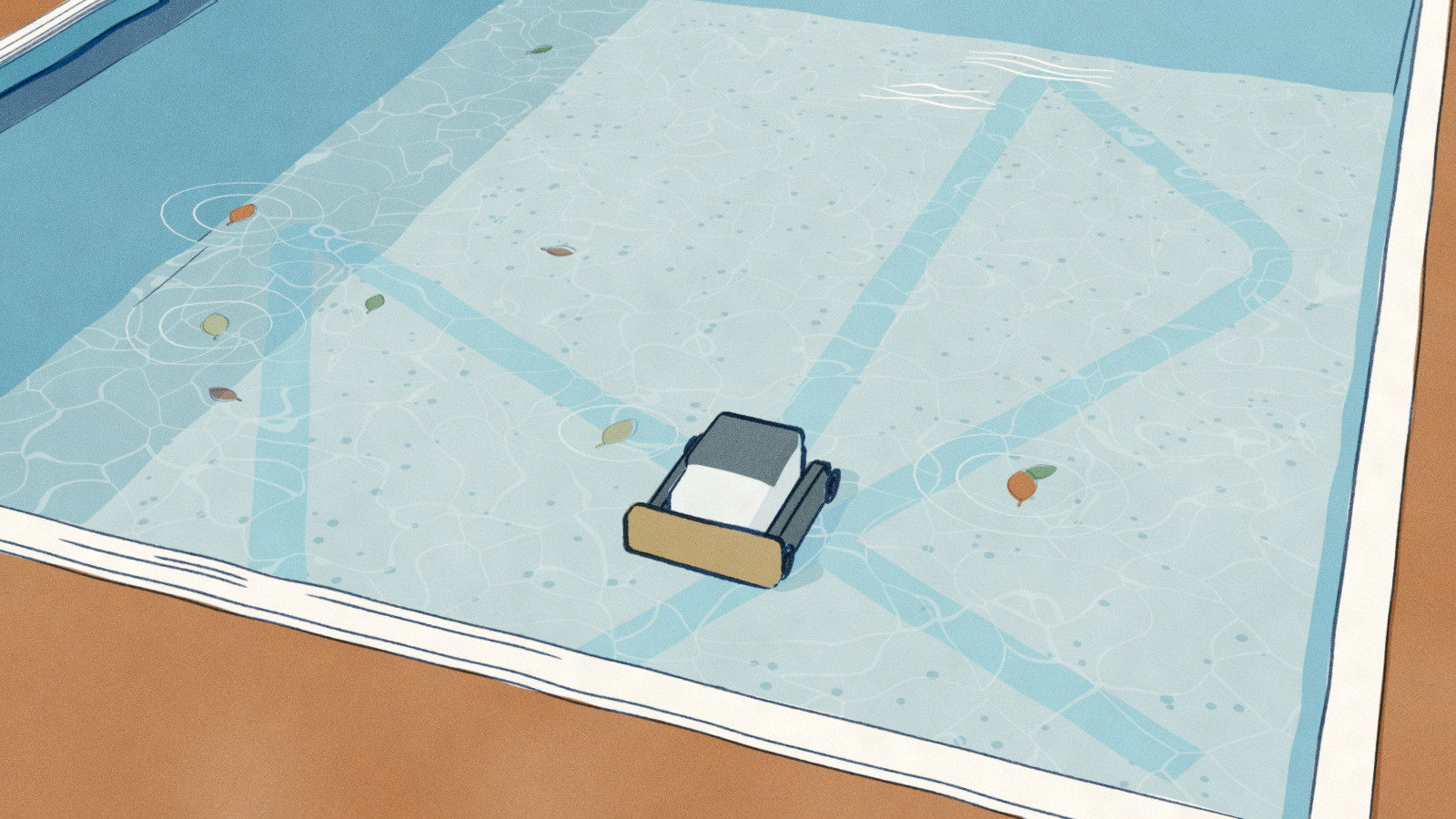
A robot with no sense of position drives straight until it meets a wall, turns to a new heading, and drives on. It keeps no record of where it has been, so coverage comes from time. A longer cycle makes a miss less likely. Still, corners and steps are the likeliest places to be skipped.
The Aiper Seagull SE, a cordless floor cleaner, is built this way. One hands-on review found it has “no navigation system” and that it “simply bumped around my pool at random.” It “will strictly stay on the floor of your pool,” too, so it never climbs a wall.
The design has its logic. There’s no heading sensor to calibrate, and no map to lose if you lift the robot out halfway through a cycle. It gives up any route, though. The robot covers your pool by chance, and chance reaches the corners least.
What a gyroscope adds
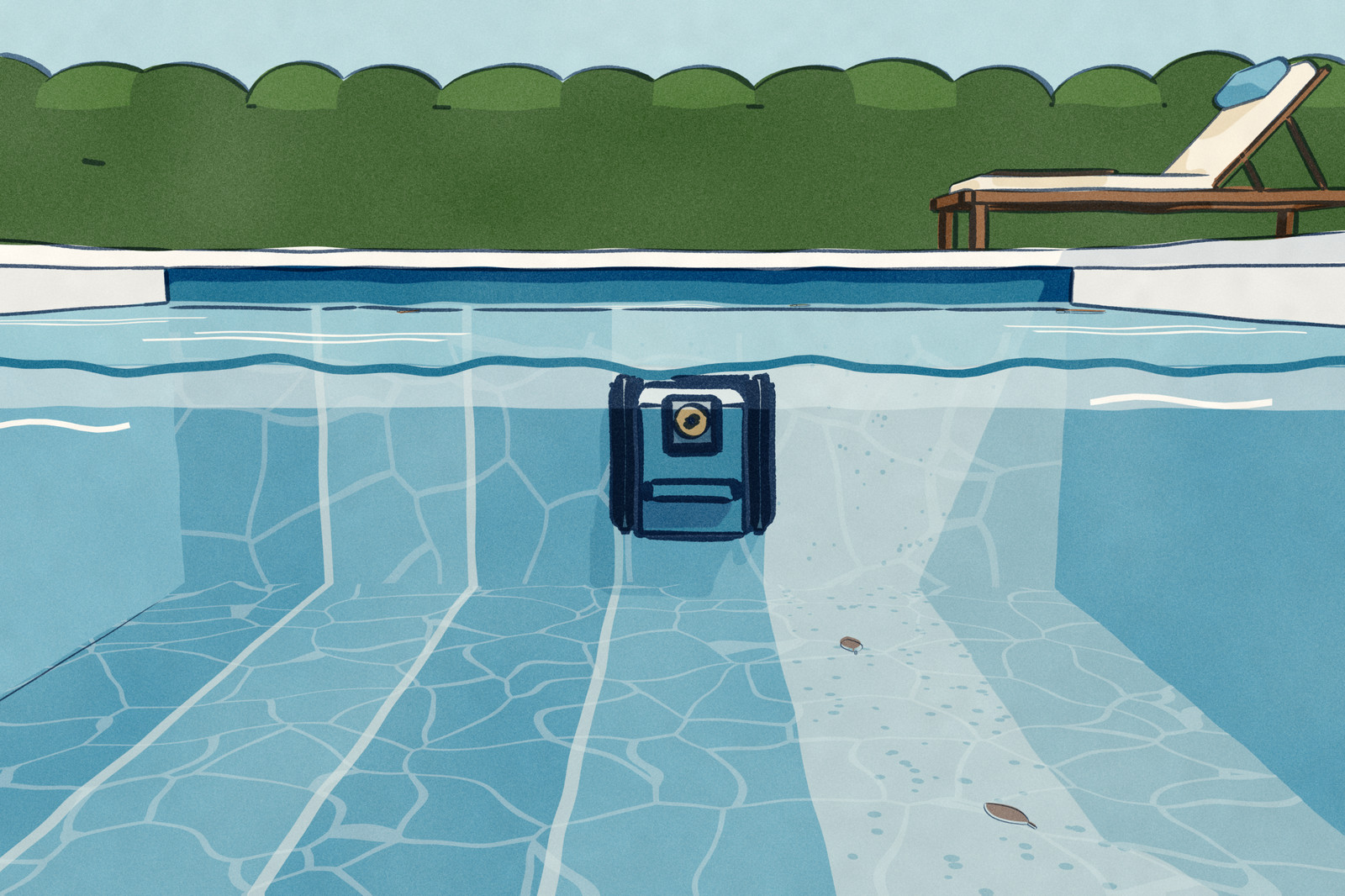
A gyroscope measures how fast the robot is turning. With that reading, a robot can hold a straight line across the floor, turn through a measured half circle at the wall, and come back one lane over. It’s the difference between mowing a lawn in stripes and pushing the mower wherever it happens to point.
Why not simply count wheel turns? That method, called dead reckoning, drifts. Wheels slip on wet plaster and vinyl, and every slip becomes a lasting error in where the robot thinks it is. A heading sensor keeps the lanes parallel while that error builds.
The Dolphin Sigma is sold on its gyroscope, which feeds the robot’s processor to “provide advanced movement throughout the swimming pool.” Its SmartNav software is meant to “detect obstacles such as a beach entry, stairs, and more.”
In the water, a tester saw the lanes. He wrote that “coverage was methodical: you can watch it work the pool in clean, deliberate passes and hit the spots lesser robots skip.” The Sigma climbed the walls as well, scrubbing all the way up to the tile line.
Heading plus distance traveled is enough to sketch a pool’s outline, and the Sigma’s retail listing describes the result as a map. Its scanning “maps your pool and calculates the most efficient cleaning path for complete coverage.” So the same machine gets marketed both ways.
What mapping promises
On the Dolphin Nautilus EON 100, SmartMap Navigation “tailors cleaning paths to your pool’s shape.” Other makers have names of their own for it. Beatbot’s AquaSense 2 pairs its CleverNav system with ultrasonic pool mapping and obstacle avoidance, using 16 sensors, two of them ultrasonic.
Aiper’s Scuba X1 Pro Max gets its “Comprehensive Pool Mapping” from an ultrasonic sensor. The Wybot S3“Scans your pool on the first run and then charts the most efficient cleaning path every time,” and adds a vision system called AI Vision.
Sound suits the job. It carries well underwater, where light fades fast and scatters in cloudy water, so an ultrasonic sensor can time an echo off a wall that a camera might not see clearly. How closely the finished map matches your pool is a figure no maker here publishes.
A map doesn’t lock in a route, either. The X1 Pro Max offers an “Edge + Random Path” among its cleaning patterns, beside grid and S-shaped routes. So a robot sold on mapping can still be told to wander.
So do the maps show up in the water? The tester who watched the Sigma drive its lanes also ran the AquaSense 2. He quoted Beatbot’s promise of “improved sensor-based navigation and advanced path optimization,” then described what he saw.
The so-called ‘optimized’ path looked more like aimless wandering. Corners? Often untouched. Steps? Hit or miss.
The Seagull SE wanders by design, with no navigation system at all. Here that kind of route came from a robot advertised for its ultrasonic mapping. The Sigma, steering by a gyroscope, had worked a pool in straight, deliberate passes.
Up the wall to the tile line
Navigation doesn’t end at the floor. A robot that climbs has to carry its route up the walls, and at the tile line the machines start to differ. A robot can touch the waterline on every climb and never scrub along it.
The Dolphin Nautilus CC Plus, sold for floor and walls, has waterline scrubbing marked “No,” and a review found it reaches the waterline as it climbs but doesn’t scrub along it. The cordless Dolphin Liberty 300 is specified for “Floor, Walls and Waterline,” though it names no navigation system.
What the maker pages claim
| Robot | Navigation the maker names | Surfaces the maker lists | Autonomy Ladder level |
|---|---|---|---|
| Dolphin Nautilus CC Plus | None named | Floor and walls | IIAssisted |
| Beatbot AquaSense 2 | CleverNav, ultrasonic mapping and obstacle avoidance | Floor, walls, waterline | IIIConditional |
| Dolphin Nautilus EON 100 | SmartMap Navigation | Floor, steps, walls, waterline | IIIConditional |
| Dolphin Liberty 300 | None named | Floor, walls, waterline | IIIConditional |
| Aiper Scuba X1 Pro Max | Ultrasonic mapping, adaptive path planning | Surface, floor, walls, waterline | IIIConditional |
| Wybot S3 | 3D mapping, AI Vision | Floor and walls | IIIConditional |
There are three designs, then, and they drive differently. A robot with no sense of position wanders, and one with a gyroscope can hold a lane. But the word “mapping” gets attached to robots that steer by sound, by a gyroscope or partly by chance, and on the AquaSense 2 it came with a route that wandered.
The S3 offers a way to check the route yourself. Its app is built to “Track the cleaner in real time via your mobile device, and remotely direct it to focus on specific areas.” Stand at the pool’s edge with that screen open, and you can watch its reported position against the corners and steps it’s meant to reach.