Explainer
Do Robot Pool Cleaners Replace a Pool’s Main Filtration System, or Only Supplement It?
A cartridge fine enough to trap 10-micron sediment sounds like it could replace a pool's main filter. It cannot: that cartridge only touches the water pulled through the robot during a single cleaning pass, while the pump most owners assume they could finally retire still has to circulate, sanitize, and filter every gallon the robot never reaches.
On this page4 sections
A robot pool cleaner drops into the water, follows a preset pattern across the floor and walls, and returns to the steps with a basket full of leaves and fine sediment. It looks, on the surface, like the pool’s entire cleaning system contained in one unit.
Marketing copy leans into that impression, describing the units as handling the pool’s cleaning without much qualification. What the packaging rarely states plainly is what the robot’s onboard filter is actually filtering, and what happens to the water the rest of the time the robot isn’t in the pool.
That gap matters because a pool’s clarity and sanitation don’t depend on debris pickup alone. They depend on a fixed volume of water getting pushed through a filter and returned on a running schedule, measured in hours per day, not the twenty or ninety minutes a robot spends working a floor pattern.
A robot pool cleaner solves one problem. Whole-pool filtration solves a different one, and no filter rating printed on a robot’s cartridge changes that math. Owners who assume a fine enough cartridge lets them cut back on pump runtime are making an assumption the equipment doesn’t support.
What the onboard basket actually filtersThe basket empties. The pool keeps circulating.
A robot’s onboard filter, whether it’s a mesh bag, a molded basket, or a cartridge, works the same way a vacuum’s dustbin does: it captures whatever passes through the intake while the unit is running its own cleaning cycle.
The Wybot C2 Vision pulls debris through a dual-layer cartridge as it works the floor and walls on one of its eight cleaning modes. Once the cycle ends and the robot returns to the steps or its charging dock, filtration through that cartridge stops. Nothing moves water through it again until the next cleaning run.
Term
Circulation turnoverThe time it takes a pool’s main pump and filter system to push the entire body of water through the filter once. Pool equipment manufacturers size pumps and filters so this happens on a predictable, repeating schedule, independent of whether a robot is in the water that day.The pattern isn’t specific to one brand. The Beatbot AquaSense 2 uses a filter foam cartridge rinsed weekly, with full cartridge replacement every three to six months. The Polaris 9650iQ Sport, a tethered unit, has its filter canister rinsed after every single use, a maintenance rhythm tied entirely to how often the robot runs, not to any schedule set by the pool’s water chemistry.
In every case documented in the Robovations database, the filter is a consumable attached to the robot’s own cleaning cycle, not a component wired into the pool’s plumbing. Swapping brands doesn’t change which system the filter actually serves.
Whole-pool circulation does three things a robot’s onboard filter cannot, no matter how fine its filter media is rated:
- Continuous circulation of the pool’s full water volume, not just the area a robot happens to pass over
- Chemical distribution, carrying sanitizer and balanced pH through water the robot’s basket never touches
- Ongoing filtration of fine, suspended particles the robot has already passed by on a previous lap
Two circuits
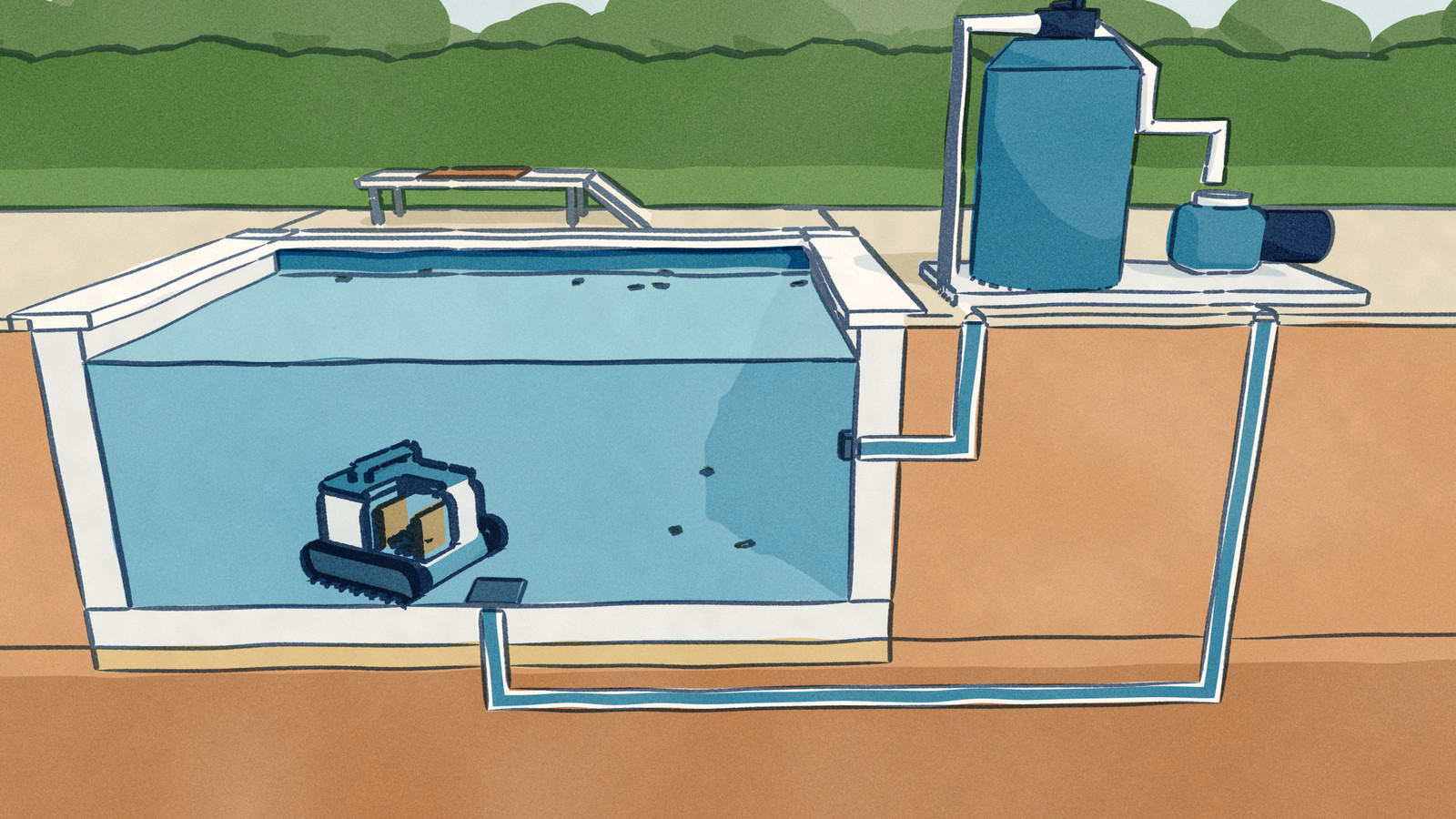
One of them leaves the pool
- SkimmerThe pool's own circuit leaves the shell here, through the wall at the surface.
- Pump and filterStanding on the deck, outside the water. Skimmer, pump, filter, return: the whole volume passes here continuously, which is what lets this circuit also carry heat and chemistry past a sanitiser.
- Robot basketIntake underneath, basket inside, outlet on top. The cleaner's circuit closes inside the water and never crosses the wall: it takes debris out of the water it drives through, and does not turn the pool over.
Filtration fineness by the numbersSand, cartridge, and DE: the same job at different resolutions
Whole-pool filters come in three common types, and pool equipment manufacturers such as Pentair and Hayward publish similar fineness ranges for each across their product lines. The three differ mainly in how small a particle they can pull out of the water on a single pass through the media, not in how the water reaches them or how often that pass happens.
- Sand filters: roughly 20 to 40 microns
- Cartridge filters: roughly 10 to 15 microns
- Diatomaceous earth (DE) filters: as fine as 2 to 5 microns
All three run continuously off the pool’s main pump, filtering the entire body of water on a repeating schedule, not in short bursts tied to a robot’s cleaning cycle.
A DE filter rated at 2 microns and a cartridge filter rated at 12 microns are both doing whole-pool work every hour the pump runs. That’s the variable a robot’s spec sheet doesn’t carry, no matter how the robot’s own filter media is rated.
Fine-stage filtration rating
10µm
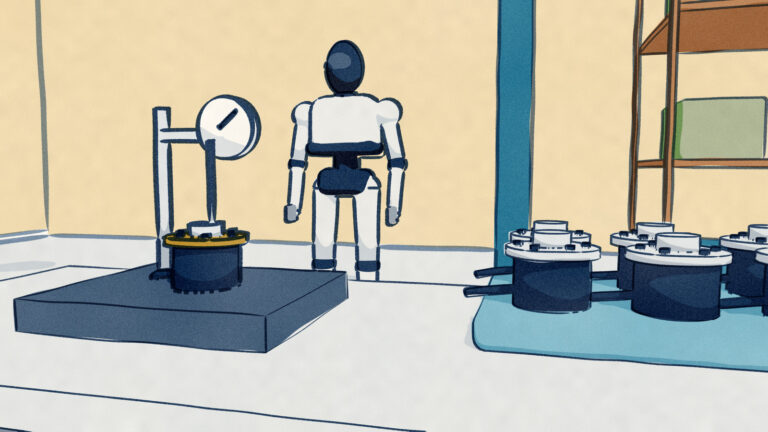
The Wybot C2 Vision's dual-layer cartridge is rated at 180 microns on its coarse stage and 10 microns on its fine stage, per Robovations product records. That fine-stage number sits inside the range of a standalone cartridge filter, but it only ever touches the water pulled through the robot during its own cleaning cycle, not the water circulating through the pool's main pump.
A 10-micron rating is a genuinely fine filter medium. It is also a filter medium that only processes water for the length of one cleaning cycle, then sits idle in a basket or a dock until the next run. A cartridge or DE filter rated in the same range processes water continuously, for as many hours a day as the pump runs.
Fine media and continuous circulation are two different variables, and a robot’s cartridge rating only ever accounts for the first one. A finer cartridge is a real upgrade to how much sediment a single pass removes; it is not an upgrade to how many passes the water gets in a day.
Robovations database
Which costs come back, and how often
- Paid oncethe purchase, and only the purchase
- Comes backevery token is another time you pay for it
Robovations Score v4.2
What the 67 is made of
Wybot C2 Vision
- Capability40% of the score74med 66
What it does without you.
- Dependability40% of the score58med 66
Whether it keeps doing it.
- Ownership burden20% of the score72med 67
What it asks of you.
this robotcorpus median
Bar length is the pillar's score out of 100, against the corpus median. Each pillar's weight is printed beside its name. Value and price are published alongside the score and never averaged into it.
Why the pump can't clock outThe chemistry doesn’t wait for the robot
Sanitizer, whether chlorine, bromine, or a salt system’s generated chlorine, has to move through the water to do its job. That distribution, along with pH balance and continuous filtration of algae spores and fine organic matter, depends on the main pump running its normal schedule, robot or no robot.
None of the robots classified in the Robovations database are marketed as a substitute for that system. Their documentation describes debris pickup and wall or waterline scrubbing between the pump’s cycles, a supplemental role rather than a replacement one, regardless of how many cleaning modes or how fine a filter cartridge a given unit ships with.
What the product data actually claimsFive robots, one shared assumption
None of the major consumer robot pool cleaners currently classified at Robovations describe themselves as circulation or filtration replacements, and that holds even as navigation method and price vary widely across the category.
The table below compares four Level II and Level III units on navigation, list price, and classification tier. All four ship as supplemental cleaning devices; none list a role in the pool’s chemical treatment or full-volume filtration, and none of their manuals suggest reducing the pump’s run schedule because a robot is also deployed.
Robovations database
Navigation, price, and class across four robot pool cleaners
| Robot | Navigation | List price | Class |
|---|---|---|---|
| Wybot C2 Vision | AI camera visual guidance with eight cleaning modes | $899 | IIIConditional |
| Beatbot AquaSense 2 | Smart mapping with obstacle avoidance | $1,298 | IIIConditional |
| Polaris 9650iQ Sport | Gyroscopic navigation with systematic floor and wall coverage pattern | $1,299 | IIIConditional |
| Polaris 9450 Sport | Random-path navigation, tethered operation | $1,199 | IIAssisted |
The pattern holds even among tethered units built around a cable and constant power rather than a battery. The Polaris 9450 Sport‘s random-path navigation puts it a full autonomy tier below the other three, but its filter canister does the same job the higher-tier units do: it gets rinsed after use, not plumbed into the pool’s circulation loop.
The Maytronics Dolphin Nautilus EON 100, priced at $799 and classified at Level III, follows the same pattern. Its filtration exists to keep the robot’s own cartridge from clogging mid-cycle, not to filter the pool between cycles, and its documentation makes no claim otherwise.
The question in the headline has a clear answer once the two systems are separated. A robot pool cleaner’s filter, even one rated finer than a sand filter, only ever processes the water it physically passes through during a cleaning run. A pool’s main pump and filter process the entire body of water on a repeating schedule that has nothing to do with whether a robot is deployed that day.
Buying a robot with a finer filter cartridge doesn’t shrink the job the main system still has to do; it adds a second, narrower job on top of it. The two systems can coexist, but one cannot stand in for the other, and no product currently classified at Robovations claims it can.
A robot’s filter cartridge can be rated finer than a sand filter and still not touch most of the pool’s water. Debris pickup and whole-pool circulation are different jobs, and no robot currently classified at Robovations claims to do both.
Robovations database
Where Wybot C2 Vision sits
Measured against every published robot in robot pool cleaners
full rangemiddle halfmedianthis robot
- List price69 in robot pool cleaners$900med $1,249