Analysis
Do robot mowers work in the rain and on wet grass?
A robot mower rated Level IV on paper still parks itself the moment a storm arrives, and the reason isn't caution about the machine getting wet. Rain scatters the satellite corrections and camera signals the mower needs to know where it is, so the weather boundary sits underneath the autonomy tier rather than beside it.
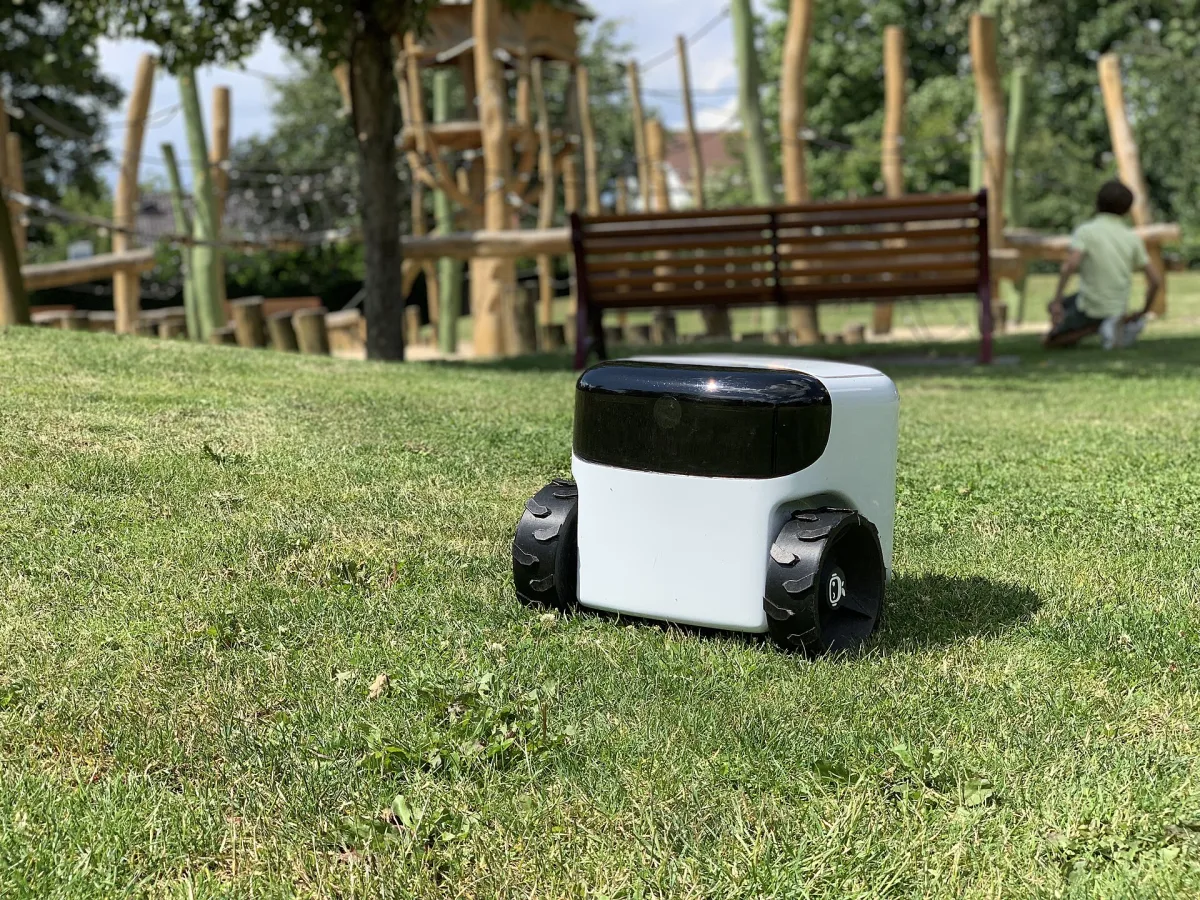
Photo by Helpingout45 on Wikimedia Commons (CC BY-SA 4.0)
A robot mower equipped with LiDAR, RTK-grade satellite positioning, and a stereo camera will still shut down an active session the instant a storm arrives. That is not a malfunction, and it is not a sign of a cheap build.
Nearly every robotic mower sold today is designed to pause when its onboard rain sensor detects moisture, returning to its dock or holding in place until conditions clear. The pause is deliberate, and it has surprisingly little to do with keeping water out of the machine.
So the useful question is not really whether a robot mower works in the rain, because the category default across the market is to stop rather than push through. The more revealing question is where rain intersects the systems a mower actually relies on to do its job.
Three of those systems matter most: the sensor that decides to halt a session, the traction and cut quality of the blades once the turf is wet, and the positioning signal the robot uses to know where its lawn ends. Each is a separate constraint, and each one quietly caps real-world autonomy no matter which Autonomy Ladder level appears on the spec sheet.
How the sensor decidesRain sensors are far simpler than the machine
Rain sensors on robotic mowers are far simpler than the rest of the machine, and understanding them explains the pause. At the category level, most designs work by detecting moisture bridging an exposed surface. A small sensor area registers a change in electrical behavior, whether through conductivity across two contacts or a shift in capacitance, when water settles across it.
Once that threshold is crossed, the controller reads it as rain and issues a stop command. This is threshold detection, not rainfall measurement. The sensor does not gauge how hard it is raining or how deep the puddles are getting. It registers that moisture is present and defers to a conservative rule, which is why a light drizzle and a heavy downpour can trigger the same response.
That behavior holds across navigation architectures that otherwise share almost nothing. A wire-boundary mower like the Greenworks Optimow 15, classified at Level II, uses a buried perimeter wire and a base station to define its cutting area, with no satellite fix to lose in bad weather. A camera-and-satellite mower like the Husqvarna Automower 435X AWD NERA, classified at Level IV with EPOS satellite positioning and an AI-Vision camera, carries far more sensing hardware and posts a materially higher Robovations score.
Both still stop for rain. That parity is the whole point. Outdoor power equipment is routinely built to tolerate dew, sprinklers, and passing showers when parked, so the pause is not principally about shielding electronics. The rain rule is applied above the navigation system, so it lands on a simple mower and a sophisticated one with equal force. It is a designed limitation, in the same category as a locked-out steep slope, not a defect the robot is working around.
Dew versus a real showerMorning dew reads to the sensor like rain
Morning dew complicates the sensor’s job because it looks, both optically and electrically, a great deal like light rain. Most mowers sidestep the ambiguity through scheduling rather than detection.
Companion apps commonly start sessions later in the morning, once dew has typically evaporated, instead of trusting the rain sensor to separate damp grass from actual precipitation. That is a calendar default, not a weather-sensing capability, and it explains why owners rarely watch a mower stall on dew the way it halts partway through a shower.
When the lawn becomes the obstacleWet grass, clumping, and cut quality
Rain that has already fallen creates a second and separate problem once a mower resumes: the grass itself. Damp clippings clump together instead of dispersing, and they cling to the deck and discharge area rather than settling evenly across the lawn. The visible result is streaking or an uneven finish that persists until the turf dries out.
Cut quality, in other words, degrades on wet grass even when the machine is mechanically capable of moving through it. This is a documented characteristic of rotary cutting in general, not a flaw unique to robots. Robots simply meet it more often, because they run unattended on fixed schedules that a person mowing by hand would postpone until the lawn dried.
Traction is the other half of the wet-grass problem, and it interacts directly with slope. Manufacturers rate maximum incline under dry-turf conditions, because wet grass reduces the grip a wheel can find, the same way it would for any walk-behind mower on a hillside. All-wheel-drive and four-wheel-drive designs exist partly to widen that margin. The Greenworks AiMowbot C20Z pairs its RTK positioning with 4WD, and the Husqvarna Automower 435X AWD NERA carries all-wheel drive for the same reason.
Neither system changes the rated slope limit. What they change is how much reserve grip remains before a wheel slips on an incline that is already near the edge, and wet grass spends that reserve. A slope a mower handles confidently when dry can become a stall point after rain, which is another reason the conservative default is to wait rather than resume onto a saturated hillside.
Where the RTK fix weakensThe bigger effect is on positioning, not the pause
The most consequential weather effect is not the pause itself but what happens to positioning accuracy in the window just before and just after it. Wire-boundary mowers like the Robomow RC308 Pro X are the least weather-sensitive for positioning, because a buried copper loop is a physical boundary rather than a computed one. Rain does not degrade a wire the way it can degrade a radio signal.
Satellite-based mowers operate on a different principle. Models such as the Segway Navimow i2 AWD, the Greenworks AiMowbot C20Z, and the Mammotion YUKA 3000 use RTK GNSS, which sharpens a raw satellite fix to centimeter accuracy by applying a correction broadcast from a fixed reference point.
The correction is the fragile part of that chain. Heavy cloud and wet tree canopy both attenuate the signal path, and accuracy can soften at exactly the moment a storm clears and the lawn is finally dry enough to cut. A mower does not need to lose its position entirely for this to matter.
It only needs to drop from a confident centimeter-level fix to a looser one, at which point the robot may hold at the dock and wait for a stronger signal rather than mow with reduced certainty about where the boundary sits. That waiting period is invisible on a spec sheet, but it is part of how weather shapes when the machine is actually willing to run.
Figure
Where traction runs out
- The gapThe rated figure is a dry figure. Wet grass is where a mower slips, and it is the same slope either way.
- Rated grademeasured on dry grass, which is how it is published
- Beyond tractionstill inside the rating, no longer inside the grip
Cameras and LiDAR in the wetVision degrades from a different angle
Vision systems face a parallel problem from another direction. Camera-based obstacle avoidance, which the eufy Robot Lawn Mower E18 runs through its V-FSD system, the Worx Landroid Vision Cloud WR320 through an AI camera, and the Segway Navimow H2 through a stereo camera, depends on a clear read of the lawn surface.
Rain on the lens, low light under storm cover, and droplets scattered across grass blades all cut the contrast a vision system needs to separate an obstacle from the lawn edge. On mowers where the same camera also confirms the robot is still inside its mapped area, degraded vision affects navigation and obstacle avoidance at once rather than one in isolation.
LiDAR sits somewhere in between. The Ecovacs Goat A3000 LiDAR PRO maps its boundary with dual LiDAR, and the Segway Navimow H2 combines LiDAR with its stereo camera and RTK-grade positioning. Laser rangefinding is comparatively more resistant to poor light than a passive camera, since it supplies its own signal, though returns can still scatter off heavy water sitting on foliage.
Owner discussions on forums such as r/robotmowers commonly describe RTK-based mowers taking longer to reacquire a confident fix after prolonged rain than after a routine overnight pause. The exact delay varies with yard shape and tree cover, and it is not something manufacturers publish as a specification.
None of this means these mowers fail outright in damp conditions. It means the margin between a confident position fix and a degraded one narrows during and right after rain, which is precisely the stretch a rain-triggered pause is built to sit out.
The practical difference between architectures shows up less in whether a mower pauses, since nearly all of them do, and more in how quickly each is built to relocate itself once the weather clears.
Reading the table by architecture rather than by score is the more useful lens for weather specifically. The two wire-boundary mowers sit at Level II with the simplest positioning method and the least to lose from cloud or canopy. The remaining eight reach Level III or Level IV through some mix of RTK satellite correction, camera vision, or LiDAR mapping, and each of those methods carries a weather dependency that never appears as a line item on a spec sheet.
None of the eight is disqualified by that dependency. It simply means the resumption window after a storm is not identical across the group, even when two mowers share the same Level and one costs several times as much as the other.
Ten mowers, three positioning approaches
Boundary and navigation type across the class
| Robot | Boundary/Navigation | Class |
|---|---|---|
| Greenworks Optimow 15 | Perimeter wire and base station, random-path | IIAssisted |
| Robomow RC308 Pro X | Perimeter wire, random-path | IIAssisted |
| Segway Navimow i2 AWD | RTK GNSS with VisionFence camera | IIIConditional |
| Greenworks AiMowbot C20Z | RTK GPS with on-board vision and 4WD | IIIConditional |
| eufy Robot Lawn Mower E18 | V-FSD vision and ultrasonic | IIIConditional |
| Worx Landroid Vision Cloud WR320 | RTK satellite with AI camera | IVEnvironmental |
| Segway Navimow H2 | LiDAR, stereo camera, and RTK-grade positioning | IVEnvironmental |
| Mammotion YUKA 3000 | RTK-GNSS with camera vision | IVEnvironmental |
| Ecovacs Goat A3000 LiDAR PRO | Dual LiDAR boundary mapping | IVEnvironmental |
| Husqvarna Automower 435X AWD NERA | EPOS satellite with AI-Vision camera | IVEnvironmental |
The domain the Ladder hidesEvery classification carries a weather condition
Robovations classifies autonomy by what a robot demonstrably does without supervision, but every classification also implies a domain: the specific conditions under which that autonomy is rated to hold. For robot mowers, that domain excludes active rain almost universally, regardless of Level.
A Level IV mower with LiDAR and RTK positioning is not more rain-tolerant than a Level II wire-bound mower. It is more capable within the same weather-restricted window, which is a narrower claim than the Level number alone implies. The Ladder measures the height of the ceiling. It does not measure how much of the year the robot is actually allowed to operate under it.
Term
Operating design domainThe specific set of conditions, including terrain, weather, lighting, and obstacle types, under which a robot’s autonomy rating is valid. A robot can hold a high Autonomy Ladder Level and still have a narrow operating design domain if that Level was demonstrated only under favorable conditions.That framing matters because rain is not a rare edge case for an outdoor robot. A mower deployed in a climate with regular rainfall meets its weather boundary far more often than it meets a slope steep enough to trigger a lockout.
How frequently a robot runs into the edge of its own operating design domain says as much about its real-world autonomy as the Level number does, and for most lawns weather is the boundary the machine is likeliest to hit in any given week. A robot idle through a rainy stretch is not demonstrating the autonomy its rating describes, however high that rating sits on the Ladder.
None of this is a defect specific to any single mower on this list. It reflects a category-wide response to one fact: rain touches sensing, traction, and positioning at the same moment, and pausing is the more conservative answer to all three at once than continuing with degraded confidence in any of them.
The weather boundary is shared across the class. Only the speed of recovery on the far side of it differs from one navigation architecture to the next.
A robot mower’s Autonomy Ladder Level describes what it can do in fair weather. The rain sensor, not the sensor stack, is what actually draws the edge of its operating design domain.