Explainer
Does a robot vacuum’s grabbing arm make it more autonomous?
No. The Roborock Saros Z70's OmniGrip arm can clear light obstacles before cleaning, but it works only in pre-mapped rooms using trained object categories and cannot reason about novel contexts. The robot stays at Level III, Conditional Autonomy; the arm improves the experience, not the classification.
On this page7 sections
The Roborock Saros Z70 entered the market in 2025 as the first consumer robot vacuum with a working robotic arm. The OmniGrip picks up soft obstacles before the cleaning cycle begins. No other mainstream floor robot does this.
That is a real distinction. It is also a narrower one than the launch coverage suggests. Adding an arm changes what the robot does in its mapped environment. It does not change where the robot sits on the Autonomy Ladder™.
Understanding the gap between those two claims is the point of this piece.
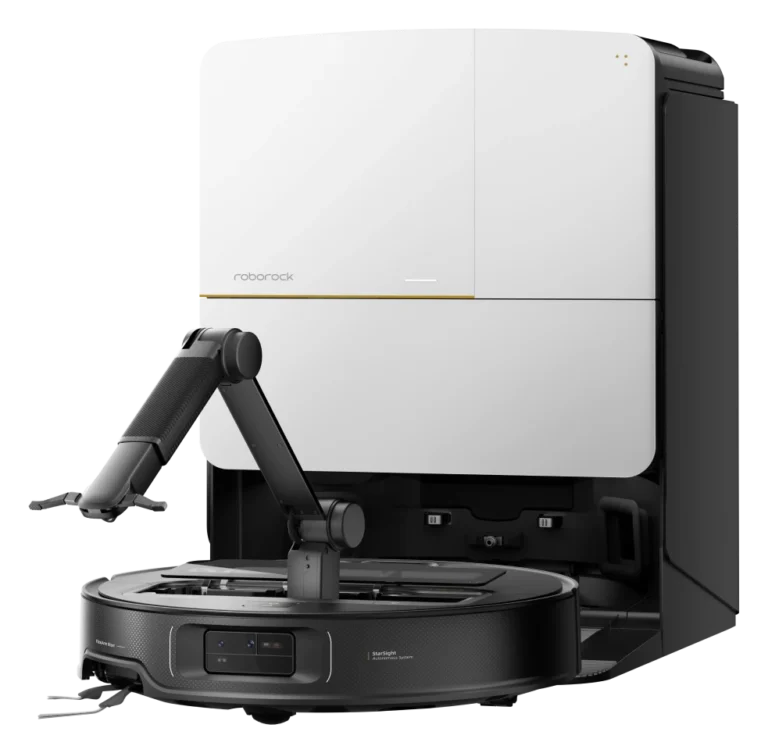
What it doesFour fingers, one job
The OmniGrip is a four-fingered pneumatic gripper on a jointed arm that extends from the Z70 body. The robot scans the room via LiDAR and structured light, identifies objects classified as graspable, extends the arm, grasps the target, and either deposits it in an onboard bin or sets it aside. The owner does not guide the arm.
Owner reports and manufacturer documentation agree on the capability boundary: socks, slippers, tissues, light clothing, and bundled cables. The documented weight ceiling sits below 300 grams. Successful grasps occur reliably for objects with clear contours and uniform density. Firmware updates through early 2026 have reduced false-positive grasps and improved fabric recognition.
The speed cost is real. Arm operations add roughly 8 to 15 minutes per 1,000 square feet depending on obstacle density. Vacuum-only mode on the same robot completes the same area in 4 to 6 minutes. In households where pre-vacuum tidying is a routine task, the net human time freed is often still positive.
The arm has no fine motor control. It grasps and releases. It cannot fold, compress, or reposition objects. When a grasp fails, the robot attempts again with the same strategy. There is no in-session adaptation.
Robovations tracker
What has actually changed
5 recorded updates for Roborock Saros Z70
- Roborock Saros Z70 firmware 2.4 improves robotic arm pickup reliability
Roborock released firmware 2.4 for the Saros Z70, improving arm pickup reliability and reducing cycle time.
Incremental - Roborock Saros Z70 launches commercially with OmniGrip robotic arm
Roborock released the Saros Z70 with OmniGrip robotic arm enabling autonomous object pickup and relocation during cleaning cycles.
Major advance - Roborock Saros Z70 enters US retail at $2599 MSRP
Roborock launched the Saros Z70 commercially in the US at $2599 MSRP in May 2025, completing the transition from CES announcement to retail distribution. The release marked the first consumer robot vacuum with an integrated robotic arm available for general purchase in the US market. Watch: whether real-world owner reports across diverse home layouts would confirm or revise the capability envelope established in controlled pre-launch demos.
Incremental - Pre-launch press demos surface arm pickup limits under real conditions
Post-launch reviews documented the OmniGrip arm's performance envelope more precisely than CES materials had. Outlets including Tom's Guide and others noted reliable pickup with socks, cables, and small toys but inconsistency with rounded objects and items placed near walls. The gap between CES stage conditions and real-world performance became the primary editorial frame for the product.
Incremental - Roborock Saros Z70 with OmniGrip arm unveiled at CES 2025
Roborock announced the Saros Z70 at CES 2025, revealing the OmniGrip robotic arm capable of grasping and depositing small floor items autonomously. The announcement established a new hardware category for consumer robot vacuums with integrated pickup. Watch: whether arm performance in uncontrolled home environments would match staged CES demonstration results.
Major advance
Hard limitsThe arm stops at about 300 grams
Items above approximately 300 grams are outside the arm’s range. Rigid obstacles, including toys, small furniture legs, and pet food bowls, do not yield to the gripper. Awkwardly shaped objects, such as kinked cables or partially balled fabrics, trigger failed attempts. Owner reports note that the robot sometimes initiates arm extension toward items it cannot grasp, adding cycle time without benefit.
In rooms with heavy rigid clutter, the arm pauses to attempt grasps it cannot complete, then proceeds around the obstacle. The cycle time impact is net negative compared to simple avoidance. For homes with very low clutter, the speed penalty applies without the corresponding benefit.
Post-grasp consequences are invisible to the robot. If moving a cable blocks the charging dock, or a relocated item creates a hazard near stairs, the robot has no mechanism to detect or respond. The grasp executes; the placement is made; the cleaning proceeds. Owner reports document cases where moved items produced unintended consequences.
Low-light environments are a documented weak spot. The structured light component of object recognition depends on adequate ambient illumination. In dark rooms or overnight runs, the arm more frequently declines engagement or makes suboptimal grasps. Roborock has acknowledged this in technical forums.
The classification questionThe arm does not decide the rung
Level III on the Autonomy Ladder™, Conditional Autonomy, covers robots that operate within a known mapped environment and execute conditional tasks based on sensor input. Level IV, Environmental Autonomy, requires independent evidence that a robot avoids ordinary obstacles before contact, copes without the space being cleared, and frees itself when stuck. The OmniGrip operates entirely within Level III.
The Z70 must first map a space using LiDAR and structured light. Only inside that mapped environment does the arm engage. Object recognition relies on trained categories. When the system encounters an obstacle outside its known set, it defaults to conservative behavior and declines to act. The robot cannot infer grasp strategies for novel shapes.
Manipulative hardware does not itself advance an autonomy classification. An arm that picks things up is a different capability from those three tests, which ask how the robot copes when clutter is left out. An arm that performs pre-programmed or learning-based grasp sequences in a mapped environment remains conditional, even if the hardware is sophisticated.
The distinction is direct: a robot that independent testers see avoiding clutter and freeing itself without help meets Level IV, with or without an arm. The Saros Z70 arm has not been shown to change those outcomes, and the robot is classified Level III. The arm adds a conditional capability, not environmental reasoning.
Robovations Score v4.2
What the 71 is made of
Roborock Saros Z70
- Capability40% of the score66med 66
What it does without you.
- Dependability40% of the score76med 66
Whether it keeps doing it.
- Ownership burden20% of the score73med 67
What it asks of you.
this robotcorpus median
Bar length is the pillar's score out of 100, against the corpus median. Each pillar's weight is printed beside its name. Value and price are published alongside the score and never averaged into it.
Arm vs no armFour robots, one comparison
With arm vs without arm
Obstacle handling across comparable floor robots
| Robot | Arm | Obstacle handling | Class |
|---|---|---|---|
| Roborock Saros Z70 | OmniGrip (pneumatic, 4-finger) | Grasps and removes soft items under 300g | IIIConditional |
| Roborock Saros 10R | None | AI-camera detection, avoidance only | IVEnvironmental |
| Dreame X50 Ultra | None | Camera-based detection, avoidance only | IVEnvironmental |
| Roborock S8 MaxV Ultra | None | Avoids via ReactiveAI 3D sensor | IIIConditional |
Across these four robots, the arm does not decide the classification: without an arm, the Saros 10R is classified Level IV and the Dreame X50 Ultra Level IV. The Z70 is the only one that removes soft obstacles from the path rather than routing around them. The class is shared; the floor experience is not.
Owner experienceThe arm changes the tidying, not the class
The clearest benefit appears in homes where pre-vacuum tidying is a routine friction point. Families with young children, pet owners whose animals scatter cloth toys, or households where socks migrate under furniture find the arm removes a behavioral bottleneck. The cycle runs longer, but human time freed is often net positive.
The arm also shifts how the robot reads behaviorally. An armless Z70 sees obstacles and avoids them. The arm-equipped version sees obstacles, categorizes them, and acts on the categorization. That shift from reactive to proactive, even within a conditional framework, is a genuine change in the ownership experience. Owner reports frequently cite this behavioral quality as a satisfier independent of time savings.
Cable-heavy rooms see real utility. Power cables, charging cords, and headphone wires cause tangles and missed cleaning in traditional vacuums. The arm identifies bundled cables and removes them from the cleaning path. This closes a specific gap that armless robots cannot address.
Rooms with heavy textile clutter, laundry piles, or craft materials see diminishing returns. The arm cannot distinguish a sock from a decorative felt scrap. When clutter density exceeds the arm’s throughput, the robot returns to human-assisted tidying for those areas regardless.
Obstacle encounters producing a false-positive grasp
5-10%
Owner reports document false-positive grasp attempts in roughly 5 to 10 percent of obstacle encounters under the latest firmware, down from substantially higher rates at launch.
The path forwardThree capabilities would have to arrive together
Three capabilities would need to develop together for the Z70 to approach Level IV. First, operation in unmapped environments: real-time semantic understanding of novel spaces without prior LiDAR mapping. Current consumer SLAM systems are not at this maturity level. The technical path is clear; the timeline is not.
Second, adaptive grasp planning. Rather than executing a library of known strategies, the robot would need to observe an object, infer its material properties, predict grasp success probability, and modify approach after failure. This level of dexterous reasoning is beyond current arm autonomy, including in research settings.
Third, post-manipulation consequence modeling. Before grasping and moving an object, the system would need to model whether the move might obstruct navigation, create a hazard, or interfere with future operations. That is world modeling, not yet available in consumer robotics.
The Z70 is the right platform to watch as these capabilities mature. Its arm hardware and training pipeline are already the most advanced in consumer floor robotics. The current classification is accurate for today, not a permanent ceiling.
Bottom lineAn arm that closes a gap, not a class
The OmniGrip is a genuine feature. It changes what the Saros Z70 does in its mapped environment and closes a specific use-case gap that armless robots cannot address. For households where textile clutter is the primary friction point, the arm is a meaningful improvement in what daily ownership feels like.
It does not move the Z70 up the Autonomy Ladder™. The robot is classified Level III, Conditional Autonomy. It operates only within pre-mapped spaces, relies on pre-trained object recognition, executes fixed grasp strategies, and cannot reason about novel contexts. Those constraints define Level III. They apply here.
The arm closes a gap between what floor robots avoid and what they can remove. That gap matters for certain households. Closing it is not the same as moving up a level.
The OmniGrip is real, and the classification constraint is also real. Both things are true at once.