How safe are consumer robots around kids and pets?
Since 2022, five federal recalls have covered robot mowers and pool cleaners, and every one is about fire. The hazards parents and pet owners picture are recorded somewhere else.
On this page3 sections
Search the Consumer Product Safety Commission’s recall list for robotic mowers and pool cleaners, and five notices come back from 2022 onward. One covers Husqvarna’s all-wheel-drive Automowers, one docking stations sold with STIHL’s iMOW mowers, one two Wybotics pool cleaners, and two are Aiper’s. Each describes a fire or burn hazard in a battery, a charger or a dock.
The two Aiper notices form a chain. Owners of the recalled Elite Pro were offered a free Aiper Seagull Pro as the replacement, and the Seagull Pro was recalled in turn in March 2025.
Robotic mower and pool cleaner recalls, 2022 to 2026
| Product | Announced | Units | What fails | Injuries reported |
|---|---|---|---|---|
| Husqvarna Automower 435X and 535 AWD | Feb 2022 | About 1,400 | Battery overheats | None |
| STIHL iMOW docking stations | Mar 2023 | About 2,700 | Circuit board shorts when wet | None |
| Aiper Elite Pro GS100 | Aug 2023 | About 22,000 | Battery overheats if charged without the adapter | One minor fingertip burn |
| Aiper Seagull Pro | Mar 2025 | About 32,660 | Charging adapter overheats | None |
| Wybotics Osprey 700 Max and S1 | Apr 2026 | About 5,000 | Battery overheats | None |
None of the five involves a blade, a brush roll or a stair edge, and one minor fingertip burn is the only injury any of them records. So if you’re picturing a toddler’s hand near a spinning brush, or a hedgehog in the grass at dusk, the recall list has little to tell you.
Where do those hazards show up, then, and how close do they come? The record sits in other places: independent tests, a 2021 study of mowers and hedgehogs, a pool cleaner’s manual and one maker’s written guarantee. Each kind of machine goes wrong in its own spot, and that spot decides where you look before you press start.
What a robot vacuum can reach
A robot vacuum’s brush roll turns behind a front lip that rides a short distance above the floor. Whatever lies flat and low can pass under that lip without touching the bumper: a phone charging cable, the fringe of a rug, the fingertips of a child playing on the floor. What slides beneath reaches the brush.
Figure
What passes under the front lip
- The openingThe gap under the front lip, which the brush works through. Anything thinner than it can be drawn in: a charging cable, a pet's tail, a rug fringe, a fingertip.
- Charging cableThinner than the opening, so it goes under the lip and onto the brush.
- Rug fringeThe same gap, the same brush. A fringe and a fingertip are the same size to the intake.
- A child's fingertipGuarding is about what the opening admits, not about how strong the motor is.
Stairs get a different guard. Cliff sensors, small optical eyes under the front edge, shine light at the floor and measure how much comes back. Too little returned light reads as a drop, and the robot backs away. But a very dark floor returns too little light as well.
One Roomba, in a December 2020 blog post, kept stopping with Error 6 on a dark carpet because its cliff sensors took the carpet for an edge. The fix was a white medical patch over the sensors, in a home with no stairs. On a landing, a patched sensor would see floor where there is a drop.
Around pets, the failure a maker has put a guarantee behind is a mess rather than an injury. A robot that rolls through dog or cat waste can drag it across every room left on its route. The Roomba j7+ was trained to recognize pet waste, and iRobot’s written promise replaces one that fails to avoid solid cat or dog waste within a year of purchase.
Pool cleaners: the cable and the charger
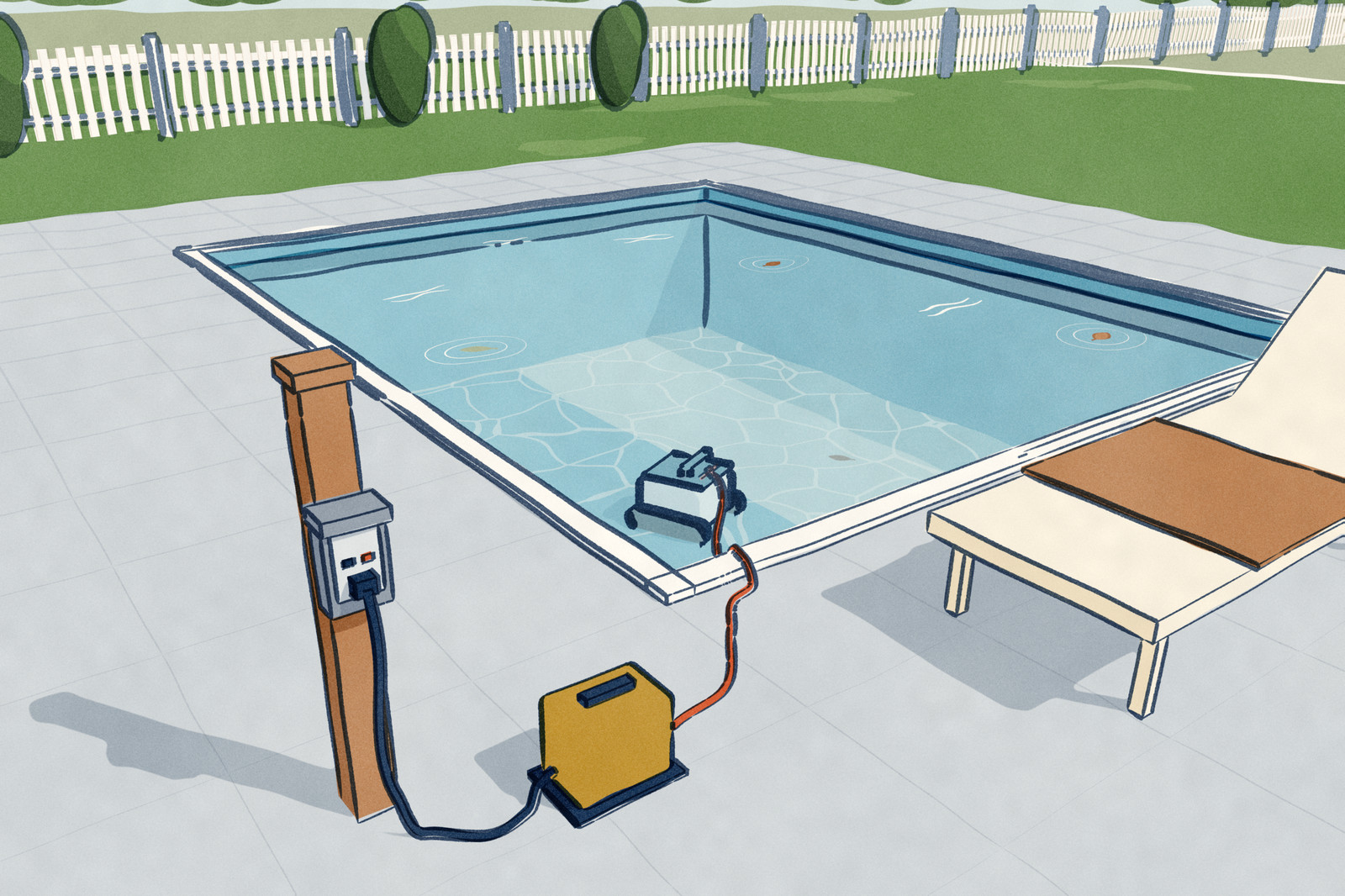
A corded pool robot is built to keep household current out of the water. Mains power stops at a transformer on the deck, and only low-voltage DC travels down the floating cable to the machine. The outlet should have a ground-fault circuit interrupter, which cuts power when current leaks to ground.
So can your kids swim while it works? Hayward’s TigerShark manual answers in capitals: “NEVER swim with the cleaner in the pool.” It also says to “Always disconnect and completely remove the cleaner before entering the pool,” and asks owners to watch children and pets so they don’t play with the machine, because “it is not a toy.”
Cordless models take the cable out of the pool and carry a lithium-ion battery instead. That moves the electrical risk out of the water and into the battery and its charger, and all three pool cleaner recalls in the table concern that hardware.
Wybotics received ten reports of its units overheating or catching fire, with nine incidents of property damage. Some happened while charging and some while not, so a battery sitting off its charger is not automatically a safe one.
Mowers find an animal by touching it
The most detailed evidence on animals comes from a peer-reviewed study published in April 2021. Its six authors ran 18 robotic mower models into dead European hedgehogs, using four weight classes of animal, each placed in three positions.
None of the mowers detected dependent juvenile hedgehogs, those under 200 grams, and every model had to touch a hedgehog before registering it. Some caused extensive damage to the carcasses while others consistently caused none. Three design features (pivoting blades, skid plates and front-wheel drive) significantly raised a mower’s score on the authors’ safety index.
Term
Pivoting bladesCutting blades mounted so they fold into a protective frame when they hit something harder than grass. Fixed blades stay exposed the whole time. A skid plate shields pivoting blades from hard objects, and in doing so shields a hedgehog from the blades.A German consumer testing organization has run the same kind of trial with children in mind, using dummies of a standing, a crawling and a lying child. Every mower turned away from the standing figure.
The crawling dummy fared worse. The Honda Miimo 310 and the Robomow RC304u hit it, neither recognized a dummy foot as an obstacle, and both were graded unsatisfactory. An arm stretched flat on the lawn can be overlooked by any robotic mower.
Lifting a running mower brings in one more sensor, and the lab test that timed it dates from 2008. The RoboMower RL1000’s blades stopped about one second after its wheels left the ground. The LawnBott LB3200 Evolution’s blade kept spinning until the machine was lifted past roughly 45 degrees, and the test rated it Not Acceptable.
Both models are 18 years old, so that result shows how the mechanism can fail and says nothing about a mower on sale today. The hedgehog findings are newer. Hedgehog safety, for an animal that does not flee from danger, now counts among the criteria in a March 2026 mower test, and some cities are considering a ban on night mowing.
Put side by side, each machine’s documented risk sits in its own place. A vacuum’s is low: under the front lip, and at a stair edge its sensors can misread. A mower’s is anything small and flat it must touch before it notices, from a young hedgehog to a child’s outstretched arm. A pool robot’s is a swimmer in the water beside it.
The five recall notices, all about fire, miss every one of those. They turn up instead in a dummy’s foot, a hedgehog under 200 grams and a line in capitals in a pool manual. So does the request the 2021 study’s authors made of manufacturers and sellers: tell customers not to mow at night, and to check the lawn for hedgehogs, leverets, fledglings and amphibians first.