Deep Dive
Pro, Max, Ultra, Omni: What Robot Vacuum Tier Names Actually Change
Roborock, Ecovacs, Dreame, and eufy have each stacked two or three suffix words onto several vacuum model names since 2023. Nine current models spanning a $1,150 price gap carry those suffixes. The Robovations database classifies every one of them at the identical Autonomy Level: the escalation buyers pay for happens at the dock and the sensor bay, not in how independently the robot operates.
On this page6 sections
A robot vacuum nameplate has become a small essay. Roborock sells an S8, an S8 Pro Ultra, and an S8 MaxV Ultra. Ecovacs sells a Deebot X8 Pro Omni and a Deebot X9 Pro Omni.
eufy has moved from the Clean X9 Pro to the RoboVac X10 Pro Omni in a single product generation. Each suffix reads like a promotion: Pro over base, Ultra over Pro, Omni layered onto either. The implied structure is a ladder of capability, one word buying more autonomy than the last.
The Robovations database classifies all of the robots named above, and several more below, at the same rung of the Autonomy Ladder. Suffix count keeps growing across the category. Autonomy classification has not moved with it.
Roborock alone runs two separate suffix systems at once. Alongside the S-series lettering above, it sells a Qrevo line with its own internal tiering, unrelated to the S-series naming and not a numbered continuation of it.
A shopper comparing an S8 MaxV Ultra against a Qrevo Master is comparing two independent vocabularies, not two points on one scale, even though both names come from the same manufacturer in the same year.
Suffix inflation, flat ceilingNine robots, one Autonomy Level
The Robovations Autonomy Ladder runs from Level I, Manual Automation, to Level V, Generalized Autonomy. Consumer robot vacuums as a category currently top out well short of that ceiling, and none of the suffix combinations examined here change which rung a given model occupies.
The Roborock S8 ships at $749 with no docking station and a Level III classification. The Roborock S8 MaxV Ultra ships at $1,799, more than double the price, with a full auto-empty, self-washing mop dock. It is also Level III.
Dreame’s lineup runs the same way in the other direction. The Dreame X40 Ultra launched in April 2024 at $1,899. The Dreame X50 Ultra launched roughly ten months later at $1,599, a lower price for a newer generation carrying the identical suffix. Manufacturer spec sheets list the X50 Ultra’s suction ceiling at 20,000 Pa against 12,000 Pa on the X40 Ultra, a real hardware jump alongside the price drop. Both are Level III.
Robovations database · 9 active products
Price and Autonomy Level, plotted
Price spans $749 to $1,899 across four manufacturers. Autonomy Level does not move.
Plotted against price, the nine robots form a flat line, not a staircase. That is the shape a reader should expect if suffixes described dock automation and sensor upgrades.
It is not the shape a reader would expect if suffixes described autonomy gains, which is what the escalating wording implies. A flat line across a $1,150 price range is itself the finding: whatever the extra money buys, it is not a higher rung on the Ladder.
Autonomy Levels separating cheapest and priciest
0
Zero. The $749 Roborock S8 and the $1,899 Dreame X40 Ultra both classify at Level III, Conditional Autonomy.
Robovations database
Where Roborock S8 sits
Measured against every published robot in robot vacuums
full rangemiddle halfmedianthis robot
- List price217 in robot vacuums$749med $800
- Suction210 in robot vacuums6,000med 10,000
- Runtime187 in robot vacuums180med 180
- Five-year cost173 in robot vacuums$1,400med $1,400
What actually escalatesDocks, suction, and cameras carry the tier
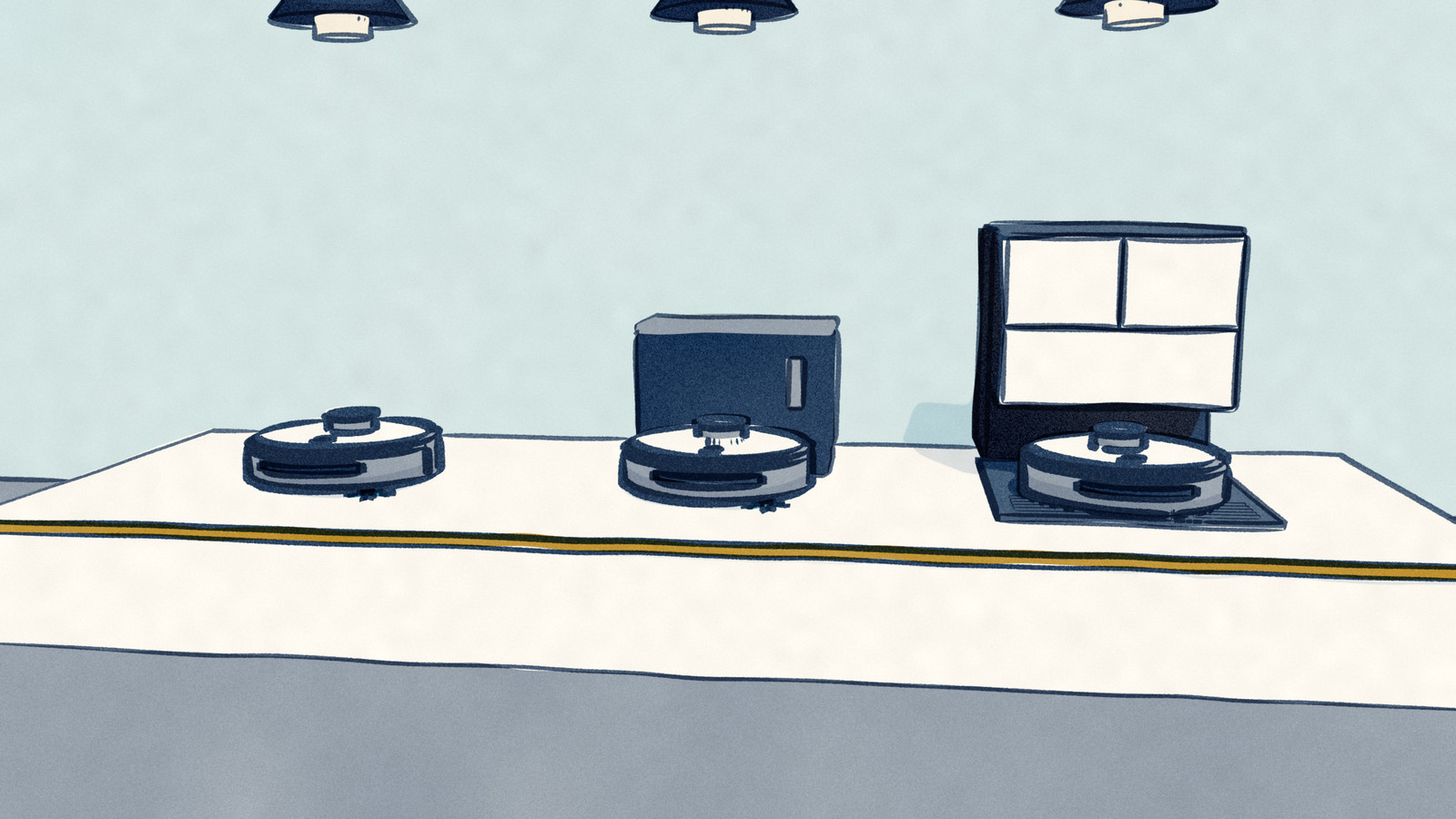
The suffixes track three things with reasonable consistency inside a single manufacturer’s lineup: dock automation, sensor count, and suction ceiling. The base Roborock S8 ships without a dock; it empties, refills, and washes nothing on its own.
Adding “Pro Ultra” or “MaxV Ultra” to the name buys an auto-empty base station, and in the MaxV Ultra’s case a self-washing, self-refilling mop system. That is a real difference in how often an owner touches the machine. It is not a difference in how the robot decides where to go or what to do once it gets there, which is the axis the Autonomy Ladder measures.
Term
Autonomy LadderRobovations’ five-rung classification, Level I through Level V, measuring how much a robot decides and executes without a human directing each task. It is independent of price, brand, or accessory count.Sensor and suction escalation follow the same pattern. Manufacturer specifications for the eufy RoboVac X10 Pro Omni list an 8,000 Pa suction ceiling and LiDAR mapping paired with a secondary RGB camera for floor-type detection, an upgrade over the single-sensor navigation eufy used on earlier models.
That is a measurable cleaning and obstacle-detection improvement. It is also a hardware upgrade layered onto the same navigation architecture and the same Level III classification, not a step to a new rung.
Across the nine models, the suffix vocabulary maps most reliably to a short, repeatable list:
- Auto-empty, auto-refill, or auto-wash dock stations
- Higher suction ceilings, sometimes several thousand Pa above the base model
- Secondary cameras or additional sensors for obstacle recognition
- Larger onboard water tanks or mop-lift mechanisms for carpet contact
What the suffixes do not reliably buy is a change in Autonomy Level, or a change in how much oversight the robot needs across a full cleaning cycle. Owner reports aggregated on r/roborock describe a similar intervention pattern (occasional stuck events, periodic brush tangles, manual zone correction) across base and dock-equipped models alike.
The dock changes how the debris and water get handled between runs. It does not change what happens mid-run when the robot meets a cable, a low chair leg, or a dark rug edge.
Robot Vacuums
Supersession, not elevationThe successor listed below the model it replaced
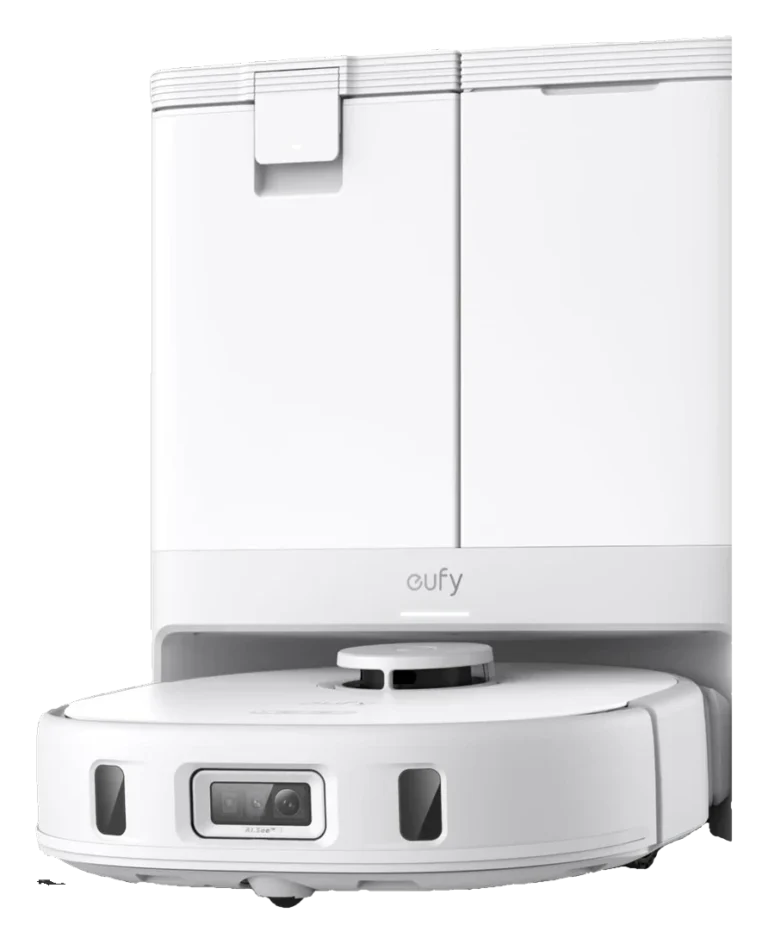
The eufy Clean X9 Pro launched in mid-2023 at an $899 MSRP. Robovations’ database lists it as superseded by the RoboVac X10 Pro Omni, which added the word “Omni” to the name and launched roughly seven months later at $799, $100 lower.
A newer model with an additional tier word priced below the model it replaced. Suffix count and price do not move together in lockstep, and neither one moves the Autonomy Level classification at all.
Same word, different meaningOmni at Ecovacs, Omni at eufy
“Omni” is not standardized across brands. On the Ecovacs Deebot X8 Pro Omni, Ecovacs pairs the word with a rotating OZMO Roller mop and a hot-water wash cycle at the dock, at a $1,300 MSRP. On the Deebot X9 Pro Omni, the same suffix pairs with a dual-roller mop design and a heated wash cycle at $1,599, a $299 step up within Ecovacs’ own lineup for a mop-mechanism change rather than a navigation or autonomy change.
Both are Level III. Neither Ecovacs model’s dock behaves identically to the eufy RoboVac X10 Pro Omni’s dock, despite sharing two of three suffix words with it.
A reader who treats “Omni” as a fixed spec, the way “4K” or “5G” functions as a fixed spec, will misjudge what they are buying. It is closer to “Deluxe”: a brand-specific signal that a dock does more than empty the bin, without specifying which more.
Robovations database
Five robots, three brands, one Autonomy Level
| Robot | Suffix | MSRP | Class |
|---|---|---|---|
| Roborock S8 | No suffix | $749 | IIIConditional |
| Roborock S8 Pro Ultra | Pro Ultra | $1,599 | IIIConditional |
| Roborock S8 MaxV Ultra | MaxV Ultra | $1,799 | IIIConditional |
| Ecovacs Deebot X9 Pro Omni | Pro Omni | $1,599 | IIIConditional |
| eufy RoboVac X10 Pro Omni | Pro Omni | $799 | IIIConditional |
Two rows in that table share the exact suffix, “Pro Omni,” at an $800 price gap. Nothing in the naming convention signals that gap to a reader comparing listings side by side. The gap is real: dock construction, wash-cycle temperature, tank capacity, and app feature depth all differ between the two. Autonomy classification does not differ.
Reading past the nameplateThe suffixes are not meaningless, and not a spec
None of this makes the suffixes meaningless marketing. Auto-empty docks, hot-water mop washing, and higher suction ceilings are documented, verifiable capability differences that change weekly maintenance load, and each robot’s individual Robovations classification page records those differences on its own terms, independent of the model name attached to it.
Wikipedia’s overview of the robotic vacuum cleaner category traces this same pattern back to the category’s earliest all-in-one docks, where automation add-ons arrived years before any meaningful jump in obstacle-handling autonomy.
What the naming convention does not do is signal autonomy tier, despite a structure that reads like one. A shopper scanning “S8” against “S8 MaxV Ultra” sees an apparent two-step climb.
The classification for both models shows a flat line at Level III. The same holds moving between brands: an Ecovacs “Pro Omni” and a eufy “Pro Omni” share a suffix and a price gap of roughly $800, not a shared feature set and not a shared autonomy ceiling.
Robovations Score v4.2
What the 69 is made of
Roborock S8
- Capability40% of the score68med 66
What it does without you.
- Dependability40% of the score86med 66
Whether it keeps doing it.
- Ownership burden20% of the score48med 67
What it asks of you.
this robotcorpus median
Held at 69 by a floor: Capped at 69: a Strong rating requires every pillar at 55 or above (ownership burden below the floor).
Bar length is the pillar's score out of 100, against the corpus median. Each pillar's weight is printed beside its name. Value and price are published alongside the score and never averaged into it.
Listing incentivesA listing problem, not an engineering one
The proliferation is easiest to explain as a listing problem rather than an engineering one. Retail search results reward exact-match product titles, and a manufacturer selling four dock configurations across two suction tiers can generate four distinct, individually searchable listings by permutation of suffix words, without four distinct navigation stacks underneath.
That does not make the resulting spec differences fake. It does mean the number of words after the model number tracks catalog structure at least as much as it tracks what the robot can decide on its own.
The practical reading is straightforward. Suffix words are a reasonably reliable guide to dock automation, sensor count, and suction spec, within a single manufacturer’s current lineup.
They are not a reliable guide across manufacturers, they are not a reliable guide to price direction across generations, as the eufy and Dreame examples both show, and they are not a guide to Autonomy Level at all. That classification lives on each robot’s individual page, not in how many words follow its model number.
Nine robots, four manufacturers, a $1,150 price spread, and one Autonomy Level. The suffixes describe the dock. They do not describe the Level III ceiling underneath it.