Skip to content
Saved
REVEALED 2023.12REASSESSED 2026.09.02
Unitree

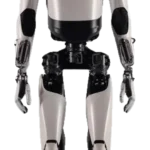
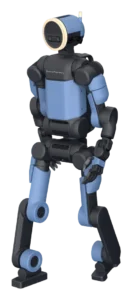
Unitree H1

Research-grade humanoid for structured autonomy tasks in controlled environments, not general-purpose home use or unscripted deployment.

Unitree H1
Price$90,000 list priceRetail price not tracked
FIT CHECK

Will the Unitree H1 fit your scenario?

Describe your scenario using the controls. Each choice reads the spec sheet for you, flagging where the Unitree H1 is built for your space and where it isn’t.

Where it operates

Primary tasks

Supervision needs

Timeline

A classification of fit for the conditions you set, not a recommendation. Verdicts describe engineering design intent, not test results.

SPECIFICATION

The full spec sheet.

Priced above the category median, with every figure charted against the category below.

70.9 in5′ 11″Dimensional drawing
Key specificationsManufacturer-published
Weight
104 lbs
Battery
864 Wh · Li-ion
Wi-Fi
Supported
Degrees of Freedom
22
Max speed
7.4 mph
Mapping & navigation

LiDAR SLAM, stereo vision, inertial measurement, proprioceptive joint feedback

Where it lands · ranked across 59 humanoid robotsThis robotMedianTypical range
Runtime120min
60 min720 min
Near median
Price$90,000

$1,385$250,000
Above median
Charge time180min

24 min480 min
Above median
Weight104lbs

26.46 lbs196.2+ lbs
Near median

Position shows where the figure sits across the tracked category, not a quality judgment.

RECORD

How the assessment has moved.

Every announcement, release and reassessment behind the current classification.

Coming soon
Just launched
Active updates
Settled
Discontinued
  1. Aug 2026 · AssessmentPre-Release Assessment revised 64 → 85
  2. Jul 2026 · AssessmentPre-Release Assessment recorded at 64 of 100
Editorial comparisons

How Unitree H1 compares.

All comparisons →
Common questions

What people actually ask.

6 answered
OperationCan H1 operate outdoors?
Unitree publishes no IP rating and no weather-resistance specification for the H1, so there is no documented tolerance for rain, spray, dust or loose ground. Treat it as an unsealed machine: water reaching the joint actuators or the electronics bay is a repair. Outdoor operation in dry conditions appears in research and demonstration footage, but nothing published establishes an envelope, and the absence of a rating is not permission.
OperationWhat is the typical battery runtime?
Unitree specifies an 864 Wh pack and describes it as quickly replaceable. Endurance falls with continuous arm motion and higher gait speeds, and Unitree publishes no per-task figures; no numbered firmware history exists to attribute battery management changes to either. Because the pack comes out, a working session is planned around how many charged packs are on hand rather than around a charging window.
OperationDoes H1 require constant teleop?
No for pre-scripted waypoints in mapped environments. Manufacturer documentation confirms autonomous execution of motion sequences and parameterized tasks. Novel scenarios or dynamic obstacles trigger fallback to operator control.
OwnershipWhat maintenance is required?
Unitree publishes no maintenance schedule for the H1: no lubrication points, no thermal benchmarking procedure and no recalibration interval. What the platform does need is inspection before use, sensor aperture cleaning, careful handling of a removable 864 Wh pack, and a service relationship with Unitree or the reseller for anything internal. Any fixed cadence quoted for this model elsewhere is not manufacturer guidance.
OperationIs the developer community active?
Yes. ROS 1 and ROS 2 are officially supported, and Unitree maintains SDK and simulation tools. Public GitHub activity from research groups is visible. Unitree publishes no support response time commitment, and none was verified for this record.
OperationWhat are common failure modes?

Joint encoder drift under sustained load is the failure class most often described for machines of this type, and recalibration addresses it. Beyond that, no rate data exists for the H1: Unitree publishes no slope rating, no duty cycle and no numbered firmware history, and no owner-report body of usable size has been collected. Any specific failure interval attached to this model should be treated as unverified.

Cite / Embed

Reference the Unitree H1 classification.

Embed the Autonomy Ladder™ mark or copy the citation. The mark is served from this record, so a reassessment updates it on your page automatically.

Get the embed code and citation
124161
268112
Clear space 3222 on all sides
Embed code

Scale proportionally only, up to 2× (536px wide)(224px wide). No recolouring, cropping, rotating, or re-typesetting.

Citation

Robovations. "Unitree H1: Autonomy Level III (Conditional Autonomy)." Autonomy Ladder™, assessed September 2026. https://robovations.com/robots/unitree-h1/

  • Link it. The mark must point at this record. An unlinked mark is not authorised.
  • Hot-link it. Never download, self-host, or re-upload the image. A saved copy stops updating, and a mark that has stopped updating is a claim we no longer stand behind.
  • A classification, not an endorsement. It may not appear beside language implying Robovations recommends, rates, or approves the product.
Where to next

Three ways to keep going.

For browsers

See every Level III.

Every robot we’ve classified at conditional autonomy. Sorted by readiness, score, and price. Filter by category, manufacturer, or release date.

Updated weekly with new entries and reclassifications.