
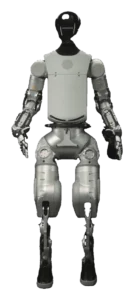
Humanoid
HMND 01 Alpha
- Autonomy
- IIIConditional Autonomy
- Score
- 75/100 Promising
- Readiness
- Not assessed
- Price
- Not tracked
All humanoid robots. Every measure below is plotted against the full class, so a difference can be read against how much the class itself varies.

Up to three
The Autonomy Ladder is the same five rungs for every robot on the site. A rung describes the conditions a robot handles without you, not how good it is.
The Robovations Score is nine inputs across three pillars, each weighted as shown and each scored so that more is better. A robot can lead on one and trail on another, which is the point of showing them apart. Cost of ownership and data handling are reported on each robot's own page and are never averaged into the score.
None of these robots carries a scored assessment yet, so there is nothing to plot here. The classification and evidence below still apply.
A number only means something next to the spread it sits in. Each track below is the real range across every classified robot in the class, with the median marked.
Not compared, because fewer than two of these robots carry a published figure: Price, Suction, Charge time, Noise.
What each design gives up to be good at what it is good at.
The Siemens trial proved 90%+ pick accuracy over 30 continuous minutes; an 8-hour sustained uptime claim with a 10% failure window in industrial production is a separate question the Alpha phase has not yet answered at scale.
220 cm and 300 kg: the reach advantage that lets it service full-height racking also means it cannot be trialled in facilities with low ceilings or weight-restricted floors without structural assessment.
Four degrees of freedom per arm, which Unitree lists as expandable, is a locomotion-first choice: the H1 is built around walking and balance, and its arms reach a pose from one direction where a higher-count arm reaches it from several.
Autonomous navigation in mapped zones reduces operator workload but excludes unmapped, dynamic spaces where teleop fallback is required.
Stated by the record itself. A robot being wrong for a household is a fact about fit, not a fault.
The upkeep ownership hands back to you, whatever the autonomy level says.
Classifications rest on different depths of evidence. A pre-release assessment and a verified one are not the same kind of claim.
| Robot | Evidence status | Sources reviewed | Last assessed |
|---|---|---|---|
| HMND 01 Alpha | Pre-Release | 11 | Aug 2026 |
| Unitree H1 | Not Consumer-Ready | 6 | Sep 2026 |
Comparing across classes is allowed — the page will switch to per-class positioning and tell you it has.