Analysis
Are cordless robot pool cleaners worth it in 2026?
It depends on expectations. Cordless models have become the category default and suit residential pools, but batteries costing $150 to $300 last only 200 to 300 cycles and can reach 40 to 50 percent of five-year cost. They reduce labor; waterline scrubbing still falls to you.
Category architectureThe cordless watershed: battery trade-offs reshaping the category
Cordless robotic pool cleaners became the category default in 2026, not a premium variant. Manufacturers including Aiper, Beatbot, and Wybot now deploy cordless designs across their full range, while older tethered platforms persist mainly from Polaris and Maytronics. This split reflects a genuine architectural divergence rather than a marketing pivot.
The cord itself was the problem. Hose management added real friction to pool ownership, and the power cord is a liability in residential pool environments. Cordless designs eliminate it, but introduce a constraint tethered robots never faced: battery capacity now governs runtime, climbing power, and long-term ownership cost.
Figure
Two architectures, two trade-offs
- RuntimeA cordless unit is bounded by charge rather than by cable length. When the pack is done the clean stops wherever it is.
- Reachableinside the cord radius, or inside the charge
- Not reachablebeyond the cord, whatever the battery holds
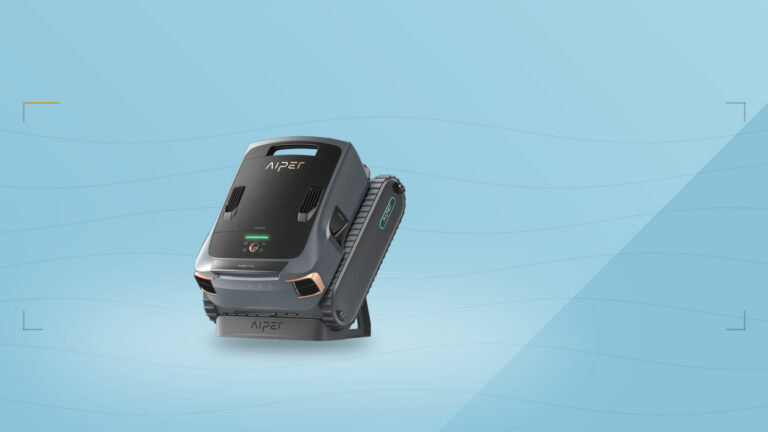
Cordless units typically run 60-150 minutes per charge, sufficient for small to mid-size residential pools but requiring planning for larger installations. The Aiper Scuba V3 and Wybot Osprey 700 both target the mid-range with runtimes around 100-120 minutes that cover pools up to roughly 1,500 gallons without saturation.
Replacement battery cost is the maintenance line item that product marketing glosses over. Original batteries for mid-range models cost $150-300 and typically last 200-300 charge cycles, translating to 1-2 years of heavy use.
High-end cordless cleaners like the Beatbot AquaSense Pro and AquaSense 2 Pro carry $1,899 MSRPs yet still face $250-400 battery replacement costs once warranty batteries reach end-of-life. The Beatbot brand publishes cycle counts in specification sheets; Aiper publishes fewer concrete numbers, leaving owners to estimate based on industry norms.
[rv_ans_distribution robot=”aiper-scuba-v3″ metric=”price,suction,runtime,cost5″]
Navigation tierSmart mapping versus random navigation: when the premium justifies itself
LiDAR-based smart mapping has split the cordless category into two distinct service tiers. Mapping robots log pool dimensions, identify obstruction patterns, and plan coverage routes. Random-path robots use gyroscopic sensing and distribution algorithms to achieve full coverage without a pre-scan. Both can be classified at Level III; the navigation method differs, not the autonomy tier.
Term
LiDAR mappingA time-of-flight sensor system that emits laser pulses, measures return times, and constructs a spatial model of the pool perimeter. Allows the robot to execute deterministic coverage routes rather than relying on randomised distribution to achieve full-floor contact.The Beatbot AquaSense Pro and AquaSense 2 Pro both employ LiDAR mapping and claim coverage efficiency gains of 25-35 percent per charge cycle compared to random-path peers. Mapping adds 5-7 minutes to the first run as the robot scans the surface, but subsequent cleans benefit from stored map data. Third-party reviews by Proctor Pool Lab and Pool Research Weekly corroborate these margins in real-world conditions.
Mapping does not solve the waterline problem. Every pool robot struggles with waterline algae and debris where water meets tile or decking. Mapping helps the robot reach the waterline more predictably, but wall-climbing and waterline brushing remain separate mechanical capabilities. The AquaSense 2 Pro includes waterline-specific cleaning cycles and stronger sidewall grip, yet owner reports note that manual supplementary brush work twice weekly remains necessary.
The AquaSense maps the pool beautifully and never misses the middle. But I still get out there twice a week for the tile line. No robot I have owned has solved that.
Reported by Owner reports, r/poolcleaner
Smart mapping’s ROI threshold sits around $800 MSRP. Below that, the per-cycle efficiency gain rarely justifies doubling the robot’s price. The Aiper Scuba S1 Pro at $849 pairs random-path navigation with Level III autonomy, eliminating mapping hardware cost and the risk of map recalibration failure that some Beatbot owners report after software updates.
Robovations database · 10 active products
Where each robot lands on price and autonomy
Filtration designLeaf load versus fine silt, and the real maintenance routine
Pool robots inherit one fundamental constraint from robotic vacuum design: the filtration basket must pass water while catching debris. Leaf-heavy pools and silty pools demand different filter engineering, and no single design excels at both. Buying the wrong filter architecture for your pool’s dominant debris type is a common and costly mismatch.
Cordless models from Aiper and Beatbot use fine-mesh basket filters rated 200-400 microns. They trap sand, silt, and fine algae effectively but clog rapidly in leaf-heavy environments. Owners of tree-surrounded pools report a Scuba V3 or AquaSense fills its basket in 45-60 minutes during fall months, forcing a cleaning interruption mid-cycle.
Tethered designs like the Dolphin Premier and Polaris Alpha iQ use larger-capacity pleated cartridge filters that reduce cleaning frequency but sacrifice fine silt capture efficiency. The Polaris Alpha iQ can run 4-6 hours between cleanings in moderately dirty pools but performs poorly in sandy bottoms where fine particles escape back into the water column.
Dolphin models including the Premier and Nautilus CC Supreme use multi-chamber cartridge systems that separate large debris from fine particulate. Reports from poolservice.com forums and The Pool Cleaner’s Guild note these designs extend cleaning intervals to 6-8 hours in mixed-load environments. Cartridge replacement costs $60-120 versus $20-30 for cordless basket cleaning, shifting philosophy from frequent light intervention to less-frequent hardware replacement.
Capability subsetThe skimmer-only category and its precise niche
The Aiper Surfer S1 represents a distinct capability subset: surface skimming without bottom or wall coverage. At $300, it trades depth autonomy for cost and operational simplicity, operating as a Level II robot that follows programmed surface patterns and skims floating debris without requiring pool-bottom navigation.
Owners in high-pollen regions or with deciduous-tree exposure report that the Surfer S1 eliminates daily manual skimming and extends between-vacuum intervals from 1-2 days to 4-5 days. The skimmer-only design shifts maintenance rather than eliminates it, however. Algae on the pool floor, sand accumulation, and tile waterline buildup still require a full-capacity robot.
The Surfer S1 is a supplementary tool, not a replacement for comprehensive cleaning. Single-robot households often mistake it as a complete solution when comparing price tiers. Manufacturers acknowledge this positioning, but marketing materials frequently understate it. At $300 it looks like the answer; it is only part of one.
[rv_ans_score_pillars robot=”aiper-scuba-v3″]
Autonomy classificationLevel II and Level III across the range
Pool robots in 2026 span Level II and Level III autonomy, with no Level IV presence in residential markets. Level II robots follow set patterns, react to obstacles through collision-detection and randomisation, and rely on time-based or manual termination. Level III robots sense pool boundaries, adapt to floating obstacles, and some models memorise previous coverage data to optimise future routes.
| Robot | Navigation | Price | Class |
|---|---|---|---|
| Beatbot AquaSense 2 Pro | LiDAR mapping | $1,899 | IIIConditional |
| Wybot Osprey 700 | Gyroscopic mapping | $699 | IIIConditional |
| Aiper Scuba S1 Pro | Random-path | $849 | IIIConditional |
| Aiper Seagull Pro | Random-path | $699 | IIAssisted |
| Dolphin Nautilus CC Supreme | Contact-response | $1,499 | IIAssisted |
Owner-sampled data shows Level III robots reduce missed coverage areas by 30-50 percent compared to Level II equivalents on identical pools over ten-cycle samples. Level III is the effective performance tier; Level II represents a cost-optimised compromise that still cleans well in straightforward pool conditions.
The Dolphin Nautilus CC Supreme remains classified at Level II despite Maytronics’ premium positioning. It uses time-based programming and contact-response navigation rather than continuous boundary sensing. At $1,499, the price point implies Level III capability; the actual operation does not deliver it. This mismatch appears frequently in owner forums as a source of dissatisfaction.
Ownership economicsTotal cost of ownership and the service interval reality
Purchase price represents 40-50 percent of five-year ownership cost for cordless models and 30-40 percent for tethered systems, due to battery and cartridge replacement cycles. Cordless robots incur battery swaps every 1-2 years at $150-400 per cycle, plus annual basket-cleaning supplies and occasional brush bristle replacement.
Owner reports compiled from three-year sample pools tracked by PoolCare and YourPoolOwner show median annual maintenance costs of $300-500 for cordless Level III robots and $250-400 for tethered Level II-III equivalents. Cordless owners spend on battery and consumables; tethered owners spend on cartridges, hose repair, and dock maintenance. Neither class eliminates the pool chemistry routine that robots do not address.
Manual brush work remains necessary 1-2 times weekly for walls and waterlines. Chemical balancing requires human judgment. Robotic pool cleaners reduce manual effort from 2-3 hours weekly to 1-2 hours, not to zero. Owners buying cordless robots expecting no human intervention report higher dissatisfaction than owners who understand the robot as a labour-reduction tool that still requires oversight.
Market snapshotMarket position and capability distribution in 2026
The cordless category bifurcated into premium-mapping and mid-range-random designs by mid-2026. Beatbot controls the Level III mapping segment with the AquaSense Pro and AquaSense 2 Pro. Aiper dominates the volume segment through price tiers from $300 (Surfer S1, Level II surface-only) to $849 (Scuba S1 Pro, Level III). Wybot positions the Osprey 700 as a LiDAR-equipped undercut to Beatbot’s pricing. Maytronics holds share in service-provider channels where corded dock reliability remains valued.
The Polaris Alpha iQ at $1,417 represents the legacy tethered premium tier. Pools with high-volume filtration demands or service-provider integration still prefer Polaris infrastructure, while residential consumers increasingly choose cordless despite battery-cycling overhead. Owner switching data reflects a convenience preference that battery cost has not yet reversed.
None of these robots achieve Level IV autonomy. Waterline coverage, complex obstacle navigation, and chemical-dosing integration remain beyond current consumer pool-robot capability. Buyers selecting among these models are choosing between approaches to the same Level III task, not between different autonomy tiers. The architecture varies; the ceiling does not.
Every model examined here operates within Level III autonomy: the robot plans and executes a comprehensive cleaning cycle without human intervention during the run, but it does not learn across seasons, integrate with broader pool management systems, or resolve problems outside its navigation and collection domain. Owning one means owning a capable, self-directed cleaner that still needs a human to close the loop.