
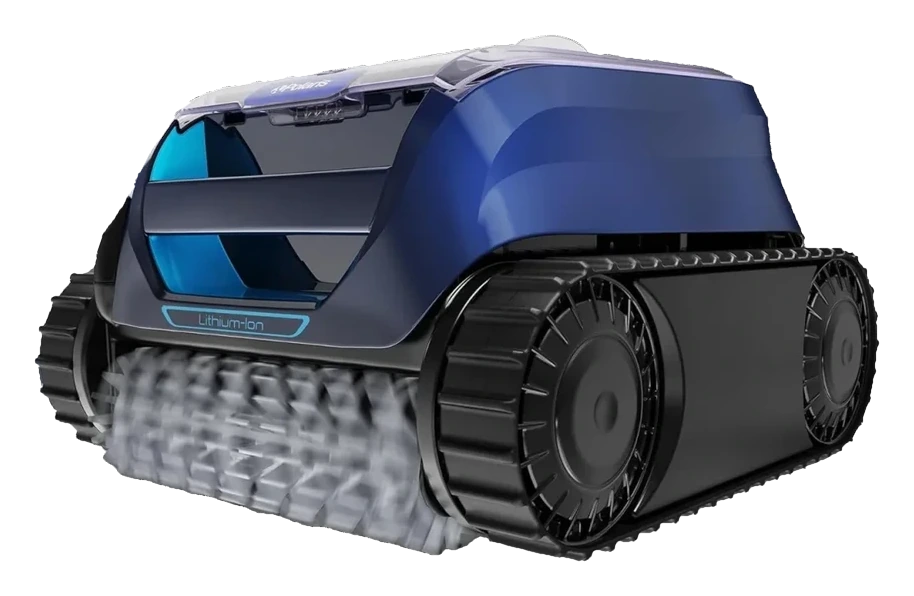
Polaris Freedom
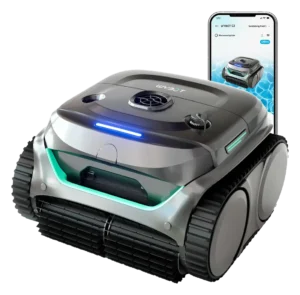
Cordless operation removes the setup friction that cable robots impose. The trade-off is a 2.5-hour session per charge, suitable for routine maintenance but not heavy-debris catch-up cycles.
Will the Polaris Freedom work in your pool?
Describe your pool using the controls. Each choice reads the spec sheet for you, flagging where the Polaris Freedom is built for your space and where it isn’t.
A classification of fit for the conditions you set, not a recommendation. Verdicts describe engineering design intent, not test results.
The full spec sheet.
Priced above the category median, with every figure charted against the category below.
- Footprint
- 18 × 18 in · 17 in tall
- Weight
- 22 lbs
- Wi-Fi
- Supported
- Cycle length
- 150 min✓
- Filter capacity
- 4 L✓
- Surfaces cleaned
- Floor, walls and waterline✓
- Power type
- Cordless battery✓
Intelligent multi-mode path (Floor, Floor/Walls/Waterline, Waterline Only, SMART Cycle); app-controlled via iAquaLink
Position shows where the figure sits across the tracked category, not a quality judgment.
Living with it.
Proven cordless drive architecture; mechanical design is field-tested across three tiers.
Polaris's cordless pool-cleaner line spans multiple seasons in market. No major firmware or drive-motor recalls documented. Owner reports highlight reliable waterline climb and mode-transition consistency.
The independent record is still forming. Failure modes are listed once an outside source reports them.
$1,399 to buy, then about $85 a year for the replaceable parts below. Over three years that is roughly $255 past the sticker price. Excludes electricity and any repairs.
- CartridgeMonthly$30–40
- BatteryAnnually$150–200
Replacement cadence from the maintenance schedule; prices shown where the source documents them.
CautionBattery handled wet; store away from children: Lithium battery near water surfaces requires proper dock placement and waterproof storage enclosure to prevent accidental contact.
NoteWall-climb areas require open deck access: Owner must maintain clear waterline and wall zones to avoid robot snag or entrapment in corners or near ladders.
How the assessment has moved.
Every announcement, release and reassessment behind the current classification.
-
Aug 2026 · AssessmentRecord status: Provisional → Pending
-
Aug 2026 · AssessmentRobovations Score revised 67 → 71
-
Aug 2026 · AssessmentRobovations Score rescored under v4.2: 63 → 67
-
Aug 2026 · AssessmentRobovations Score rescored under v4.0: 65 → 63
-
Jul 2026 · AssessmentRobovations Score revised 61 → 65
-
Jul 2026 · AssessmentRobovations Score recorded at 61 of 100
-
Mar 2024 · UpdateLT iAquaLink scheduling update expands app control
-
Mar 2023 · AnnouncementCordless robotic pool cleaner line announced
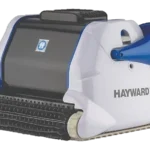
How Polaris Freedom compares.
What people actually ask.
OperationDoes the Polaris Freedom climb the waterline and walls like cable robots?
OperationCan I use the Freedom model on an above-ground pool?
OperationWhat happens if the battery dies mid-session?
OperationIs the 2.5-hour runtime enough for a 20,000-gallon pool?
OperationHow does the FREEDOM Plus differ from the base FREEDOM?
 II
II
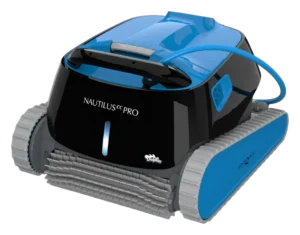
Maytronics Dolphin Nautilus CC Pro
 II
II
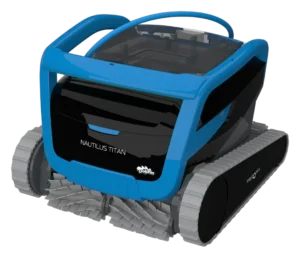
Maytronics Dolphin Nautilus Titan
 II
II
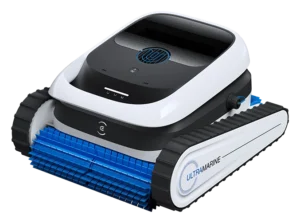
Ecovacs Ultramarine P1
Where it's sold
We may earn commission from qualifying purchases. This does not influence classification.
Reference the Polaris Freedom classification.
Embed the Autonomy Ladder™ mark or copy the citation. The mark is served from this record, so a reassessment updates it on your page automatically.
Get the embed code and citation
Scale proportionally only, up to 2× (536px wide)(224px wide). No recolouring, cropping, rotating, or re-typesetting.
Robovations. "Polaris Freedom: Autonomy Level II (Assisted Autonomy)." Autonomy Ladder™, assessed August 2026. https://robovations.com/robots/polaris-freedom/
- Link it. The mark must point at this record. An unlinked mark is not authorised.
- Hot-link it. Never download, self-host, or re-upload the image. A saved copy stops updating, and a mark that has stopped updating is a claim we no longer stand behind.
- A classification, not an endorsement. It may not appear beside language implying Robovations recommends, rates, or approves the product.