Can a robot vacuum keep pet hair off its own brush?
Rubber fins, split rollers, flip-down combs and hidden blades all promise a brush roll that stays clear. The hair still has to go somewhere.
On this page4 sections
Ask eufy how to get more out of the hair-clearing comb on its X10 Pro Omni, and the answer is about the dock. The FAQ on its product page is written for homes with animals: “For pet owners, please increase the self-empty frequency to every 15 minutes and set the suction power to Turbo or Max.”
The part being tuned is what eufy calls the Pro-Detangle Comb, there to clear hair off the roller brush without anyone touching it. Followed to the letter, the advice sends the robot back to its dock again and again during a single clean, running at its top suction settings.
If you live with a dog that sheds, you know the chore the comb is meant to end: a brush roll wound tight with hair, and a pair of scissors. Makers have redesigned that one part several ways. Which of them spares you the job, and where does the hair go instead?
Why hair winds onto a roller
A roller spins against the floor, and any strand long enough to reach around it gets wound on like thread on a spool. Narwal, which sells anti-tangle robots, puts most of it down to length. In its guide to anti-tangle design, long hair “has more length to span the roller and more surface area to catch on bristles, so a single strand can loop completely around the shaft.”
Short hair is more likely to be lifted by suction before it has a chance to wind. Pet hair is usually shorter but finer, and a shedding dog or cat supplies far more of it.
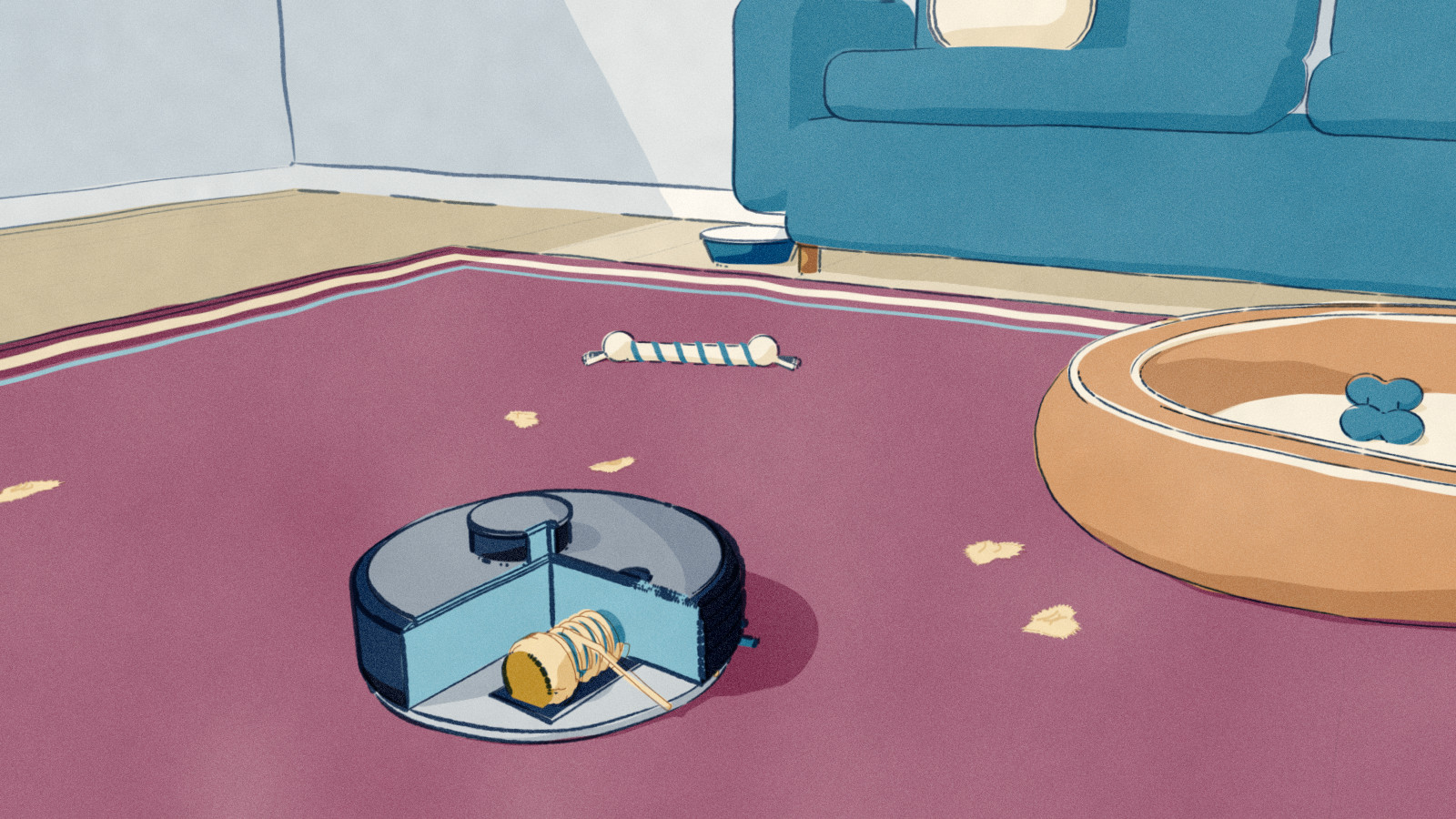
Bristles give a strand somewhere to settle. A tufted roll has gaps between its tufts, and hair that works down into them wraps the core underneath, where the tufts hold it in place. Getting it off usually means scissors or a seam ripper drawn along the shaft.
Rubber changes the surface. A roll with continuous fins has no gaps for a strand to sink into, so the strand lies across the outside of the roll, where the airflow can pull it away before it wraps.
Figure
Where hair settles on two kinds of roll
- Bristle coreHair works between the tufts, migrates to the core and stays there. Clearing it means cutting it off the shaft.
- Closed surfaceA continuous fin has no gap for hair to work into, so it wraps on the outside where it can be pulled off whole.
How makers have redesigned the roll
iRobot took the bristles away. The Roomba s9+, which iRobot now lists as unavailable, carries two rubber rolls side by side under the robot: “Dual Multi-Surface Rubber Brushes that flex to adjust to different floor types and avoid getting tangled with pet hair.” The idea is prevention: keep hair from wrapping in the first place.
Roborock kept bristles on the Qrevo Curv and changed their shape. Its DuoDivide main brush is “two parallel short bristle rollers with spiral blades that guide hairs towards the central dustbin inlet.” Picture two screw threads turning toward each other: hair travels from each end of the roll to the middle, where the inlet sits.
The side brush gets the same treatment. A spiral arc arm guides hair “towards the end of the bristles,” and a soft rubber rib partway along the arm is there to stop hair climbing the bristles in the first place.
eufy’s comb works on the roll while it turns. On the Omni C20, the Pro-Detangle Comb “flips down while the roller reverses to clear wrapped strands automatically,” so hair is allowed to wrap and the comb pulls it off afterward.
Yet eufy’s own long-hair buying guide steers readers who want “fewer main-brush cleanups” toward three other eufy models with DuoSpiral Detangle Brushes, noting that the C20 “uses a Pro-Detangle Comb instead.” Read that way, eufy places the comb behind its spiral rolls for anyone who wants to clean the brush less.
Go back to the X10 Pro Omni with that in mind. eufy’s advice for a better-working comb is a busier dock and stronger suction. The comb loosens the hair; the dock and the airflow still have to carry it out of the robot.
Dreame’s answer is to cut the hair. Its TriCut Brush is “a rubber brush with a built-in hair-cutting blade that picks up dust, cuts through hair and fur, and collects debris efficiently.” It fits 19 Dreame models, among them the X40 Ultra and the L10s Ultra.
A blade like that sits inside the roller, trims hair that has already wrapped and drops the cut pieces into the suction path. The hair still wraps around the roll for a while. It just doesn’t get to stay there.
Where the hair still collects
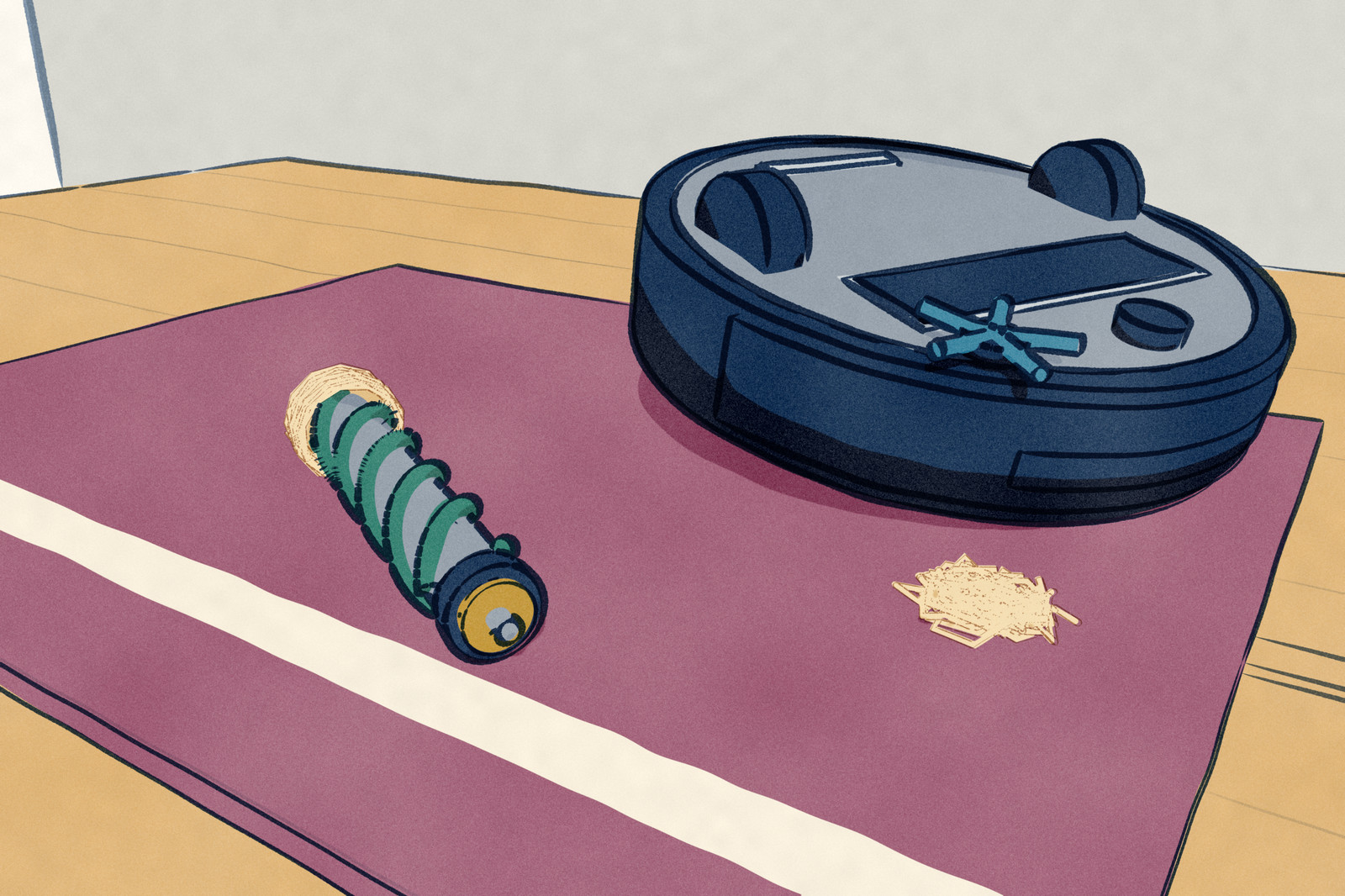
Every design so far works along the length of the roll, whether it sheds hair, steers it, combs it off or cuts it free. The ends, where the roll meets the bearings that carry it, sit beyond the reach of all four.
Pet hair drifts to the ends of the roller, where the brush meets its housing, and packs into a thick collar around the end caps. Those spots sit outside the main suction path. Hair packed there adds friction, slows the roller and cuts how much it picks up.
Rubber has a catch here. A finned roll moves hair along its length, and the ends are where the length runs out. So the same surface that keeps hair off the middle of the roll carries it toward the end caps.
Clearing the collar is the job it always was on a bristle roll. You lift the roll out, pull the packed hair off each end, check that the roll turns freely and refit it. The side brush has its own version of the problem, with strands wrapping the post at its base.
Even Narwal stops short of promising a brush you never touch. It draws the line for the whole category, its own robots included: “An anti-tangle system reduces how often you clean the brush, but rollers and side brushes still need periodic inspection and hair removal.”
What a zero-tangle figure covers
Roborock promises more. Its page for the Qrevo Curv says the DuoDivide brush “is certified by SGS with 0% hair entanglement rate,” and the Saros 10R listing on Roborock’s US store shows a “0% Hair Tangling Rate” beside a “100% Hair Removal Rate.”
Narwal’s caution and Roborock’s zero disagree on their face. So which do you believe? Each comes from a company selling the design it describes, and neither Roborock page spells out the test behind its zero: how long the hair was, what kind it was, or how much of it.
Term
SGSSGS is a testing, inspection and certification company based in Geneva, Switzerland. Manufacturers hire it to test a product against a set method and certify the result.One independent lab that reviews robot vacuums does print its method, in its pet-hair guide: “we use one gram of seven-inch hair and run each vacuum twice over a 4×8-foot test surface.” The robot then docks and empties, and the testers check the main and side brushes for caught hair.
On that test the Dreame L60 Pro Ultra, with its HyperStream DuoBrush system, came back with 0% hair tangles. It is the same kind of zero Roborock prints, this time with the method written out beside it.
But a gram of hair over two passes is a fixed dose, checked once. In your home, hair arrives every day and packs into the ends between cleanings. Neither the lab’s zero nor Roborock’s says how many runs a roll can go before those ends need clearing.
So can a robot vacuum keep pet hair off its own brush? Along most of the roll, it can. Fins shed the hair, spirals steer it to the inlet, a comb pulls it off and a blade cuts it free. The ends are still yours to clear.
Narwal’s advice is to check the roller and side brush “every few runs, especially in shedding season.” For a dog owner that is the old chore in miniature: the roll lifted out, turned in your hand, and a collar of hair pulled off each end cap.