
iLife V3s Pro
Simplicity as a feature: no app, no Wi-Fi, no learning curve. Bump-and-turn random coverage across four fixed modes, one daily start time on the remote, and no brush roll to untangle. Delivers basic cleaning for small homes with minimal owner interaction beyond emptying the bin.
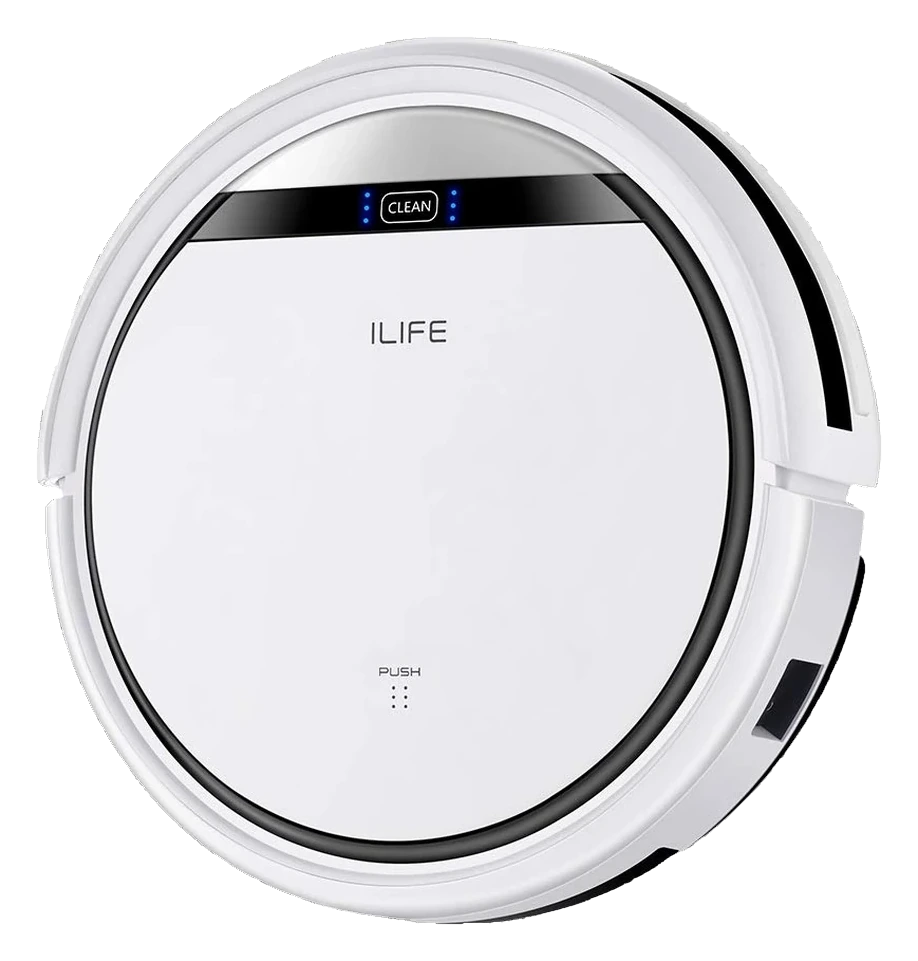
Will the iLife V3s Pro work in your home?
Describe your home using the controls. Each choice reads the spec sheet for you, flagging where the iLife V3s Pro is built for your space and where it isn’t.
A classification of fit for the conditions you set, not a recommendation. Verdicts describe engineering design intent, not test results.
The full spec sheet.
Priced below the category median, with every figure charted against the category below.
- Footprint
- 11.8 in dia · 3 in tall
- Weight
- 4.9 lbs
- Battery
- 25 Wh · Li-ion
- Onboard dustbin
- 300 mL•
- Dock type
- Charge-only dock, no self-emptying
Random bump-and-turn coverage with infrared cliff sensors and bumper contact
Position shows where the figure sits across the tracked category, not a quality judgment.
Living with it.
Basic engineering with no moving complexity; six-year market durability with minimal degradation.
Launched March 2017 with stable low-complexity design. No documented recalls or widespread failure modes. Owner reports spanning 5-7 years confirm reliable motor operation and consistent cliff-sensor performance. Primary failure point is brush bristle wear after 12-18 months; secondary is battery degradation.
The independent record is still forming. Failure modes are listed once an outside source reports them.
$160 to buy, then about $30 a year for the replaceable parts below. Over three years that is roughly $90 past the sticker price. Excludes electricity and any repairs.
- Side brushEvery 12-18 months
- BatteryEvery 18-24 months$30–40
Replacement cadence from the maintenance schedule; prices shown where the source documents them.
CautionStair safety compliance depends on sensor alignment: Cliff sensors require monthly cleaning to avoid false positives or missed drop-off detection. Misaligned sensors on carpeted stairs are a documented risk.
How the assessment has moved.
Every announcement, release and reassessment behind the current classification.
-
Sep 2026 · AssessmentRecord status: Provisional → Pending
-
Aug 2026 · AssessmentRecord status: Verified → Provisional
-
Aug 2026 · AssessmentRobovations Score rescored under v4.2: 40 → 42
-
Aug 2026 · AssessmentRobovations Score rescored under v4.0: 69 → 40
-
Jul 2026 · AssessmentRobovations Score revised 71 → 69
-
Jul 2026 · AssessmentRobovations Score recorded at 71 of 100
What people actually ask.
CompatibilityDoes the iLife V3s Pro have any way to control it remotely or on a schedule via an app?
OperationWhat is the difference between the V3s Pro and the original V3s?
ComparisonCan the V3s Pro handle pet hair better than hard-floor dust?
OwnershipHow long does the battery last, and can I buy a replacement battery?
OperationIs there a cliff-detection sensor or safety feature to prevent the V3s Pro from falling down stairs?
 II
II
Ecovacs Deebot N79S
 II
II
Shark ION Robot 750
 II
II
Eufy RoboVac 15C Max

Where it's sold
We may earn commission from qualifying purchases. This does not influence classification.
Reference the iLife V3s Pro classification.
Embed the Autonomy Ladder™ mark or copy the citation. The mark is served from this record, so a reassessment updates it on your page automatically.
Get the embed code and citation
Scale proportionally only, up to 2× (536px wide)(224px wide). No recolouring, cropping, rotating, or re-typesetting.
Robovations. "iLife V3s Pro: Autonomy Level II (Assisted Autonomy)." Autonomy Ladder™, assessed August 2026. https://robovations.com/robots/ilife-v3s-pro/
- Link it. The mark must point at this record. An unlinked mark is not authorised.
- Hot-link it. Never download, self-host, or re-upload the image. A saved copy stops updating, and a mark that has stopped updating is a claim we no longer stand behind.
- A classification, not an endorsement. It may not appear beside language implying Robovations recommends, rates, or approves the product.