
Autonomy Library·Category guide
Robot Mower Autonomy
A robot mower cuts, docks, and reschedules on its own, and the most capable current models handle surprises well enough to earn Level IV, Environmental Autonomy, when they are documented avoiding lawn clutter and freeing themselves. How much of that you experience depends on the yard: slope, tree canopy, and narrow passages move the outcome by a full level.
Counts are live·reviewed July 5, 2026
The yard is half the machine
- 1
Gate pinchThe opening is narrower than the cutting deck, so everything past the fence is unreachable however long the battery lasts.
- 2
CanopyOverhead cover degrades the satellite fix that boundary-less mowers navigate on, and the machine wanders instead of stopping.
- 3
FallGround steeper than the drive wheels hold, wet or dry. A property of the site, not a fault in the machine.
Autonomous where?
No consumer robot’s autonomy is as environment-dependent as a mower’s. The same model can run for weeks unattended on a flat, open lawn and strand daily on a yard with steep grades, dense tree canopy, and a narrow side passage.
This is why mower autonomy claims need a qualifier the marketing rarely includes: autonomous where. A useful assessment names the yard conditions under which the claim holds.
What determines mower autonomy
Six factors separate a mower that runs itself from one that becomes a weekend project.
| Boundary system | A physical perimeter wire, or a wireless virtual boundary defined by satellite positioning or vision. The single largest determinant of setup burden. See robot mower boundary wire. |
|---|---|
| Positioning | RTK satellite positioning offers centimeter accuracy but needs open sky. Vision systems handle canopy better but have their own failure modes. Random-bounce wire mowers need neither, and cut less efficiently. |
| Terrain handling | Slope limits are hard physics: traction, tilt cutoffs, and wet grass. See the percent-grade ceiling on robot mowers. |
| Rescue frequency | How often the mower strands, beaches, or loses position and waits for a person. The clearest behavioral difference between Level II and Level IV in this category. |
| Docking reliability | Whether the mower consistently finds its dock to charge and resume, including from distant zones. |
| Weather behavior | Rain sensing, scheduling around conditions, and how the mower protects the lawn and itself when conditions turn. |
Where robot mowers stand
Live Autonomy Ladder distribution for every robot mower in the Robovations database.
| Level | IManual automation | IIAssisted autonomy | IIIConditional autonomy | IVEnvironmental autonomy | VGeneralized autonomy |
|---|---|---|---|---|---|
| The robot | Performs one action on command. | Runs preset routines in simple spaces. | Finishes familiar jobs on its own. | Copes with clutter and frees itself. | Any task, any setting. |
| You | Operate it, continuously. | Supervise runs and rescue it often. | Prepare the space; handle the edge cases. | Setup and maintenance. | Nothing. |
| Robot Lawn Mowers | none | 30 robots | 66 robotsMost robot mowers are here | 32 robots | none |
Robot: Performs one action on command.
You: Operate it, continuously.
Robot: Runs preset routines in simple spaces.
You: Supervise runs and rescue it often.
Robot: Finishes familiar jobs on its own.
You: Prepare the space; handle the edge cases.
Most robot mowers are here
Robot: Copes with clutter and frees itself.
You: Setup and maintenance.
Robot: Any task, any setting.
You: Nothing.
Level IV, Environmental Autonomy, goes to mowers documented avoiding lawn clutter before contact and freeing themselves; where independent reports and the maker disagree, the independent report wins. The spread across Levels II through IV reflects two generations on the market at once: wire-guided random-bounce mowers, and mapping mowers that plan their own routes.
The human work that remains
Blade replacement, deck cleaning, seasonal storage, and boundary upkeep remain owner work on every mower. Wire systems add break-finding and repair. Wireless systems add map editing when the garden changes and, for RTK, keeping the reference antenna placed and powered.
The best-behaved mowers reduce rescue to nearly zero. None yet removes the maintenance calendar.
Questions
Are robot mowers really autonomous?
The most capable current mowers come closer than any other mainstream home robot: they map, plan, avoid obstacles, and recover with little help, which is how some earn Level IV, Environmental Autonomy. Autonomy remains yard-dependent, and setup and maintenance stay human work.
Does RTK positioning make a robot mower Level IV?
No. RTK tells a mower where it is, not what to do about a hose on the lawn. Level IV needs the behavior itself to be documented: the mower avoids ordinary clutter before contact, copes without the lawn being cleared, and frees itself when stuck.
Do all robot mowers need a boundary wire?
No. Wire-free mowers using RTK satellite positioning or camera vision are now common. Wire remains in service on many current and installed models, and each approach has distinct failure modes.
How do slopes affect a robot mower?
Every mower has a maximum grade, set by traction and tilt safety cutoffs, and effective capability drops on wet grass. Yards near the limit see stranding and scalping. The published figure is a dry-condition ceiling, not a routine operating point.
Do robot mowers work in the rain?
Most can physically run in light rain, and most manufacturers advise against it. Wet grass cuts poorly, clogs decks, and reduces traction on grades. Higher-autonomy models sense rain and reschedule on their own.
In the database
The category’s range, in real records. Every classification links to its evidence.
 II
II
Greenworks Optimow 15
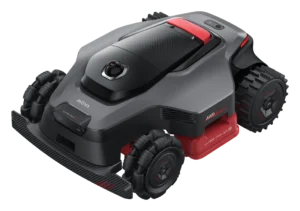 III
III
MOVA LiDAX Ultra 3000 AWD
Robot Mower Boundary Wire·Robot Firmware Update·Robot Autonomy Levels·Robot Autonomy·Full library
Browse classified robot mowers →·Robots at Level IV →·Small-yard RTK analysis →
Cite this page
Robovations. “Robot Mower Autonomy: Boundaries, RTK, and Yard Complexity” Robovations Autonomy Library. Last reviewed July 5, 2026. https://robovations.com/robot-mower-autonomy/