What slope can a robot mower handle? Percent-grade limits explained
Robot mower slope ratings read like one number. Your lawn tests them at the fence, in the morning dew and at the crease where two slopes meet.
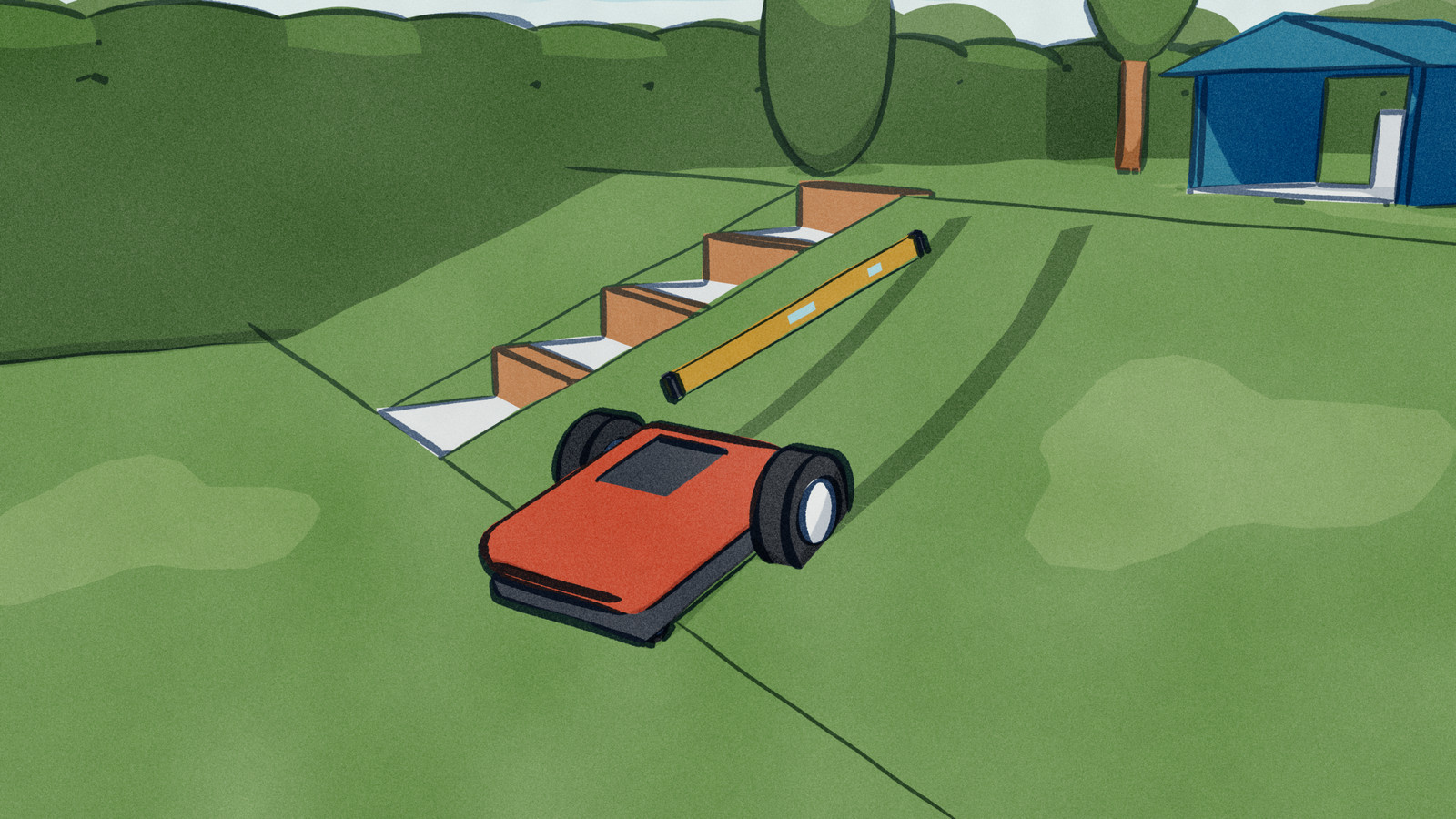
Say your lawn is flat except for one bank that drops away at the back fence. The Husqvarna Automower 435X AWD is rated for slopes up to 70 percent, which sounds like plenty. Read the next line, though, and the rating at the boundary, where your bank sits, is 50 percent.
The Automower 420 iQ, which doesn’t drive all its wheels, has the same two lines: 45 percent inside the working area and 15 percent at the boundary. Its edge rating is a third of the one printed first.
So which number is yours? Makers lead with the big one. The small one, and the conditions neither of them mentions, decide whether your mower finishes a steep yard or beaches itself on the back slope every Tuesday. It helps to know what the percentage measures, and where on the lawn it stops holding.
Slope ratings as the makers list them
| Mower | Drive | Inside the working area | At the boundary |
|---|---|---|---|
| Husqvarna Automower 420 iQ | Not all-wheel | 45% | 15% |
| Husqvarna Automower 440 iQ | Not all-wheel | 45% | 15% |
| Husqvarna Automower 435X AWD | All-wheel | 70% | 50% |
| Husqvarna Automower 435 iQ AWD | All-wheel | 70% | 50% |
| Mammotion LUBA 2 AWD | All-wheel | 80% | No separate figure listed |
Percent grade, degrees and the drivetrain
Walk 100 feet across a slope and climb 45 feet on the way, and you’ve crossed a 45 percent grade. At 100 percent the ground rises as fast as it runs, which is a 45-degree slope. So the percentage runs ahead of the angle, and 45 percent is only about 24 degrees.
The 435X AWD’s 70 percent works out to 35 degrees, and the Mammotion LUBA 2 AWD is rated for 80 percent, or 38.6 degrees. That cuts both ways. A yard that looks alarming can sit inside a mid-range mower’s window, while a long slope that looks gentle can exceed it.
Why can one Husqvarna climb 45 percent and another 70? Grip. A mower that drives two wheels can turn only the weight resting on those two into traction. When they slip, it stalls, slides or stops with a fault. Drive every wheel and the whole machine’s weight goes to work.
Every all-wheel-drive mower in the table is rated for 70 percent or more inside the boundary. The Automower 435 iQ AWD rides on a pivoting rear axle and carries the same 70 and 50 percent pair as the 435X AWD.
The rating tracks the drivetrain more closely than the price. On Husqvarna’s US site the 435X AWD costs less than the 420 iQ, and the Automower 440 iQcosts more than both. The 440 iQ is sized for a two-acre lawn, yet it carries the same 45 and 15 percent pair as the 420 iQ.
Where the printed number stops applying
Start at the fence, where the second number applies: 50 percent for the all-wheel-drive models, and 15 percent for the 420 iQ and 440 iQ, which is under 9 degrees. At the boundary a mower stops, turns and heads back in, often across the slope. And a turn on a grade asks more of the tires than a straight climb.
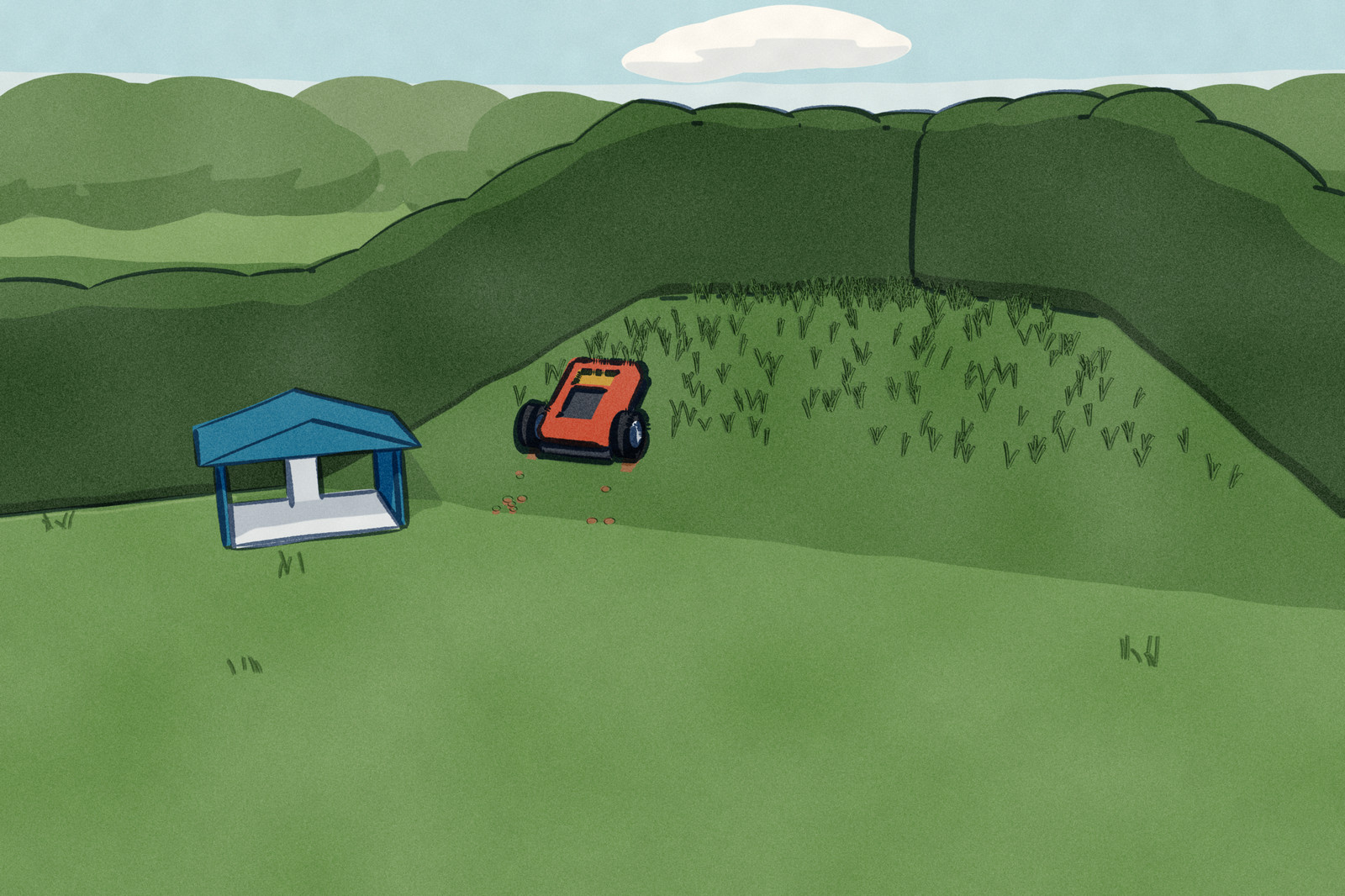
So a lawn can be flat almost everywhere and still be too steep for its mower. One 20 percent bank at the edge already exceeds a 420 iQ’s boundary rating, though the same mower is rated for more than twice that out in the open.
Inside the boundary there’s a second split. Up to 50 percent, the 435X AWD’s operator’s manual says, “the product will operate normally.” Between 50 and 70 percent you’re asked to “make sure that there are no obstacles in the slope,” and steeper ground “must be isolated with the boundary wire.”
Term
Boundary wireA wire laid around the whole working area and held down with stakes. The mower treats it as the edge of the ground it may mow. Run around a bank or a flower bed inside the lawn, it makes an island the mower keeps off, which is how a slope too steep to mow is isolated.Water pulls the limit down too. The 435X AWD is rated IPX4, and Husqvarna says it “can mow in the rain.” Yet the manual’s fault table lists a steep slope among the causes of a “No drive” stop, and tells the owner: “If it is due to wet grass, wait until the lawn has dried before using the product.”
The LUBA 2 AWD’s 80 percent comes with no condition attached. Mammotion’s line about wet grass, “Easily Handles Tall, Thick, and Wet Grass,” headlines the cutting motor. And if your schedule starts at dawn, your mower is out on dew-wet grass whether or not it rained.
Then there’s the seam, where two slopes meet or a slope flattens onto level ground. A mower can ground its deck there, or lift a driven wheel off the grass. A yard can sit inside the rating on every face and still strand a mower at the crease between two faces.
So what slope can a robot mower handle? Husqvarna’s fault table answers in two sentences: “Maximum guaranteed slope is 70%. Steeper slopes should be isolated.” That is the open lawn’s figure, and the same table has you wait out wet grass. The bank by your fence answers to the boundary rating, 50 percent or 15, and a seam can stop a mower inside either.
The slope worth measuring, then, is the steepest bank at your lawn’s edge, rise over run, held against that boundary rating. Even a bank that passes has a time of day. On a dry afternoon the mower may cross it without a pause. At dawn, on dew, the same bank can be where the No drive fault comes up.