How quiet is a robot mower? What the decibel figure on the spec sheet measures
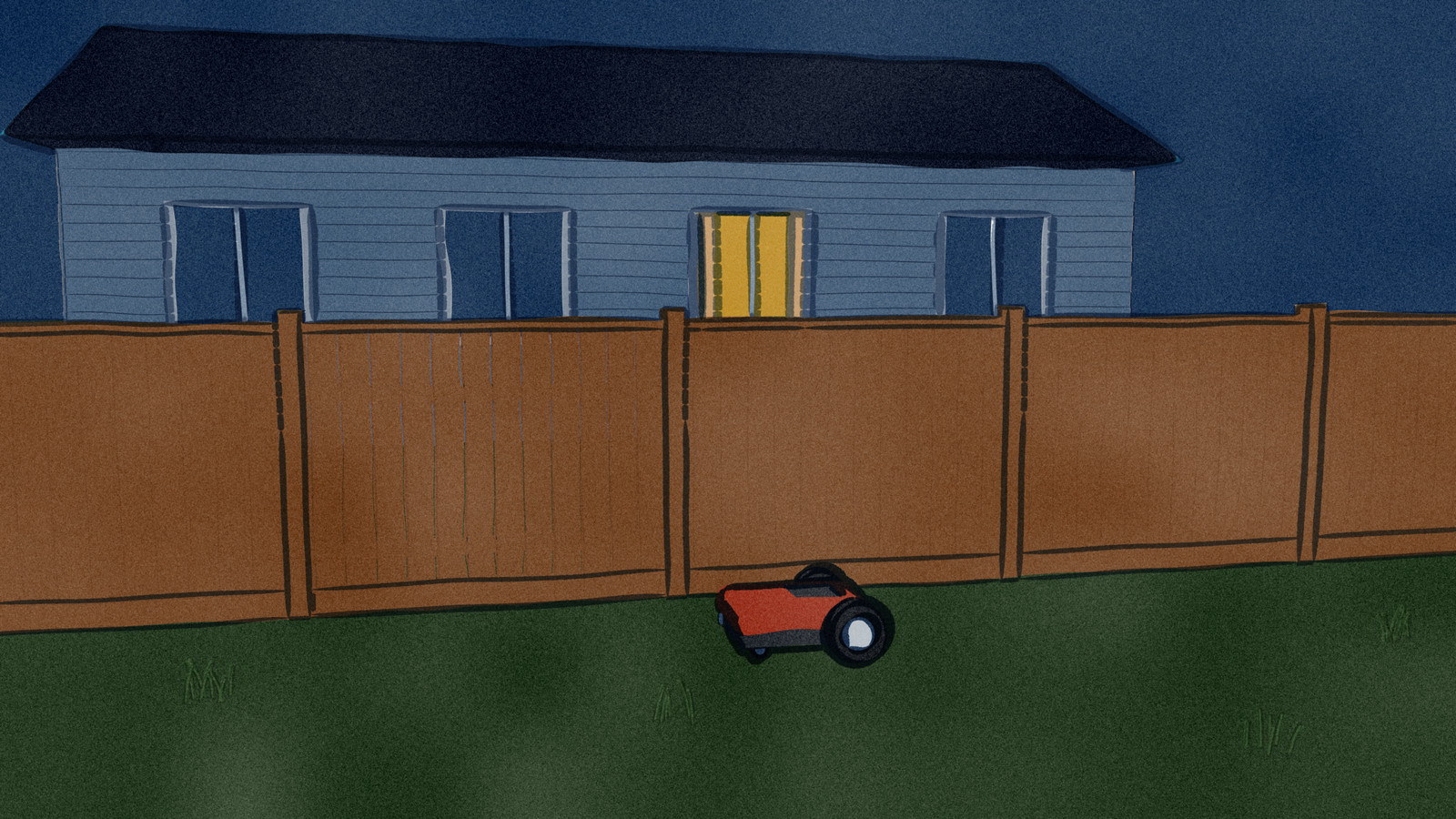
A robot mower built to work through the night comes with one noise figure and no distance attached. The people next door hear it from across the fence.
On this page4 sections
Say you want a robot mower that works while the street is asleep. The spec sheet gives you one number to go on. On Husqvarna’s UK page for the Automower 410VE NERA, it sits between the mower’s color and its water rating: “Sound level perceived: 60 dB(A)”. The line names no distance and no test method.
And Husqvarna expects the mower out at night. Its camera “works even in the dark, detecting and avoiding nocturnal animals during nighttime mowing,” and its maximum active time is 24 hours.
So if yours runs after dark, how much of it will the people next door hear? That decides whether a night schedule stays a quiet convenience or starts an argument over the fence. In some cities, a level taken at the property line is exactly what the noise code checks.
Four numbers in the manual
The 410VE’s operator’s manual is more specific. Its technical data table, reproduced on a manuals archive site, lists four sound figures, the same for its smaller sibling, the Automower 405VE NERA. They are a measured sound power level of 60 dB(A), an uncertainty of 1 dB, a sound pressure level “at the operator’s ear” of 52 dB(A), and the 60 dB(A) perceived level.
The figures were determined under the EU Machinery Directive, 2006/42/EC, and standard EN 50636-2-107. The perceived level alone is measured to a different standard, ISO 11094:1991.
Sound power and sound pressure describe different things. Sound power is the acoustic energy a machine emits, a property of the mower wherever it stands. Sound pressure is what a microphone or your ear picks up at one spot, and it changes with distance and surroundings.
An explainer from Nidec’s US Motors division compares sound power to “the wattage rating of a light bulb” and sound pressure to “the brightness in a particular part of the room.” In that analogy, the 60 dB(A) you see on the spec sheet is the wattage. Husqvarna’s US site uses the same “sound level perceived” label: the Automower 440 iQlists 62 dB(A).
The 52 dB(A) is the only one of the four tied to a place, and the place is “the operator’s ear” on a machine that runs with nobody walking behind it. The table does not say how far from the mower that ear is.
From the mower to the fence
Getting from a sound power level to what you would hear at a distance takes arithmetic and some assumptions. For a small machine on hard, open ground with nothing in the way, the usual textbook approximation subtracts 8 dB to reach the level one meter out, then roughly 6 dB more each time the distance doubles.
Term
Decibel (dB)A decibel figure compares a sound with a fixed reference on a logarithmic scale, so equal steps in decibels stand for equal multiples of sound energy. In open air, each doubling of distance cuts the energy reaching a listener by the same multiple. That is why the estimate above takes the same number of decibels off at every doubling.Run the 410VE’s 60 dB(A) through that rule and the first step lands on 52 dB(A) at one meter, the same figure the manual gives for the operator’s ear. All four in the table below are estimates from a formula.
Estimates on hard, open ground
The 410VE’s 60 dB(A), by distance
| Distance from the mower | Estimated level |
|---|---|
| 1 meter | 52 dB(A) |
| 4 meters | 40 dB(A) |
| 8 meters (about 26 feet) | 34 dB(A) |
| 16 meters (a little over 50 feet) | about 28 dB(A) |
Real gardens depart from that model in both directions. A house wall behind the mower reflects sound toward the listener and adds to the level. A solid fence or a thick hedge between the mower and a window takes some away, and a closed window takes away more.
On calm, clear nights the air near the ground is often cooler than the air above it, a layering that bends sound back down so it carries farther than the daytime arithmetic suggests. The formula makes no allowance for any of these.
Picture a neighbor’s bedroom window about 26 feet from the lawn. The estimate there is 34 dB(A). Passing traffic can bury that. On a still night it has the air to itself.
The mower keeps at it, too. With a typical 110 minutes of mowing per charge and the same again to recharge, a mower given the whole night works in cycles of just under two hours.
Clicks and whines the average smooths over
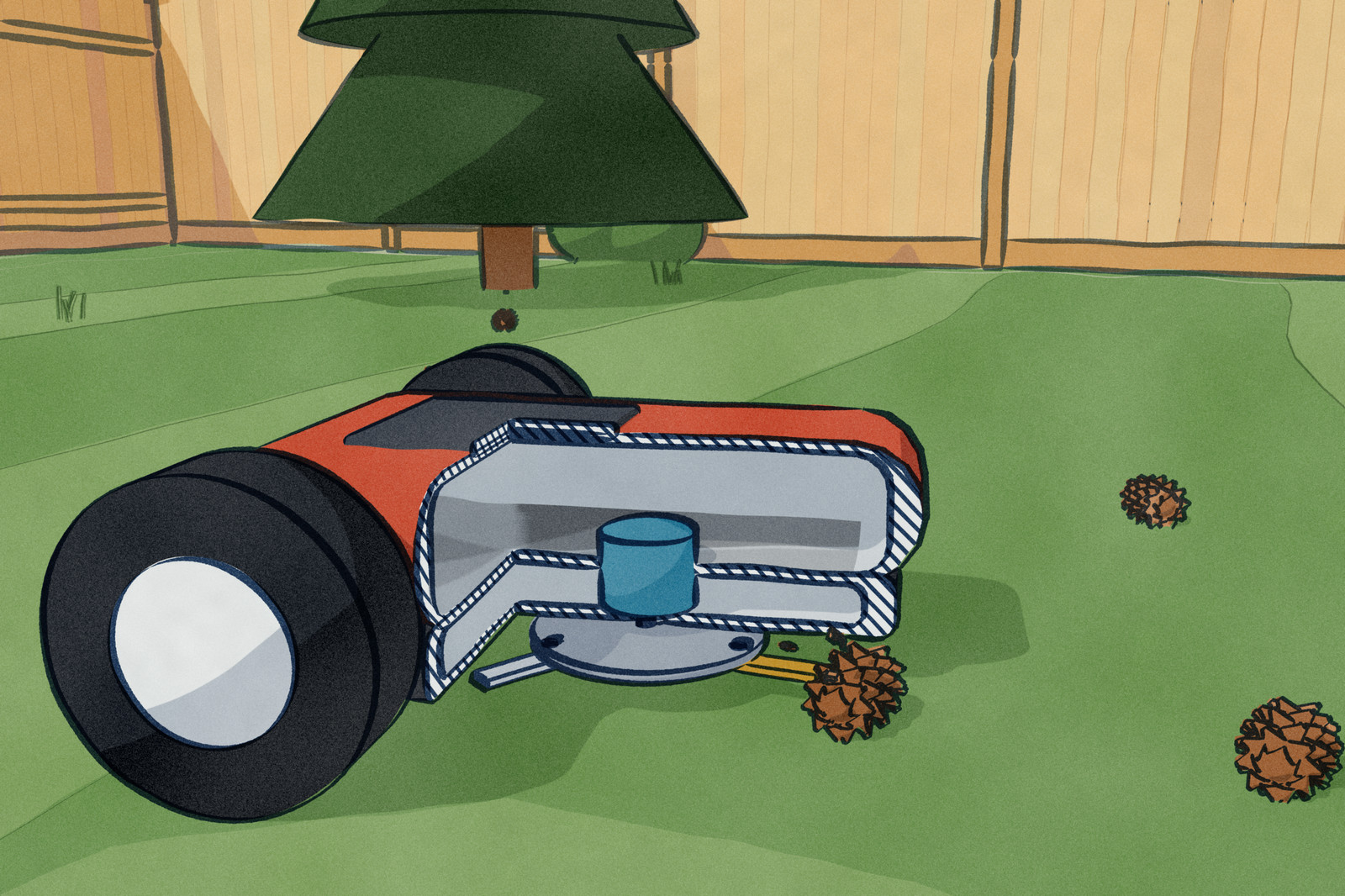
A declared sound level is an average. The A in dB(A) weights frequencies roughly the way human hearing does, and the result is spread across the whole measurement. Two kinds of sound lose their character in that process: steady tones, such as the whine of an electric motor, and short impacts.
The 410VE cuts with “2 discs with 3 pivoting razor blades.” When one of those blades meets a pinecone or a dry twig, it makes a sharp click lasting a fraction of a second, which adds almost nothing to an average taken over a full run.
People who assess noise complaints for a living weigh both features more heavily than their level suggests. BS 4142:2014, the British Standard for rating industrial and commercial sound, adds a correction to the measured level before it is compared with the background.
One UK acoustics consultancy summarizes the corrections as 2 to 6 dB for a tonal quality, “e.g., a hum or whine,” and 3 to 9 dB for impulsive sounds “such as bangs or clatters.”
The standard was written for industrial and commercial sources, but its reasoning travels. Another consultancy explains why the correction exists: “noise with such features is found to be more annoying than featureless noise at the same level.”
Term
Background levelThe surrounding sound at a place, from traffic, wind or other machines, measured while the source being assessed is silent. BS 4142 sets the corrected level of the new sound against it. The further the new sound rises above the background, the more likely it is to draw complaints.Two mowers with the same dB(A) figure can differ in how much of their sound sits in one pitch. And how often the blades click depends on what is lying on the lawn.
Where night mowing meets the rules
Some places settle the night question by the clock. In Germany, a federal ordinance on equipment and machinery noise, the 32. BImSchV, bars the machines on its list from running outdoors in residential areas at set hours. Those hours are all day on Sundays and public holidays, and 8 p.m. to 7 a.m. on weekdays.
Lawnmowers are on that list, with no exception for robotic or battery-powered ones. Quieter machines with the EU Ecolabel escape some extra weekday limits, but lawnmowers get no such allowance. Under this rule, a mower rated at 60 dB(A) and a quieter one get the same hours.
Other places check the sound itself, where the neighbor hears it. Portland, Oregon, measures at the property line: 55 dBA from one residential lot to the next by day, five less at night, and five less again for “narrow band or steady sound,” because the adjustments add up. A motor’s steady whine is the kind of sound that last rule describes.
So the 60 dB(A) on the spec sheet is the mower’s wattage, a property of the machine. What reaches a window about 26 feet away works out near 34 dB(A) on open ground. A wall behind the mower or a still night can push that up, and a whine or a click weighs more than its decibels.
Portland leaves a steady hum 45 dBA at the property line after dark, and the arithmetic puts the 410VE at 40 dB(A) just four meters out. If your neighbor does complain, though, the arithmetic will not settle it. The level that counts is read at the property line, with the mower running on a real night, pinecones and all.