Does a small yard suit an RTK robot mower?
Several of the smallest wire-free mowers no longer need a base station in the garden. They still need a view of the sky, and a small fenced plot rations it.
On this page3 sections
Before Husqvarna sells you its Automower Aspire R6V, the smallest-rated mower in its current UK range, it gives you a job. Walk the lawn with your phone and watch the Wi-Fi bars. The product page is exact about it: “Your phone should indicate at least one bar for the robotic lawn mower to operate reliably.”
The R6V has no boundary wire. It steers by satellite, and the corrections that make its satellite fix precise arrive over the internet. So your Wi-Fi has to reach the whole lawn, out to the far corner by the fence, or the mower loses the thing that keeps its passes straight.
A walk with a phone is what satellite navigation now asks of a small garden. The older case against RTK mowers on small plots was the base station: a second receiver you had to mount somewhere with an open view of the sky. It took the same effort whether it served 100 m² or 1,000.
On several of the smallest current models, the base station has moved off the property. What stays is the mower’s own need to see the sky from every corner of the lawn. And a small garden hemmed in by a house and fences is where that view is narrowest.
Start with size, since it’s the first thing you’d check. A 1,500-square-foot back lawn is about 139 m². Even the wired Husqvarna Automower Aspire R4, the smallest-rated mower here, is rated for 400 m², close to three times that. The YUKA mini is rated higher still.
So area ratings don’t separate these mowers on a plot that size. What does? How each one learns where the lawn ends, and how it behaves when that information goes bad.
Where the correction comes from
Figure
Passes with and without a correction
- The wanderOn satellites alone the machine knows its position to about half a metre either way, wider than its own cutting width.
- Strips left standing2 strips of this plot were never cut. Each is a place where two passes drifted apart by more than the plan allowed for.
- Base stationA receiver fixed at a known point works out the satellite error and radios a correction to the mower.
- Passes abutCorrected to a few centimetres, narrower than the seam between two stripes, each pass lands beside the last and the plot is covered.
- Cutground the machine actually covered
- Missedleft standing where two passes drifted apart
RTK, short for real-time kinematic positioning, works by comparison. A receiver at a fixed, surveyed position tracks the same satellites as the mower and streams its measurements to it. The two see nearly the same atmospheric and orbital errors, so the mower can cancel most of them out.
You can see the difference on the grass. An uncorrected fix wanders by more than the width of a cutting deck, enough to leave strips of uncut grass between passes. A corrected one holds to a few centimeters, which is why the passes meet.
Husqvarna puts the R6V at “typically better than 5 cm” on its cloud corrections. An optional reference station in the garden tightens that further, though Husqvarna says a dealer must install it. That is the old base station, back as an extra.
The reference receiver doesn’t have to be yours. Mammotion sells the YUKA mini in an “H version” with “Free NetRTK for Automatic, Centimeter-Level Positioning,” under the line “No Wire, No RTK Installation.” Kress feeds its RTKn mowers from what it calls “our exclusive network of base station antennas,” with “NO antenna” at the owner’s house.
Segway’s entry model takes another route. The Navimow i105e, the 500 m² entry in the Navimow i Series, pairs its positioning system with a camera. Segway saves network RTK, pitched as “Say Goodbye to Antennas,” for its larger X4 series.
What three small-garden mowers ask of the yard
| Mower | How it finds the lawn edge | What the owner provides | Rated area | Listed price |
|---|---|---|---|---|
| Husqvarna Automower Aspire R4 | Perimeter wire around the lawn | Installation of the perimeter wire | 400 m² | No price on Husqvarna’s UK page |
| Husqvarna Automower Aspire R6V | Satellite corrections through Husqvarna’s cloud, plus AI vision | Wi-Fi across the full lawn | 600 m² (400 m² in irregular pattern) | £999 |
| Mammotion YUKA mini (H version) | NetRTK corrections, plus AI vision | No wire and no RTK installation, per Mammotion | 0.15 acre (600H) or 0.2 acre (800H) | $749, marked down from $1,099 |
What a fenced garden does to a satellite fix
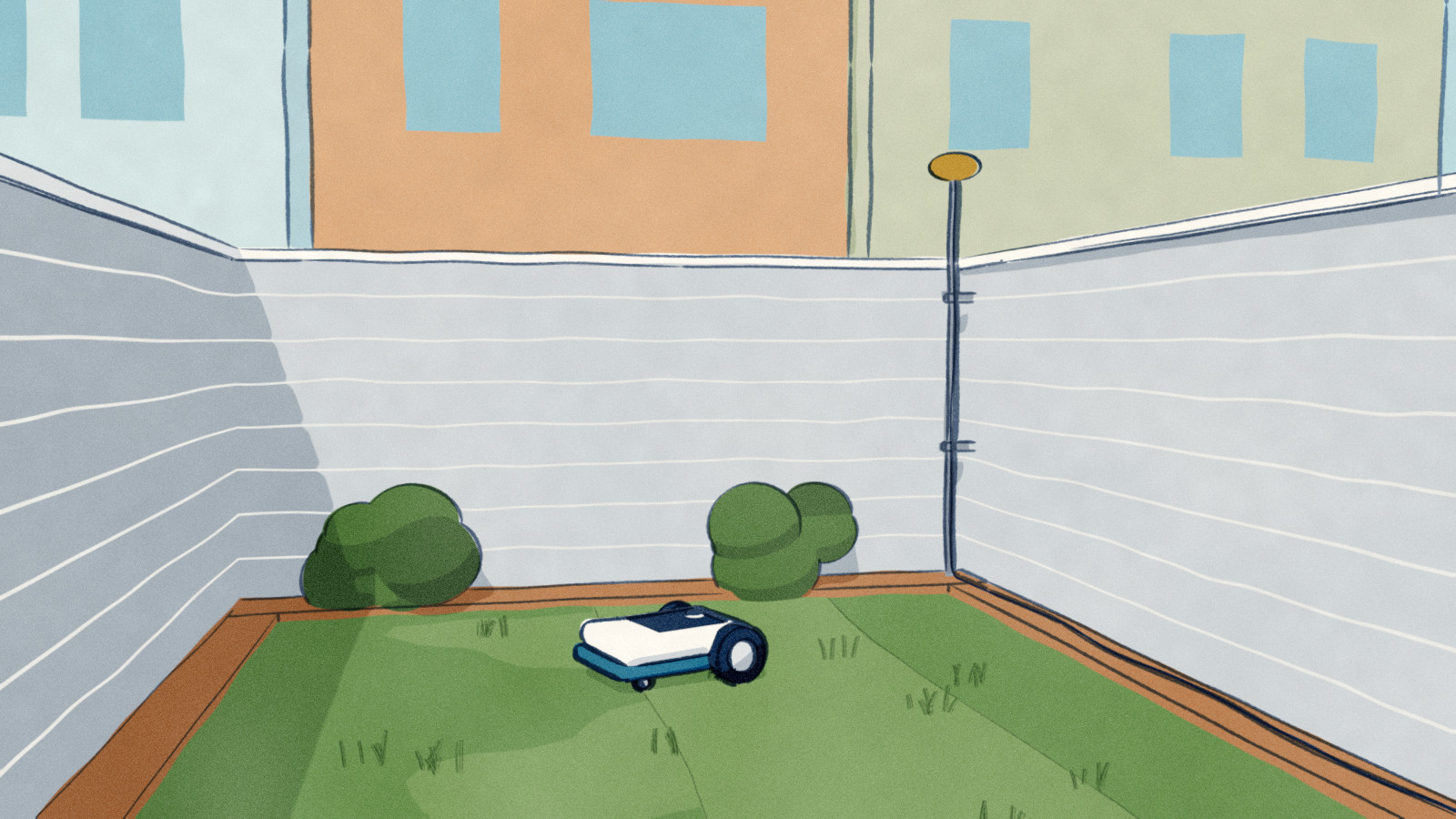
Picture a rear lawn of 600 square feet, about 56 m², behind a two-story house. A board fence stands within two meters of the grass on the other three sides, and a mature apple tree fills one corner.
Stand the mower in the middle. The house hides a wide band of sky on its side. Satellites low on that horizon are either blocked or reach the mower as reflections off the wall.
A reflected signal travels farther than a direct one. A receiver that takes the bounce for the true path computes a position that is off, by an amount it may not detect. Low satellites suffer most, because their signals skim across the walls and fences closest to the receiver.
The bad spots keep time, though not by the sun. GPS satellites retrace the same path across the sky once every sidereal day, about four minutes shorter than a solar day. So a corner that goes bad at 10:00 today tends to go bad again at about 9:56 tomorrow.
Trees, on the other hand, do follow the seasons. Leaves hold water, which absorbs satellite signals, so the apple tree in full leaf in July blocks more sky than the same bare tree in January. And GPS isn’t alone up there: Galileo, BeiDou and GLONASS repeat on longer cycles, and a receiver tracking several blends their patterns.
Term
Galileo, BeiDou and GLONASSSatellite navigation systems run by the European Union, China and Russia, working alongside the American GPS. Each flies its own satellites in its own orbits, which is why each repeats its pattern across the sky on a cycle of its own.So what does the mower do in that corner? Each maker of the small wire-free models describes a fallback. Husqvarna says the R6V’s “AI vision technology combines with satellite navigation, providing full lawn coverage, even in areas with weak satellite signals.”
Kress says its mowers “switch to inertial navigation and odometry to maintain accurate routing, until a clear satellite connection is available again.” Mammotion’s YUKA mini page promises “Mow Anywhere, No Signal Worries” and describes no mechanism behind it.
Kress’s fallback is dead reckoning. The mower estimates where it is from where it last knew it was, counting wheel turns and reading motion sensors, and each estimate carries the error of the one before. Wheels slip on wet grass and the sensors drift, so the longer the sky stays hidden, the less the estimate is worth.
How long will a mower steer on that estimate before it stops and tells you? The answer decides what the owner of the fenced garden finds after a run: an alert in the app, or a mower that carried on from a guess.
A broken wire reports itself
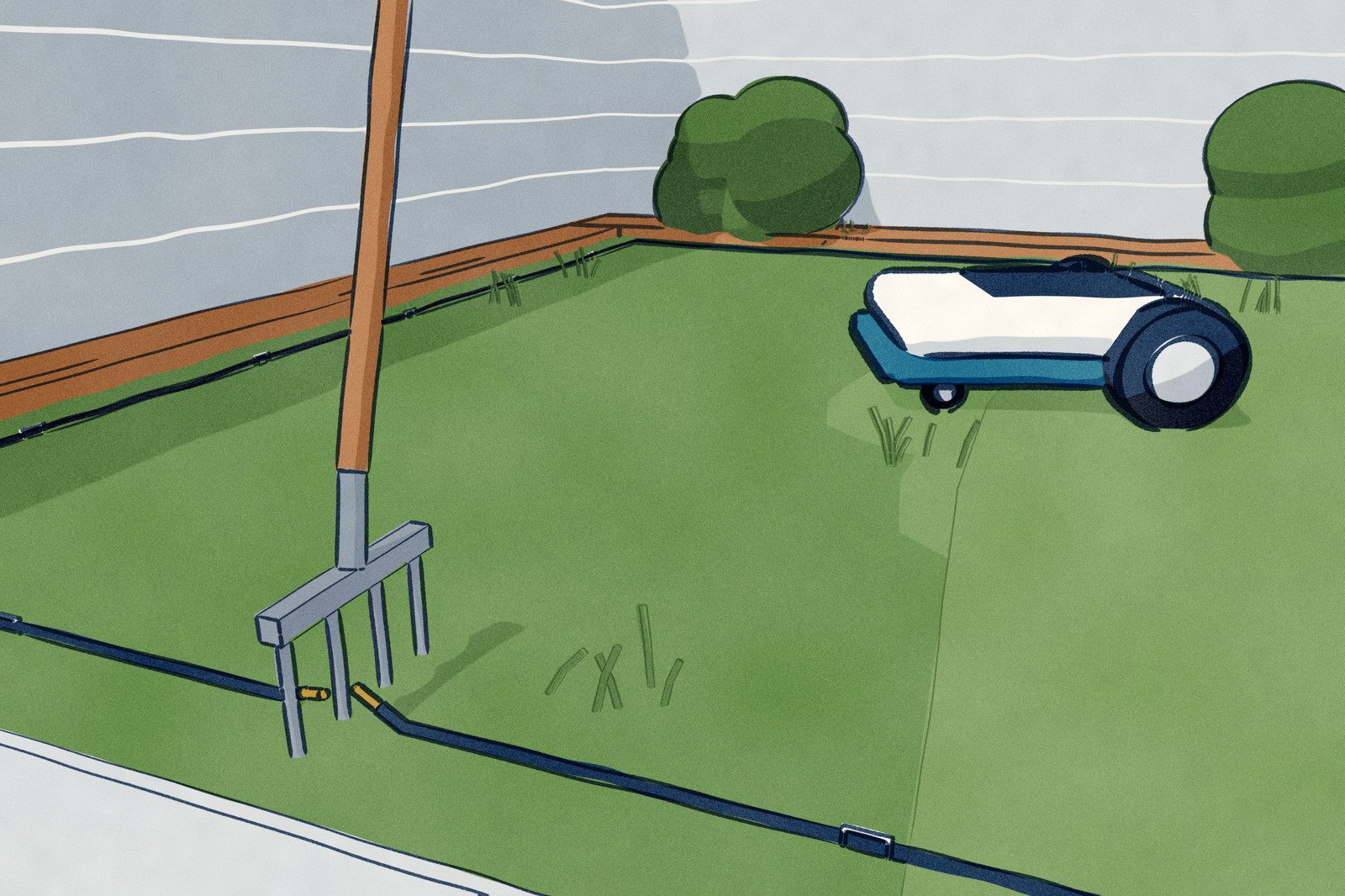
A boundary-wire mower works from a simpler signal. The charging station sends a current around a loop of wire pegged or buried at the lawn’s edge, and the mower turns back when it senses the field. Put an aerator’s tine or a border spade through that loop, and the whole circuit goes dead at once.
And the mower tells you. The charging station flashes a blue light, and the app or the mower’s display reads “No loop signal.” The usual causes are wire damaged by cutting, weather or animals, or a faulty connection at the station.
Finding the break is methodical. You swap the guide-wire and boundary-wire connections at the station, watch the light, and keep splitting the loop in halves until one half holds the damage. A handheld detector speeds that up, though Husqvarna warns it “may not be as effective with partial wire breaks.”
The fix is a coupler. Trim about 60 centimeters (2 feet) from each end of the damaged wire, push one end into each hole, and press the coupler shut with pliers.
A partial break, the kind a detector may miss, is the nearest thing the wire has to the satellite mower’s bad corner. Even that has an address you can dig up.
So does a small yard suit an RTK mower? On size, easily, and on several of the smallest models the base station has left the garden. What a small fenced plot tests is the sky. You can walk the Wi-Fi with your phone. The point where the mower stops trusting its own estimate sits in its firmware, and none of these makers publishes it.
In the 56 m² garden, then, a wired mower’s failure is a place: a nick in the wire somewhere along the fence. A satellite mower’s failure is a time. It tends to come around behind the house about four minutes earlier each day, and it grows once the apple tree is in leaf.