Skip to content
Saved
REVEALED 2024.10REASSESSED 2026.08.04
Pollen Robotics

Pollen Robotics Reachy 2

Dual-arm research platform combining VR teleoperation with an open policy stack: Reachy 2 is programmable in Python and runs learned policies from Hugging Face's LeRobot library, which is the stated purpose of the April 2025 acquisition. The platform launched in October 2024 and has been deployed across research institutions in approximately 20 countries.
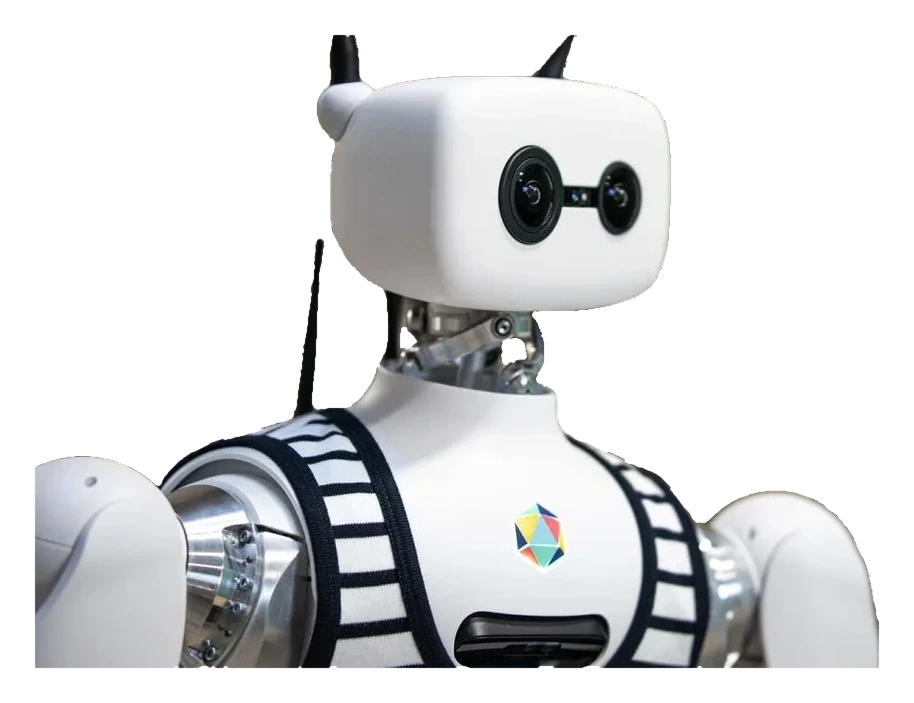
Pollen Robotics Reachy 2
Price$70,000 maker’s listNo retailer listing
FIT CHECK

Will the Pollen Robotics Reachy 2 fit your application?

Describe your use case using the controls. Each choice reads the spec sheet for you, flagging where the Pollen Robotics Reachy 2 is built for your space and where it isn’t.

Who you are

Primary use

Programming

Setting

A classification of fit for the conditions you set, not a recommendation. Verdicts describe engineering design intent, not test results.

SPECIFICATION

The full spec sheet.

Priced above the category median, with every figure charted against the category below.

Dimensions not publishedDimensional drawing
Key specificationsManufacturer-published
Wi-Fi
Supported
Mapping & navigation

Mobile base with differential drive; VR teleoperation via wireless connection.

Where it lands · ranked across 36 specialty robotsThis robotMedianTypical range
Runtime480min
30 min960 min
Near median
Price$70,000
$29$100,000
Above median

Position shows where the figure sits across the tracked category, not a quality judgment.

Official referencesProduct page
OWNERSHIP

Living with it.

Open-source dual-arm research platform with VR teleoperation; architectural maturity established but production scale and real-world task durability unproven.

Dual-arm design documented in academic robotics; ROS integration provides maintenance access. No published field-use reports on joint wear, battery runtime under continuous VR teleoperation, or thermal stability. Hugging Face acquisition signals backing but does not guarantee shipping reliability.

Reliability trendUnprovenowner-reported arc
What goes wrong · 4 documented · 0 self-recover
Common
Gripper pad wear after 300+ demonstration cyclesGrasp success rate drops; object drop risk increases
Owner fixReplace gripper pads (~$200 per set)
Occasional
VR headset latency cascade during arm task handoffOperator loses position tracking; arm motion stalls mid-reach
Owner fixCheck wireless range; reduce simultaneous peripheral connections
Occasional
Dual-arm coordination desynchronization under loadOne arm lags the other; fine-grained bimanual tasks fail
Owner fixROS-level servo sync check; motor calibration via firmware update
Occasional
Mobile base wheel tread degradation on lab floorsTurning radius drifts; autonomous locomotion pattern breaks
Owner fixWheel replacement and IMU recalibration
Upkeep routine
Monthly12×/yr
Gripper and wrist sensor calibration; cable inspection for wear.
Seasonal4×/yr
Software updates from the Hugging Face ecosystem; firmware verification for arm servo controllers.
As neededno fixed schedule
Arm motor bearing lubrication; gripper pad replacement when worn. · Base wheel replacement if tread is damaged from lab floor use.
Cost over time · past the sticker

$70,000 to buy. Ongoing running cost for this model hasn’t been assessed yet.

Safety notes

CautionVR operator loss-of-control scenarios undocumented: No published emergency stop or default arm behavior if VR signal drops

NoteDual-arm entanglement risk during simultaneous reach: Open-source control stack allows custom motion planning; unsafe trajectories possible if developer unfamiliar with arm kinematics

RECORD

How the assessment has moved.

Every announcement, release and reassessment behind the current classification.

Coming soon
Just launched
Active updates
Settled
Discontinued
  1. Jul 2026 · AssessmentPre-Release Assessment recorded at 54 of 100
  2. Jul 2026 · AssessmentPre-Release Assessment revised 54 → 57
  3. Aug 2026 · AssessmentPre-Release Assessment revised 57 → 70
Common questions

What people actually ask.

5 answered
OperationIs Reachy 2 available for purchase outside research partnerships?
Pollen Robotics sells to research institutions and universities; no general consumer availability. Hugging Face acquisition (2025) signals academic and developer focus but does not establish consumer retail channels.
OperationHow does VR teleoperation differ from other arm platforms?
Manufacturer documentation highlights haptic feedback and dual-arm coordination in VR; most research arms use 2D screen interfaces. In the LeRobot workflow those sessions double as demonstration capture, so operator time feeds policy training rather than competing with it.
OperationWhat open-source tools ship with Reachy 2?
Pollen publishes a complete public hardware guide, and Hugging Face maintains a Reachy 2 page inside the LeRobot documentation. The stack includes ROS drivers, a simulation environment, a Python SDK, and LeRobot policy integration.
OperationDoes Reachy 2 have autonomous manipulation capabilities?
Reachy 2 is programmable in Python and runs learned policies from Hugging Face’s LeRobot library. VR teleoperation is the usual way demonstrations are collected to train those policies, so it feeds autonomy rather than substituting for it. What has not been published is end-to-end task completion in an unstructured setting without supervision.
OperationWhat is the timeline for broader availability?
Release window and production scale unknown. Hugging Face acquisition suggests sustained commitment; specific delivery dates have not been announced.

Cite / Embed

Reference the Pollen Robotics Reachy 2 classification.

Embed the Autonomy Ladder™ mark or copy the citation. The mark is served from this record rather than saved as a file, so it always shows the level we currently hold. If we reassess, it updates on your page by itself.

  • The mark must link to this record. An unlinked mark is not authorised.
  • No recolouring, cropping, rotating, restyling, or re-typesetting. Scale proportionally only, up to 2×: the seal to 536px wide, the standard to 224px.
  • Leave clear space equal to half the numeral tile on all sides: 32px on the seal, 22px on the standard.
  • The mark states a classification, not an endorsement. It may not appear beside language implying Robovations recommends, rates, or approves the product.
  • Hot-link the image from robovations.com. Do not download, self-host, proxy or re-upload it: a saved copy stops updating, and a mark that has stopped updating is a claim we no longer stand behind.
  • The mark is live. It reflects the classification on this record as it stands. If we reassess, it changes on your page automatically. If we withdraw the classification, it stops rendering. Nothing is required from you either way.
Citation
Where to next

Three ways to keep going.

For browsers

See every Level II.

Every robot we’ve classified at assisted autonomy. Sorted by readiness, score, and price. Filter by category, manufacturer, or release date.

Updated weekly with new entries and reclassifications.