Skip to content
Saved
Comparison · 2 robots

Pollen Robotics Reachy 2 · Starship Delivery Robot

All specialty robots. Every measure below is plotted against the full class, so a difference can be read against how much the class itself varies.
  1. Pollen Robotics Reachy 2
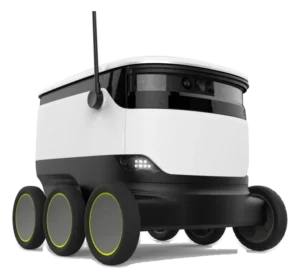
  2. Starship Delivery Robot
Pollen Robotics

Pollen Robotics Reachy 2

Autonomy
IIAssisted Autonomy
Score
75/100 Promising
Readiness
Not assessed
Price
$70,000list

Starship Technologies

Starship Delivery Robot

Autonomy
IIAssisted Autonomy
Score
90/100 Pre-Order Ready
Readiness
Not assessed
Price
Not tracked

Up to three

01 Classification

What each one does on its own.

The Autonomy Ladder is the same five rungs for every robot on the site. A rung describes the conditions a robot handles without you, not how good it is.

V
Generalized
Any task, any setting
IV
Environmental
Handles new obstacles without help
III
Conditional
Finishes familiar jobs on its own
II
Assisted
Runs preset routines, needs rescue
Pollen Robotics Reachy 2Starship Delivery Robot
I
Manual
One action, on command
02 Assessment

Where they actually differ.

The Robovations Score is nine inputs across three pillars, each weighted as shown and each scored so that more is better. A robot can lead on one and trail on another, which is the point of showing them apart. Cost of ownership and data handling are reported on each robot's own page and are never averaged into the score.

None of these robots carries a scored assessment yet, so there is nothing to plot here. The classification and evidence below still apply.

03 Measured against the class

How far apart is a long way?

A number only means something next to the spread it sits in. Each track below is the real range across every classified robot in the class, with the median marked.

Weight41 with a published figure
  • Pollen Robotics Reachy 2110.2 lbs
  • Starship Delivery Robot50.7 lbs
0.1 lbsmedian 24.3 lbs2,646 lbs
Height41 with a published figure
  • Pollen Robotics Reachy 265.4 in
  • Starship Delivery Robot21.8 in
0.9 inmedian 20.2 in82 in

Not compared, because fewer than two of these robots carry a published figure: Price, Suction, Runtime, Charge time, Noise.

04 Ownership

What the numbers leave out.

The trade-off

What each design gives up to be good at what it is good at.

Pollen Robotics Reachy 2

VR teleoperation gives fine-grained control and doubles as the demonstration path for imitation learning, but each behavior still has to be trained; out of the box the robot does what an operator or a trained policy tells it to.

Starship Delivery Robot

Remote-assistance layer sits behind a fleet Starship describes as operating at over 99 percent autonomy, with assistants on standby rather than driving. The dependency is real: the platform runs only in Starship-mapped service zones and is backed by staffed support that has to scale with the fleet. Starship does not break out how often that support is called, so the size of the human contribution behind the 99 percent figure cannot be checked.

Who each one is wrong for

Stated by the record itself. A robot being wrong for a household is a fact about fit, not a fault.

Pollen Robotics Reachy 2
Autonomous task execution without supervision
Learned policies run trained tasks, but published operation is either operator-driven or a policy running under supervision. Unsupervised end-to-end task completion in unstructured environments has not been documented.
Commercial warehouse or logistics pilots
Research platform status, roughly 3 kg of payload per arm, and integration work on an open stack make it a poor match for time-critical warehouse operations.
Cost-constrained robotics programs
$70K+ price point exceeds typical educational robotics budgets. The software stack itself is free and open source, so the constraint is hardware cost rather than recurring license fees.
Starship Delivery Robot
Consumer retail or unrestricted public sidewalk operation
Not available for purchase by individuals or small businesses. Operates only in Starship-managed fleet zones; unavailable for independent consumer use or ad-hoc delivery markets.

What stays your job

The upkeep ownership hands back to you, whatever the autonomy level says.

Pollen Robotics Reachy 2
  • Monthly: Gripper and wrist sensor calibration; cable inspection for wear.
  • Quarterly: Software updates from the Hugging Face ecosystem; firmware verification for arm servo controllers.
  • As needed: Arm motor bearing lubrication; gripper pad replacement when worn.
  • As needed: Base wheel replacement if tread is damaged from lab floor use.
Starship Delivery Robot
  • Daily: Recharges overnight on Starship’s wireless charging installations inside its service zone; the company documents autonomous charging with no manual plug-in task.
  • As needed: Sensor and camera cleaning is carried out by Starship field staff; no interval is published.
  • As needed: Wheel and tire replacement is handled at Starship’s regional maintenance centers; parts are not sold to the public.
  • As needed: Cargo compartment cleaning and hardware repairs are performed by Starship staff within its managed zones.
  • As needed: Software updates are pushed fleet-wide by Starship; no user action exists.
  • As needed: There are no owner tasks at all: Starship does not sell robots or spare parts, and it publishes neither a service interval nor parts pricing.
05 Evidence

How much each of these is standing on.

Classifications rest on different depths of evidence. A pre-release assessment and a verified one are not the same kind of claim.

Evidence behind each classification
Robot Evidence status Sources reviewed Last assessed
Pollen Robotics Reachy 2 Not Consumer-Ready 6 Aug 2026
Starship Delivery Robot Not Consumer-Ready 4 Sep 2026

Robovations classifies robots; it does not rank them. Nothing on this page is a recommendation, and no manufacturer influences a classification or its placement here.