
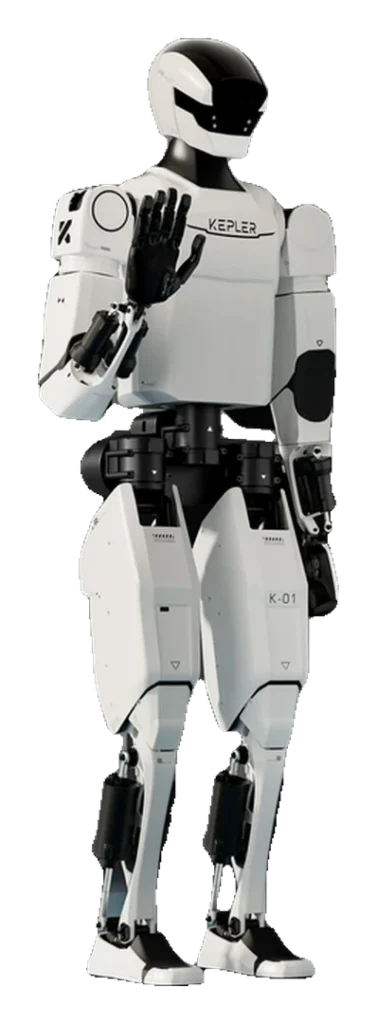
Kepler Forerunner K2
Industrial bipedal humanoid built around its hands: rope-driven five-digit grippers with 11 degrees of active and passive freedom each and 15 kg (33 lb) of payload per hand, on a body carrying 52 degrees of freedom, over 80 onboard sensors and 100 TOPS of onboard compute. Kepler rates the 2.33 kWh pack for a full eight-hour untethered shift with roughly an hour to recharge. Unveiled at Gitex Global in October 2024 with a stated target retail band of $20,000 to $30,000; no Western distributor or export channel has been announced.
Will the Kepler Forerunner K2 fit your scenario?
Describe your scenario using the controls. Each choice reads the spec sheet for you, flagging where the Kepler Forerunner K2 is built for your space and where it isn’t.
A classification of fit for the conditions you set, not a recommendation. Verdicts describe engineering design intent, not test results.
The full spec sheet.
Manufacturer-published figures, measured against every humanoid robot we track.
Position shows where the figure sits across the tracked category, not a quality judgment.
How the assessment has moved.
Every announcement, release and reassessment behind the current classification.
-
Aug 2026 · AssessmentPre-Release Assessment revised 56 → 69
-
Jul 2026 · AssessmentPre-Release Assessment revised 52 → 56
-
Jul 2026 · AssessmentPre-Release Assessment recorded at 52 of 100
-
Oct 2024 · AnnouncementKepler Robotics Forerunner K2 humanoid formally announced
What people actually ask.
OperationIs the Kepler K2 available for purchase outside of China?
OperationWhat assembly tasks can the K2 perform autonomously?
ComparisonHow does the K2's gripper compare to earlier Forerunner models?
OperationWhat happens if the K2 encounters an unexpected part or assembly error?
OperationHow long is the K2's runtime on a single charge in factory duty?
 II
II
Leju Kuavo 5
 II
II
Nori A3
 II
II
Zeroth Bridge
 II
II
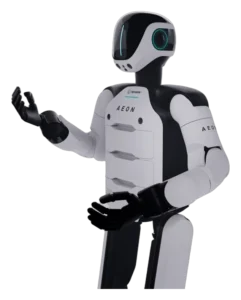
Hexagon AEON
Reference the Kepler Forerunner K2 classification.
Embed the Autonomy Ladder™ mark or copy the citation. The mark is served from this record, so a reassessment updates it on your page automatically.
Get the embed code and citation
Scale proportionally only, up to 2× (536px wide)(224px wide). No recolouring, cropping, rotating, or re-typesetting.
Robovations. "Kepler Forerunner K2: Autonomy Level II (Assisted Autonomy)." Autonomy Ladder™, assessed August 2026. https://robovations.com/robots/kepler-forerunner-k2/
- Link it. The mark must point at this record. An unlinked mark is not authorised.
- Hot-link it. Never download, self-host, or re-upload the image. A saved copy stops updating, and a mark that has stopped updating is a claim we no longer stand behind.
- A classification, not an endorsement. It may not appear beside language implying Robovations recommends, rates, or approves the product.