How much clearance does a robot vacuum need to fit under furniture?
Robot vacuum makers print a height, sofa makers sometimes print a clearance, and the two rarely meet on one page. What decides whether a robot gets underneath?
On this page3 sections
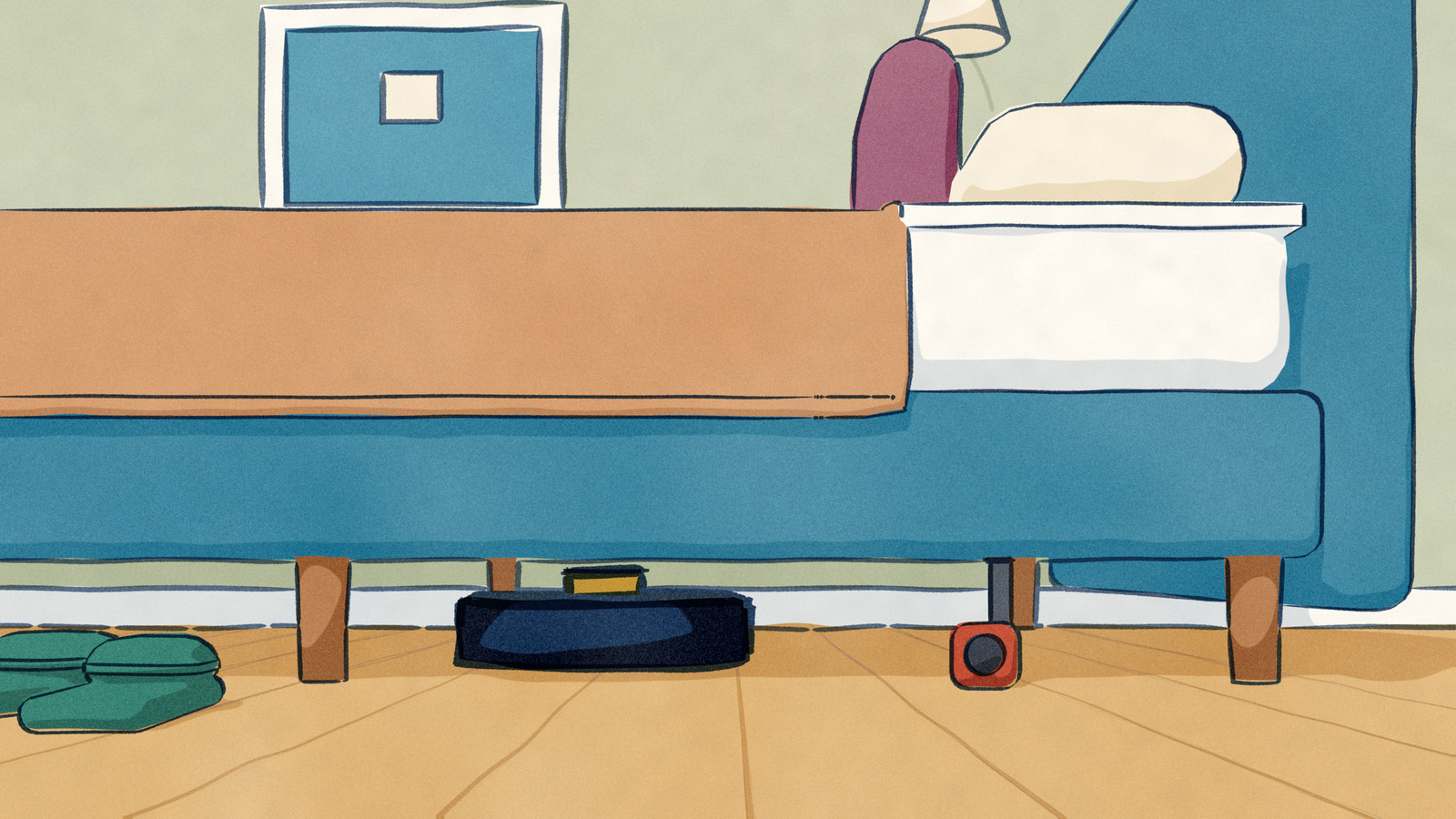
IKEA’s sofa pages list a measurement labeled height under furniture. The FINNALA sofa lists 2 3/8 inches, the VISKAFORS 4 3/8 inches and the UPPLAND 6 3/4 inches. Three sofas from one catalog differ by more than four inches in the space a robot vacuum would have to drive into.
The robot’s half of the comparison comes from its maker. Roborock lists the Roborock Qrevo 2 Pro at 13.86 by 13.78 by 3.80 inches, navigating with a PreciSense LiDAR and structured-light obstacle sensors. Against those three sofas it passes under the UPPLAND with nearly three inches to spare and under the VISKAFORS with a little over half an inch, and it cannot get beneath the FINNALA at all. No robot vacuum height quoted below is as low as the FINNALA’s 2 3/8 inches, including the models built to be slim.
The part on top sets the height
Most robot vacuums map a room with a spinning laser rangefinder, called LiDAR or an LDS, and the laser needs a clear line of sight in every direction. The common way to give it one is a raised disk on the lid, above everything else on the machine. However tall the bin, battery, motor and wheels make the body, the disk adds its own height on top.
Roborock’s page for the Saros 10 puts a number on that disk, because the laser on this model can drop into the body. The spec table gives one robot two heights: 3.68 inches (93.5 mm) with the LDS elevated and 3.14 inches (79.8 mm) with it retracted. The raised sensor accounts for 0.54 inch, about 14 millimeters, or roughly a seventh of the robot’s full height.
Roborock says its RetractSense system “lowers its LDS to pass under low-clearance areas and rises again in open spaces.” An upward range finder adjusts the sensor’s height for low-clearance areas, and a top contact sensor, the page says, “prevents forced entry and surface scratches.” Dreame builds the same idea into the Dreame X50 Ultra. Its product page says that when the retractable dToF sensor lowers, the robot’s height drops to 89mm, about 3.5 inches. The page does not give the height with the sensor raised, which is the figure that applies wherever the robot keeps it up.
Term
dToF sensorShort for direct time-of-flight. The sensor sends out a pulse of laser light and times how long it takes to bounce back from a surface, which gives the distance to that surface. Dreame and Ecovacs use the name for the navigation laser that Roborock calls an LDS.The Roborock Saros 10R removes the rising part altogether. Roborock lists it at 350 by 353 by 79.8 mm, the same 3.14 inches as the Saros 10 with its laser lowered, and describes a navigation package made of a solid-state LiDAR, a 3D time-of-flight sensor and an RGB camera. No part of it spins above the lid.
Which height on the spec sheet to read
Ecovacs’s page for the Ecovacs Deebot X8 Pro Omni shows how many heights one listing can carry. It gives a Deebot dimension of 353 by 351.5 by 98 mm, a station 533 mm tall and an outer carton 405 mm tall. Only the first describes the robot, and 98 mm works out to 3.86 inches.
A retracting sensor puts two heights on the spec sheet, and the lower one holds only where the robot decides to lower its laser, a decision Roborock assigns to the upward range finder reading the edge ahead. A sofa that clears the raised height takes the robot either way. One that clears only the lowered height depends on that reading being right on every pass.
From maker and IKEA product pages
Listed robot heights and the room left under a 4 3/8 inch sofa
| Robot | Height its maker lists | Sensor as the maker describes it | Headroom under the VISKAFORS |
|---|---|---|---|
| Roborock Saros 10R | 3.14 in (79.8 mm) | Solid-state LiDAR, 3D time-of-flight sensor, RGB camera | 1.23 in |
| Roborock Saros 10 | 3.14 in lowered, 3.68 in raised | Retractable LDS (RetractSense) | 1.23 in lowered, 0.69 in raised |
| Dreame X50 Ultra Complete | 3.50 in (89 mm) lowered, raised height not listed | Retractable dToF sensor | 0.87 in lowered |
| Roborock Qrevo 2 Pro | 3.80 in | PreciSense LiDAR, structured-light sensors | 0.58 in |
| Ecovacs Deebot X8 Pro Omni | 3.86 in (98 mm) | dToF navigation | 0.52 in |
When a robot fits and still stays out
Clearance lets a robot go under a piece of furniture, and the robot still has to read the opening from outside and choose to enter. Jorge Jimenez, reviewing the Saros 10R for Gizmodo in February 2025, wrote that the 3.14-inch robot “refused to go under furniture like the couch and dining table” on its first runs. On the third attempt it went under both, and he did not see the problem again. The couch and the table had the same clearance on every run.
A thin margin also has to absorb everything a single published figure leaves out. A sofa’s front rail is not always its lowest point, since a center leg or a cross rail farther back can sit lower. A rug under the furniture lifts the robot by the depth of its pile. A robot climbing a rug edge or a threshold tilts nose-up for a moment, raising its front above its listed height.
Measuring at home means taking the gap at the lowest point under the piece, across its full depth, with any rug in place, and comparing it with the robot’s raised height when its sensor retracts. For the FINNALA the comparison is short: at 2 3/8 inches, it sits about three-quarters of an inch below the slimmest height any of these makers lists.