How do robot vacuums clean corners and edges?
A round robot can’t reach into a square corner, yet three 2026 flagships promise to clean one down to the last inch of wall.
On this page3 sections
The product page for the Roborock Saros 20 makes two promises about the edge of a room: “100% Edge and Corner Coverage” and “0 inches Along the Edge and Corner.” Read plainly, that is a claim to leave nothing behind where the floor meets the wall.
The shape of the machine argues with the claim. A robot vacuum is a disc, and a disc driven into the corner of a room stops with a curved gap between its rim and the two walls it cannot touch. The spinning side brush that flicks grit toward the suction mouth sits inside that circle.
For most of a decade the practical limit of a round robot was a faint ring of dust along the skirting board, and a small triangle stranded in every corner, the line a mop could not finish and the owner wiped by hand.
The old fix was to accept the gap, or to hunt down a rare flat-front model. In 2026 that changed, and reaching the edge is the headline feature on the Narwal Freo 20 Edge, the Dreame X60 Ultra Extreme and Roborock’s Saros line. The question is practical: what did makers add, and how close to the wall does it get your floor?
How the brush reaches the wall
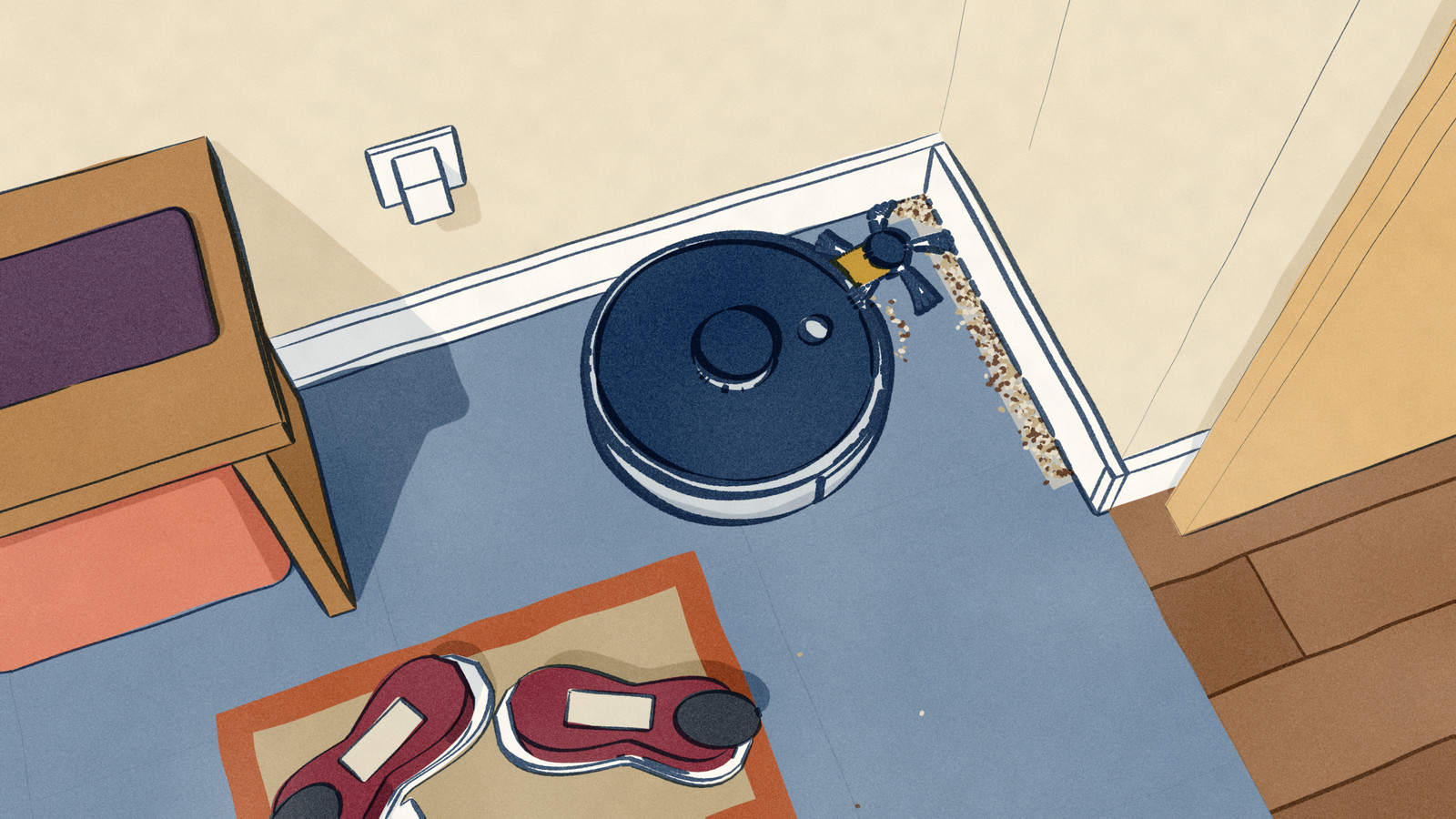
The fix is mechanical, and nearly the same across brands: the side brush rides an arm that swings out past the body when a sensor reads a wall, sweeps the strip the round chassis cannot cover, then folds back in.
Roborock calls its version FlexiArm. On the Saros 20 the arc-shaped brush reaches toward the wall and into toe-kick recesses as low as 0.79 inches, the shallow slot under a kitchen cabinet that a fixed brush never entered. Dreame mounts two arms instead of one, and its brush and mop pad reach well past the robot’s body.
The extension is small and the timing is everything. The arm only has to cover the two or three inches the circle gives up, and only while the robot tracks a wall, so it spends the rest of a run tucked inside the footprint, clear of cords and rug fringes. On most machines it flicks out and back in the half-second the robot passes the corner.
Why the mop needed an arm too
A brush and a mop solve two different edge problems, which is why the newest machines extend both. Loose grit is a sweeping job: the bristles carry the last inch and throw the dust inward. A dried spill or a greasy film at the foot of a cabinet is a scrubbing job, and a round pad that stops short of the baseboard leaves a dry margin you can see.
So the mop now rides its own arm. The Narwal extends a scrubbing track rather than a pad, reaching “right up to the skirting boards” with no manual adjustment from the owner. What the reaching brush does when it finally meets the corner is the part worth watching.
With crumbs and rice scattered along a wall and into a tight corner, the extended side brush swept the debris back towards the main suction path rather than pushing it further away.
The whole mechanism is built around that one move: carry the bristles the last inch, then pull the dust back toward the suction mouth instead of flinging it along the wall where the next pass has to chase it.
How close it gets, and where it stops
Reviewers who scatter debris along a wall and read the line afterward describe a genuine change. A hands-on test of the Saros 20 found one mop pad extending to the side along walls and furniture, the brush reaching into corners, and the machine clearing debris of many sizes on hard floors and carpet.
Owner-facing guidance for the earlier Roborock Saros 10R reports that most owners no longer go back to touch up the edges by hand.
What none of them publishes is a number for the corner itself. The reports describe cleaner edges and less to re-sweep, and the arm is easy to watch working, but a measured share of the corner recovered is not something the labs put in print. Roborock’s “100%” is a claim no published test has put a figure to.
The “0 inches” is a design target rather than a measurement of your room, and geometry sets a floor under it. A square corner comes to a point, and no disc, however long its arm, can lay a round brush into the apex of a 90-degree angle. Owner-facing guidance says as much, that very tight corners might still need occasional attention.
The extending arm is a real advance, and a narrow one. It buys back the thin strip of floor that a round body always surrendered along the wall, which on most runs is the dust you would have noticed first. An arm adds reach. It does not redraw the circle the robot drives.
So the strip along the skirting board is now the machine’s to clean. The apex of the corner stays geometry’s: a small triangle, a little smaller with each new brush, that a longer arm keeps narrowing and never quite closes.