Skip to content
Saved
RELEASED 2019.07REASSESSED 2026.08.07
Ecovacs

Ecovacs Winbot 920

Four-stage cleaning path provides methodical coverage without real-time path planning. Wired design is straightforward; entry-level positioning relative to current cordless models such as the W2 Omni and W2 Pro Omni.

Ecovacs Winbot 920
Price$349 list priceRetail price not tracked
FIT CHECK

Will the Ecovacs Winbot 920 work on your windows?

Describe your windows using the controls. Each choice reads the spec sheet for you, flagging where the Ecovacs Winbot 920 is built for your space and where it isn’t.

Window style

Frame style

Building height

Power preference

A classification of fit for the conditions you set, not a recommendation. Verdicts describe engineering design intent, not test results.

SPECIFICATION

The full spec sheet.

Priced near the category median, with every figure charted against the category below.

10.6 in10.6 in3.5 inDimensional drawing
Key specificationsManufacturer-published
Footprint
10.6 × 10.6 in · 3.5 in tall
Weight
2.9 lbs
Backup battery runtime
30 min•
Power type
Mains-corded with backup battery•
Mapping & navigation

Onboard path traversal across the pane; the four-stage sequence (wipe, scrape, scrape, wipe) is the pad process, not a movement pattern

Where it lands · ranked across 27 robot window cleanersThis robotMedianTypical range
Adhesion2,800Pamode not stated
2,800 Pa10,000 Pa
Bottom of range
Price$349

$150$850
Near median
Noise67dB

63 dB75 dB
Near median
Weight2.9lbs

1.3 lbs4.8 lbs
Near median

Position shows where the figure sits across the tracked category, not a quality judgment. The vacuum holding the robot on the glass, not cleaning power. The figure has no standard test method, so it is comparable only within a brand and generation.

Official referencesProduct page
OWNERSHIP

Living with it.

Six years of stable operation; suction motor degradation is predictable; no major design flaws or recalls documented.

Owner reports from 2019 onwards document consistent performance with gradual suction loss by 4-5 year mark. No major firmware regressions or mechanical failures beyond routine wear. Refurbished units show similar longevity when properly maintained. Mechanical simplicity (no rotating mechanisms) contributes to reliability.

Owner effort~40 minhands-on per month
Consumables$55replaceable parts / yr
Reliability trend Stableowner-reported arc
What goes wrong · not yet documented independently

The independent record is still forming. Failure modes are listed once an outside source reports them.

Upkeep routine
Weekly52×/yr
Rinse cleaning pads and spray jets under tap water; inspect pads for fraying or cover damage. · Clean motor intake ports with compressed air or soft brush; test suction motor sound for consistency.
Monthly12×/yr
Deep-clean spray jets by soaking in distilled vinegar if mineral spray residue visible; inspect power cable for insulation damage. · Replace motor intake filter (~$8-10); monitor suction grip as replacement interval; accelerated wear indicates intake blockage.
Seasonal4×/yr
Replace cleaning pads (~$18-22 per pair); check power connector for corrosion or looseness.
As neededno fixed schedule
Replace vacuum motor assembly if suction drops below specification (~$70, typical at 4-5 year mark with weekly use).
Cost over time · past the sticker
PurchaseRunning cost
Year 1
$404
Year 3

$514
Year 5

$624

$349 to buy, then about $55 a year for the replaceable parts below. Over three years that is roughly $165 past the sticker price. Excludes electricity and any repairs.

What you replace
  • Mop padEvery 4-5 months$18–22
  • FilterBi-monthly$8–10

Replacement cadence from the maintenance schedule; prices shown where the source documents them.

Safety notes

CautionElectrical hazard in wet environment: Outdoor power source must have GFCI protection. Keep cable and connector dry. Wet insulation creates shock risk in spray-heavy conditions.

NoteGrip dependency on suction only: Robot relies solely on vacuum suction for glass grip. Inspect motor suction monthly; use external secondary tether for heights above 20 feet.

RECORD

How the assessment has moved.

Every announcement, release and reassessment behind the current classification.

Coming soon
Just launched
Active updates
Settled
Discontinued
  1. Aug 2026 · AssessmentRobovations Score revised 55 → 54
  2. Aug 2026 · AssessmentRobovations Score rescored under v4.2: 62 → 55
  3. Jul 2026 · AssessmentRobovations Score revised 60 → 62
  4. Jul 2026 · AssessmentRobovations Score recorded at 60 of 100
Common questions

What people actually ask.

5 answered
OperationHow does the Winbot 920 differ from the newer W1 Pro?
The 920 (2019) runs from a mains adapter that Ecovacs requires to be used indoors, and it pairs with the ECOVACS HOME app over Bluetooth. The W1 Pro (2022) is cordless and costs more. App control is not the dividing line between them; cord reach is. Ecovacs distributor listings give the 920 a short power cable, on the order of four meters, so it works within about one room’s reach of an inside socket.
OperationCan I use the Winbot 920 on second-story windows?
Yes, if Ecovacs’ tethering instruction is followed exactly. Ecovacs specifies fastening the supplied safety tether with the carabiner to a firm, safe metal railing, and confirming the robot is properly tethered to a safe position before it goes on the glass; the manual permits outside windows only on that condition. The plug and power adapter must be used indoors, which Ecovacs states directly, so running the adapter to an exterior outlet is against the instruction, not a way to gain reach. Ecovacs publishes no height ceiling and no story limit for this model. It does publish three limits that decide whether a job is safe: do not run it in whole gale storms or force-10 winds, do not use it where the altitude exceeds 2,000 m (6,162 ft) above sea level, where thinner air weakens the suction seal, and do not use it on a window with a frame smaller than 5 mm.
OperationWhat happens if the power is cut while it is on the glass?
It stays on the glass. Ecovacs specifies that the appliance is plugged in while it cleans and that an onboard back-up battery charges during use; if the plug is pulled or household power fails, that battery keeps it attached. Ecovacs states for the WINBOT line that the back-up can hold it on the window for more than 30 minutes. The status indicator turns solid red when the back-up runs low, and the instruction at that point is to take the robot off the window. It does not park itself and it does not come down on its own.
OperationWhat cleaning performance should I expect on mineral-spotted glass?
The four-stage sequence is a pad process, wipe then scrape then scrape then wipe, applied at a fixed spray volume rather than varied by how dirty the glass is. Heavy mineral deposits need pre-soaking or a second run; the cycle cannot be adjusted mid-pass.
OperationIs the Winbot 920 still available for purchase?
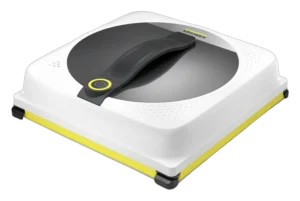
Original production ended circa 2021; units are primarily available as refurbished stock or used inventory. Ecovacs has taken the product page down and manufacturer support for the model is limited.

Cite / Embed

Reference the Ecovacs Winbot 920 classification.

Embed the Autonomy Ladder™ mark or copy the citation. The mark is served from this record, so a reassessment updates it on your page automatically.

Get the embed code and citation
124161
268112
Clear space 3222 on all sides
Embed code

Scale proportionally only, up to 2× (536px wide)(224px wide). No recolouring, cropping, rotating, or re-typesetting.

Citation

Robovations. "Ecovacs Winbot 920: Autonomy Level II (Assisted Autonomy)." Autonomy Ladder™, assessed August 2026. https://robovations.com/robots/ecovacs-winbot-920/

  • Link it. The mark must point at this record. An unlinked mark is not authorised.
  • Hot-link it. Never download, self-host, or re-upload the image. A saved copy stops updating, and a mark that has stopped updating is a claim we no longer stand behind.
  • A classification, not an endorsement. It may not appear beside language implying Robovations recommends, rates, or approves the product.
Where to next

Three ways to keep going.

For browsers

See every Level II.

Every robot we’ve classified at assisted autonomy. Sorted by readiness, score, and price. Filter by category, manufacturer, or release date.

Updated weekly with new entries and reclassifications.