
Deep Robotics X30
General-purpose industrial quadruped for patrol, inspection, and hazardous-environment operations. IP67 sealing tolerates substation spray and dust. Deep Robotics sells it for unattended autonomous patrol: it navigates on fused LiDAR, depth, infrared and RGB perception including in total darkness, and with the X30 Pro Dock it returns and recharges without anyone handling it.
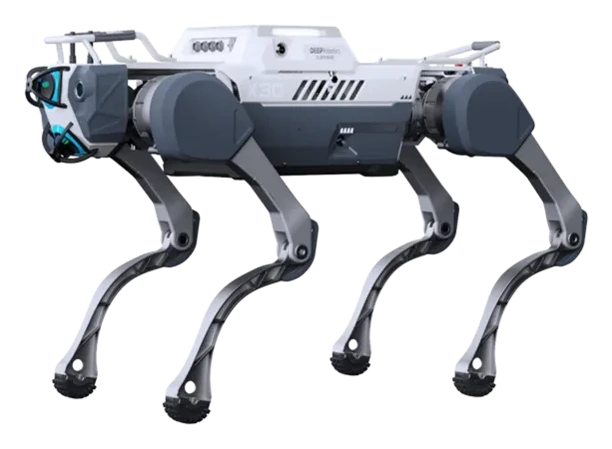
Will the Deep Robotics X30 fit your application?
Describe your use case using the controls. Each choice reads the spec sheet for you, flagging where the Deep Robotics X30 is built for your space and where it isn’t.
A classification of fit for the conditions you set, not a recommendation. Verdicts describe engineering design intent, not test results.
The full spec sheet.
Manufacturer-published figures, measured against every specialty robot we track.
- Footprint
- 18.5 × 39.4 in · 27.4 in tall•
- Weight
- 123.5 lbs•
- Network
- Cellular
- Max speed
- 8.9 mph•
- Degrees of Freedom
- 12•
Fused LiDAR, depth camera, infrared and RGB perception; autonomous navigation including in total darkness and under glare. Teleoperation available.
Position shows where the figure sits across the tracked category, not a quality judgment.
How the assessment has moved.
Every announcement, release and reassessment behind the current classification.
-
Aug 2026 · AssessmentPre-Release Assessment revised 61 → 75
-
Aug 2026 · AssessmentAutonomy Ladder reclassified II → III
-
Jul 2026 · AssessmentPre-Release Assessment recorded at 61 of 100
-
Oct 2023 · ReleaseLaunched for IP67 industrial inspection in October 2023
How Deep Robotics X30 compares.
What people actually ask.
ComparisonCan the Deep Robotics X30 climb stairs steeper than 45 degrees?
OperationHow does the IP67 rating hold up to substation water spray and wet tunnel environments?
OperationWhat camera payloads are compatible, and how much does multispectral gear affect speed?
OperationHow long can the X30 operate before returning for battery service?
 III
III
Whisker Litter-Robot EVO
 III
III
Labrador Systems Retriever
 III
III
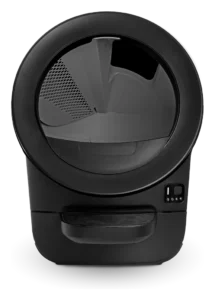
Whisker Litter-Robot 5 Pro
 III
III
Piaggio gitaplus
Reference the Deep Robotics X30 classification.
Embed the Autonomy Ladder™ mark or copy the citation. The mark is served from this record, so a reassessment updates it on your page automatically.
Get the embed code and citation
Scale proportionally only, up to 2× (536px wide)(224px wide). No recolouring, cropping, rotating, or re-typesetting.
Robovations. "Deep Robotics X30: Autonomy Level III (Conditional Autonomy)." Autonomy Ladder™, assessed August 2026. https://robovations.com/robots/deep-robotics-x30/
- Link it. The mark must point at this record. An unlinked mark is not authorised.
- Hot-link it. Never download, self-host, or re-upload the image. A saved copy stops updating, and a mark that has stopped updating is a claim we no longer stand behind.
- A classification, not an endorsement. It may not appear beside language implying Robovations recommends, rates, or approves the product.