Investigation
Are humanoid robot demos teleoperated or actually autonomous?
Usually teleoperated or human-supervised at some level. Most major demos from Tesla, Figure, and 1X involve a human in the loop, whether direct VR control, scripted behavior with oversight, or expert fallback. Teleoperation caps a system at Assisted Autonomy regardless of how fluid the motion looks.
On this page6 sections
A humanoid robot walks across a kitchen, opens a cabinet, retrieves a mug, and sets it on the counter. The clip is shared widely. The caption reads autonomous. Very often a person wearing a VR headset is doing the hard part.
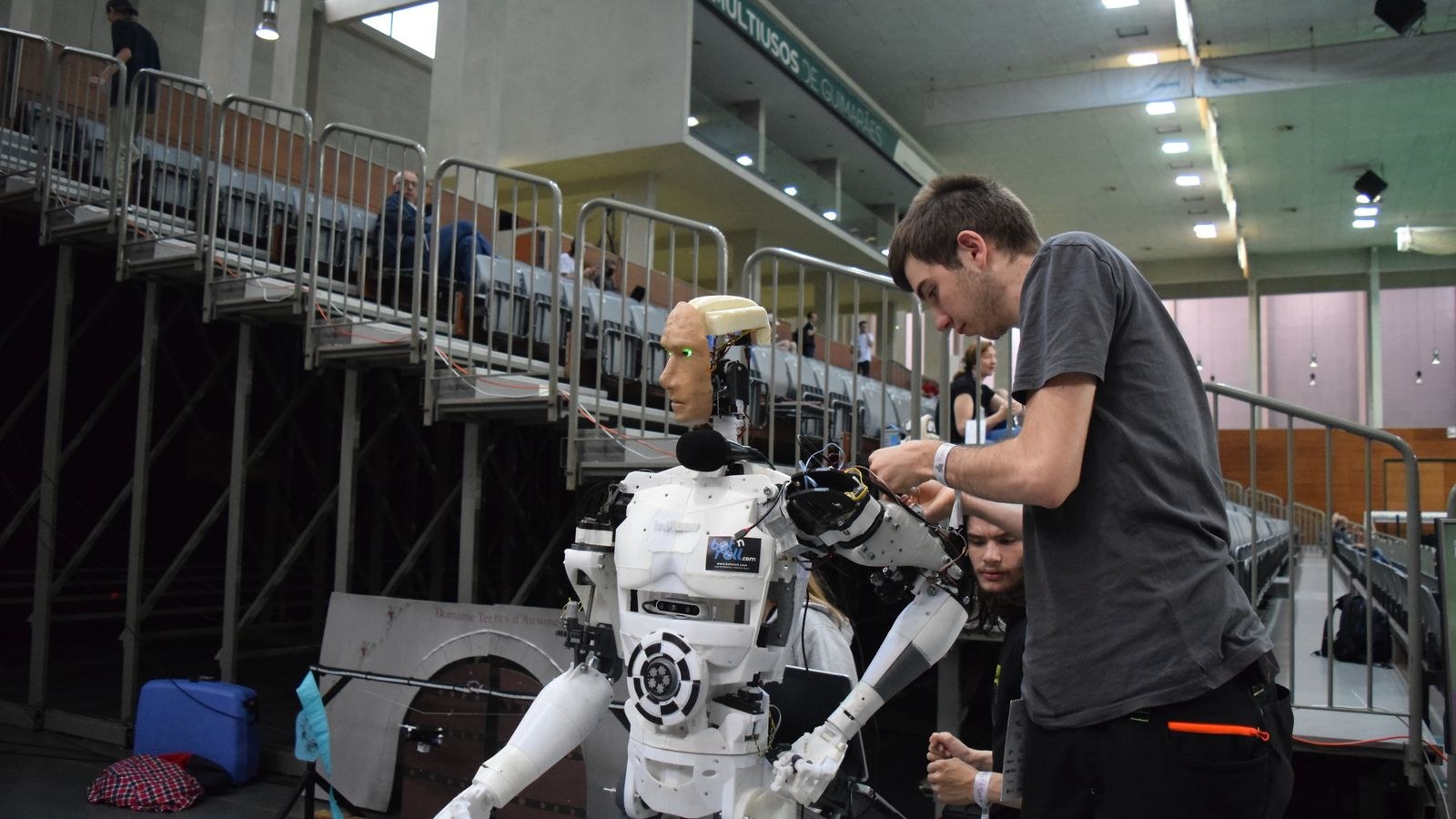
Teleoperation is the quiet center of gravity in humanoid robotics in 2026. Nearly every public demo from Tesla Optimus, Figure 02, 1X NEO, Apptronik Apollo, and Agility Digit involves a human in the loop at some level. That is not inherently dishonest. The problem is that viewers and many buyers treat the demo as evidence of autonomous capability when the underlying system is not autonomous at all.
Term
TeleoperationA control mode in which a human operator generates the robot’s actions in real time, via direct remote input or motion-capture mirroring. The robot executes the motions; the human produces them. No autonomous decision-making occurs on the robot side.Four typesDirect VR control is a pilot in a headset
Direct VR control means a pilot wears a headset and tracking gloves and the robot mirrors them in real time. Every motion is human-generated: the robot is a remote-controlled puppet. Supervised autonomy means the robot performs scripted or learned behavior while a human watches and can intervene. Training-data capture means the pilot teleoperates to generate demonstration datasets for later autonomous training.
Expert-pilot fallback is a fourth mode: the robot runs autonomously most of the time, but a remote operator steps in for novel situations. This is closer to a help-desk escalation than to autonomy. Each mode has different implications for the Autonomy Ladder, and Robovations does not treat them as interchangeable.
Figure
Why teleop caps a robot at Level II
- The linkEvery decision travels out of the machine and back over this. Latency, a dropped connection and an operator looking elsewhere are all failures of the task, and none of them are faults in the machine. A machine run this way caps at Level II.
- The operatorThe person at the console generates the action sequence. The machine is the actuator.
- Closed on boardThe same loop, entirely inside the machine. Nothing off-board has to be working for it to keep going, which is what makes it eligible for Level III.
The LadderThe Ladder caps teleoperated robots at Level I
The Autonomy Ladder measures what the robot does on its own. Level I, Manual Automation, covers any system where a human generates the action sequence. Direct VR teleoperation falls in this tier regardless of how impressive the resulting motion looks. The robot is a sophisticated mechanical extension of the human, not an autonomous agent.
Level II, Assisted Autonomy, applies where the robot executes a scripted or learned behavior in a controlled environment without human action generation, but with human supervision. Most published end-to-end humanoid demos from 2024 to 2026 land here, including Figure’s BMW manufacturing footage and 1X NEO’s household scenarios.
Level III, Conditional Autonomy, requires end-to-end task completion without teleoperation in conditions that match the robot’s training distribution. The robot must handle perception, planning, and execution while recovering from minor variations. As of early 2026, no consumer-facing humanoid meets this threshold consistently across novel environments.
Humanoid demo clips involving teleoperation or human fallback
70-80%
Across third-party analysis of major humanoid demo clips published between 2023 and early 2026, an estimated 70 to 80 percent involved teleoperation or supervised human fallback at some stage, based on manufacturer disclosures and contemporaneous press reporting.
Five questionsReading humanoid demos critically
The most useful question to ask of any humanoid demo is what was end-to-end and what was edited or assisted. Was a human teleoperating the robot during the demo? If autonomous, how many takes produced the clip? What is the success rate across attempts? Was the environment a working setting or a controlled stage?
Demonstrations rarely include this information voluntarily. When a manufacturer publishes a clip without a success rate, an environment description, or a take count, the conservative interpretation is that conditions favored the robot. The robots generating the most impressive demo footage are also the hardest to assess from the outside.
Disclosure gapDisclosure varies sharply across manufacturers
1X has been public about the role of teleoperation in its platform. The company has stated that NEO Beta and Gamma include both autonomous and teleoperated modes, and that human pilots can take over for tasks the robot cannot complete alone. The household subscription model explicitly contemplates expert-pilot fallback.
“NEO is designed to operate autonomously for familiar tasks and to request assistance from a remote operator when it encounters situations outside its trained distribution. The operator completes the task, and that interaction becomes a training example for future autonomous behavior.”
Reported by 1X Technologies, NEO product documentation
Other manufacturers have been less transparent. Tesla’s We, Robot event in October 2024 featured Optimus units that, according to subsequent reporting, were teleoperated for portions of the demonstration without disclosure on stage. Figure has shown end-to-end autonomous behavior in its BMW pilot, but consumer-facing clips often leave teleoperation status unclear.
Signal shiftTeleoperation is the standard way to collect data
Teleoperation is not always a problem. It is the standard data-collection mechanism for behavior cloning and imitation learning. Foundation models like RT-2, OpenVLA, and Figure’s Helix are trained substantially on teleoperated demonstrations. The field expects autonomous behavior to emerge from those datasets over time.
The shift from teleoperated demo to autonomous behavior is gradual. A robot that is teleoperated in 2026 may run a comparable behavior autonomously in 2027 or 2028. Robovations classifies what the robot does today, not what its training pipeline projects. The cleaner signal that a humanoid has crossed a Ladder threshold is documented end-to-end task completion in conditions the robot was not specifically prepared for.
For nowThe Ladder is not a verdict on usefulness
The Autonomy Ladder is not a verdict on whether humanoid robots are useful or whether the trajectory is real. It is a description of where they are right now. Classifying teleoperation accurately is the only way the classification framework keeps its meaning. A humanoid that requires a pilot is a tool of the pilot, not an autonomous robot.
The marketing language does not reliably distinguish among manual, supervised, and conditional autonomy. The Ladder does. Until evidence supports a higher classification, the conservative position is also the accurate one.
A teleoperated humanoid is an impressive tool. It is not yet an autonomous robot, and that distinction is what makes the classification framework worth having.
Robovations tracker
What has actually changed
5 recorded updates for Apptronik Apollo
- Google DeepMind demonstrates Gemini Robotics 2 whole-body autonomy on Apptronik Apollo
Google DeepMind released Gemini Robotics 2, a vision-language-action model suite built for whole-body control, dexterity and multi-robot coordination, and demonstrated it running on Apptronik's Apollo humanoid. The robot walked, crouched and bent under model-driven control while completing a multi-step retrieval task from a single spoken instruction. Watch for independent verification of task success rates and whether this control stack ships outside demo settings.
Major advance - Apptronik Closes $350 Million Series A to Scale Apollo Production
Apptronik raised approximately $350 million in a Series A round in early 2025, the largest capital event in the company's history. The round positions the company to move Apollo from demonstration-phase hardware toward commercial pilot manufacturing. Watch whether production timelines and unit volumes are disclosed in subsequent partner announcements.
Major advance - Google DeepMind Partners with Apptronik to Advance Apollo AI Stack
Google DeepMind disclosed a research partnership with Apptronik aimed at applying DeepMind's robotics AI work to the Apollo platform. The collaboration targets task-learning and generalization, areas where Apollo's current teleoperation dependency represents the primary constraint on autonomy classification. Watch whether the partnership produces documented autonomous task performance that reduces reliance on teleoperator input.
Major advance - Mercedes-Benz Expands Apollo Pilot to Additional Manufacturing Sites
Apptronik and Mercedes-Benz disclosed expansion of their Apollo manufacturing pilot to additional sites following the initial deployment reported in late 2023. The expansion indicates the original pilot met continuation criteria, though performance metrics and task scope details were not publicly released. Watch whether Mercedes-Benz publishes task throughput comparisons or announces permanent integration timelines.
Major advance - Apollo Enters GXO Logistics Pilot for Warehouse Task Deployment
Apptronik disclosed a pilot agreement with GXO Logistics to deploy Apollo in warehouse settings, representing the first named commercial partner deployment for the platform. The pilot focuses on materials handling and pick-and-place tasks in a supervised logistics environment. Watch whether GXO publishes performance metrics, throughput comparisons, or autonomous operation time as the pilot matures.
Major advance