Analysis
Are robot mowers more autonomous than robot vacuums?
Yes. RTK-guided lawn mowers reach Level IV, a full rung above flagship vacuums at Level III. Mowers use centimeter-accurate positioning to handle unmapped lawns and changing conditions immediately, while vacuums still depend on learned maps. Neither is fully hands-off; mowers still need help with tall grass and debris.
The robot vacuum mapping your living room with LiDAR and avoiding pet waste with neural-network classifiers feels more sophisticated than the lawn robot rumbling through the back yard. The Autonomy Ladder™ disagrees. Premium lawn robots classify higher than any consumer vacuum in 2026, and the gap is wider than marketing on either side suggests.
This piece works through why. The short version: positioning is destiny. The longer version clarifies what the Ladder is measuring in the first place.
The ceiling most owners never noticeWhy most robot vacuums cap at Level III
The Autonomy Ladder™ treats environmental dependency as the central limit on autonomy. A robot that operates only in environments it has previously mapped, and depends on those maps to function, classifies at Level III (Conditional Autonomy) at best. Move it to a new home and it needs a learning run before operating fluently.
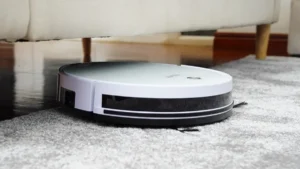
Vacuum flagships, including the Roborock S8 MaxV Ultra, Dreame X50 Ultra, and iRobot Roomba Combo J9+, all share this dependency. Their LiDAR or visual SLAM stacks are excellent within a learned map. Outside that map, they degrade.
The OmniGrip arm adds capability inside the existing envelope. It does not widen the envelope. The Ladder treats added capability inside an unchanged envelope as a strengthening of L3, not a step toward L4.
Owner reports document the boundary in everyday terms: persistent confusion after a dining table is moved, repeated failures on dark threshold strips, returns to dock that abort halfway. None are catastrophic. All require occasional human intervention, which is what holds the classification at L3.
A different positioning principleHow RTK lawn mowers cross into Level IV
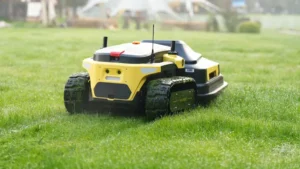
Premium RTK-equipped lawn robots, including the Husqvarna Automower 450X NERA, the Mammotion Luba 3 AWD 5000, and the Segway Navimow X4, operate on a fundamentally different principle. RTK GNSS provides centimeter-accurate absolute coordinates. The mower does not need to learn a map; the boundary is defined in real-world coordinates.
That distinction matters because the mower can handle a lawn it has never seen on its first run. Set the virtual boundary, drop the mower in, and it operates immediately. Bring it to a different lawn and the same unit handles that lawn after a fresh boundary setup.
Weather changes, grass height varies week to week, and sections of the yard fall in or out of useful operating condition. The robot manages the variability without re-learning. That is what Level IV (Environmental Autonomy) requires: reliable operation across novel environments within a defined task envelope.
The mower mows. It does not also edge or weed. The task is bounded. Within that bound, it generalizes. That combination, bounded task plus genuine generalization, is the definition of L4.
Measuring contrast across categoriesMowers and vacuums on the same scale
Plotting both categories together makes the gap visible. RTK mowers cluster at Level IV while vacuum flagships cluster at Level III, with no crossover in either direction among current consumer products. The separation is not marginal; it is a full rung on the Ladder.
Robovations database · 10 active products
Where each robot lands on price and autonomy
The chart is useful because it separates the autonomy question from the marketing question. Vacuum pages emphasize obstacle-avoidance AI; mower pages emphasize coverage hours. Neither set of claims is what the Ladder measures. What it measures is visible once both categories share a frame.
Why the gap stays hiddenThe visibility gap
Part of why this gap is invisible is that vacuums are watched and mowers are not. A vacuum runs in your living room for an hour while you read. Every collision, hesitation, and stuck-on-a-rug moment is observed. A premium RTK mower runs for hours in the back yard while you do something else entirely.
Manufacturer marketing reinforces the bias. Vacuum companies have spent years emphasizing visible AI features: pet detection, obstacle classification, room recognition. Lawn robot companies emphasize coverage and reliability, partly because the underlying autonomy is mature enough to take for granted.
The robot learns your home over time, building a map to understand each room and how they connect.
iRobot, Roomba Product Documentation
That framing, a robot that learns your home, makes L3 dependency sound like a premium feature. For the vacuum, it is. For a comparison with RTK mowers, it marks the exact constraint that separates the two tiers. The Ladder does not reward visibility. That is a feature, not an oversight.
Capability has a ceiling here tooWhat Level IV lawn mowers still cannot do
The L4 classification is a description, not an endorsement. Lawn robots have specific limitations worth understanding. Tall grass after a two-week vacation is a common failure point. Many models refuse or struggle once grass exceeds a height threshold, requiring manual intervention before the mower will run again.
Storm cleanup is on the owner. The mower will hit, fail, or navigate around fallen branches depending on size and what obstacle detection can resolve. Pets and children introduce variability the detection systems handle imperfectly; supervised operation is recommended during high-traffic moments.
Steep slopes, narrow gates, irregular flower beds, and complex zoning all require thoughtful boundary setup. Winterization, blade replacement, RTK base-station maintenance, and firmware updates remain owner responsibilities throughout the product life cycle.
L4 means the robot handles within-task variability autonomously. It does not mean the robot is finished or the lawn equivalent of a self-driving car. The classification makes no such claim.
The robot doing more autonomous work on any given afternoon may well be the one you cannot see from your window.