How much maintenance does an automatic litter box need, and are they safe for cats?
A self-cleaning box ends the daily scoop. What it still asks every week, and what keeps a cat clear of the mechanism, is less advertised.
On this page3 sections
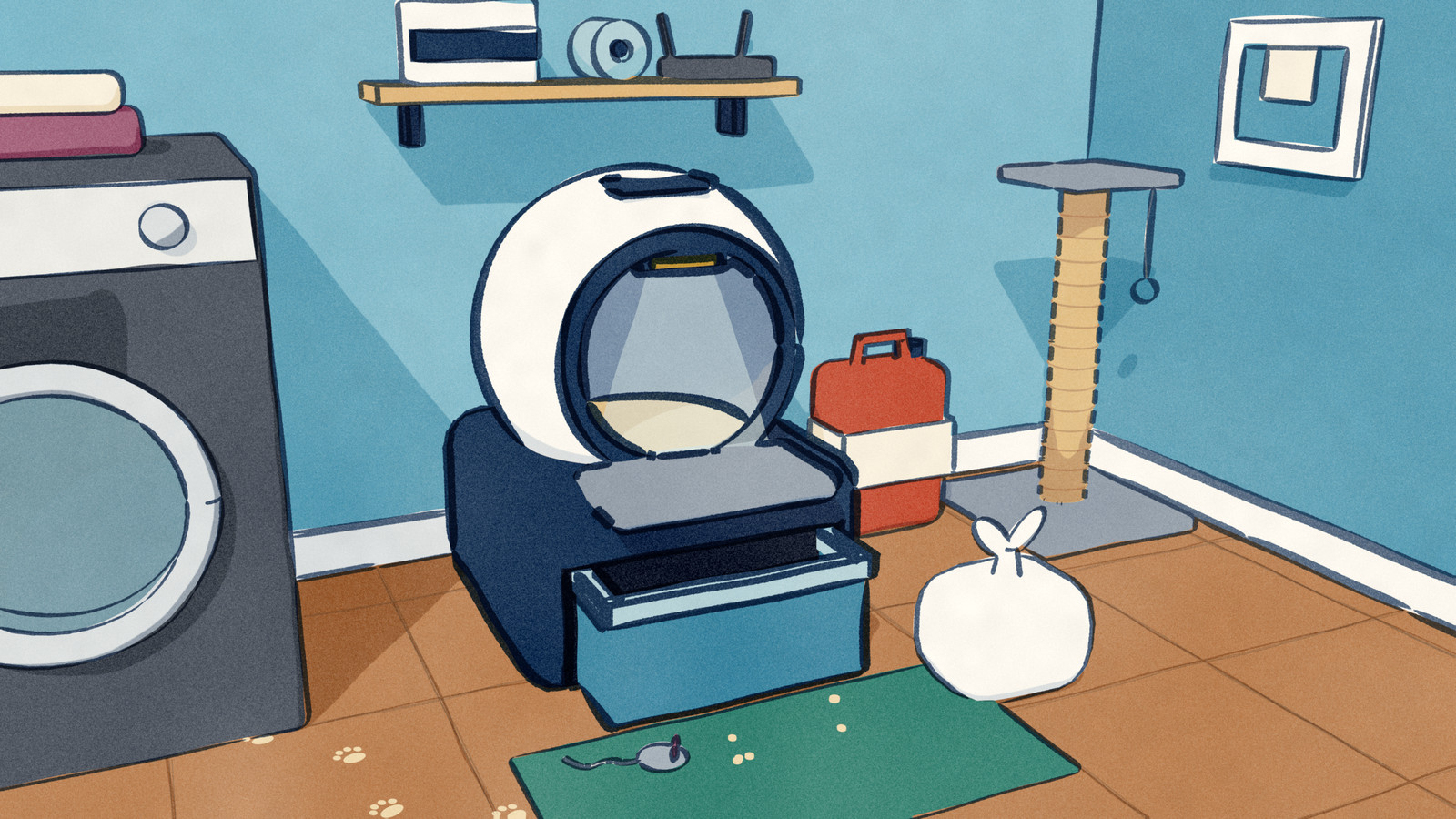
An automatic litter box makes one promise: you stop scooping. After the cat leaves, a globe rotates or a rake combs the litter, the clumps fall through a screen, and the waste drops into a drawer or a sealed bag beneath the unit. The next morning there is nothing to lift.
Automation moves the work. It does not end it. Two questions sit under the pitch, and neither is printed on the box: what the machine still asks of you every week and every month, and what keeps a cat out of the mechanism while it turns. The seven units here, listed from about $550 to $900, answer both differently.
Fully automatic still means someone empties the receptacle, tops up the litter, and changes an odor filter. Where the waste goes is the first split.
The Litter-Robot 4, Litter-Robot 5 and Litter-Robot EVO drop clumps into a lined open drawer. The Litter-Robot 5 Pro and Neakasa M1 Plus seal them into a bag. The PetKit Purobot Max Pro 2 lines an 8-liter bin, and the CatLink Scooper Pro Ultra uses a 13-liter drawer.
How often you empty it depends on the cats. Whisker lists roughly every 10 days for one cat on the Litter-Robot 5, down to every other day for four cats on the 4. Others publish nothing at all: PetKit gives no emptying interval for its bin, and CatLink none for its drawer. That silence is itself worth weighing, because it leaves the schedule to be discovered rather than planned.
The subscriptions, and what still runs without them
Whisker sells an optional plan, Whisker+, at $7.99 a month or $79.90 a year after a 30-day trial. It buys longer activity history and unlimited video streaming; without it, live streaming is capped at about five minutes a day. The core jobs stay free. The box still sifts, and SmartScale weight tracking is still included.
PetKit runs a 30-day free video-history trial on its Care+ plan, after which video playback needs a paid renewal. The plan’s own description page carries no US price, so what the renewal costs an American owner is not something the maker publishes plainly.
It runs on your WiFi, and some of it stops without it
The connection is ordinary home WiFi, and often only the slower band. The Litter-Robot 4 support page states the unit requires a 2.4 GHz signal and does not support 5 GHz. The sifting is mechanical, so it keeps running if the network drops. The monitoring does not.
PetKit’s video playback, CatLink’s health tracking and multi-cat recognition, and the Pro models’ remote alerts and camera streaming all need the connection to work.
How it knows a cat is inside

Detection is the safety system. Most units combine two kinds of sensor: load cells in the base that read the weight in the chamber, and infrared beams across the opening that register a body. Some newer designs add millimeter-wave radar that senses motion and even breathing.
The Litter-Robot 4 uses laser and weight sensors to tell when a cat enters and leaves the globe. As long as a sensor reads a cat, the cycle should not start.
Kittens should never use automatic litter boxes. They are too small and often do not weigh enough to activate the sensors that would stop the litter boxes mid-cycle.
That is where the sensing can fail. A weight sensor has a threshold, and a cat under about two pounds may not trip it, which is why the safer designs pair weight with infrared or radar rather than trusting one reading. A single sensor set too high is not a safeguard for the smallest animal in the house.
The reports that reach the news are about a different class of machine. A safety-focused report documented at least four cat deaths tied to cheap automatic boxes, among them a rotating-globe unit, Amztoy, sold as a low-cost imitation of the name brands.
A hardware teardown described generic, often rebranded single-opening boxes sold through online marketplaces whose inner chamber rises whether or not a cat is poking through the opening, with the safety sensors switched on only by a firmware update an owner may never install.
No CPSC recall of an automatic litter box turns up for 2023 through 2026. The worst-implicated model was pulled from a marketplace through a private settlement, with no regulatory order behind it. So the checking falls to the buyer.
The design features that track with the risk in the reporting are a single point of entry with no bypass, a chamber that can move while a cat is still inside, and weight-only sensing set too high for a small cat. A box that reads weight alongside infrared or radar, and halts the moment either one detects a cat, is doing what the dangerous units did not.
Automation does not erase the work or the risk. It trades the daily scoop for a drawer to empty on a schedule, a filter to reorder, and a subscription prompt. And it trades a covered pan for a mechanism that keeps a cat safe only as long as a sensor reads the cat is there. The smallest cat in the house decides whether that last part holds.