Skip to content
Saved
Comparison · 2 robots

Roborock Qrevo MaxV · Shark PowerDetect UV Reveal

All robot vacuums. Every measure below is plotted against the full class, so a difference can be read against how much the class itself varies.

  1. Roborock Qrevo MaxV
  2. Shark PowerDetect UV Reveal
Roborock

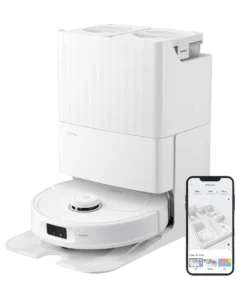
Roborock Qrevo MaxV

Autonomy
III Conditional Autonomy
Score
85/100 Exemplary
Readiness
Ready Now
Price
$1,399.99list
Shark

Shark PowerDetect UV Reveal

Autonomy
III Conditional Autonomy
Score
58/100 Capable
Readiness
Promising Progress
Price
$849.99confirmed

Up to three

01 Classification

What each one does on its own.

The Autonomy Ladder is the same five rungs for every robot on the site. A rung describes the conditions a robot handles without you, not how good it is.

V
Generalized
Any task, any setting
IV
Environmental
Handles new obstacles without help
III
Conditional
Finishes familiar jobs on its own
Roborock Qrevo MaxVShark PowerDetect UV Reveal
II
Assisted
Runs preset routines, needs rescue
I
Manual
One action, on command
02 Assessment

Where they actually differ.

The Robovations Score is nine inputs across three pillars, each weighted as shown and each scored so that more is better. A robot can lead on one and trail on another, which is the point of showing them apart. Cost of ownership and data handling are reported on each robot's own page and are never averaged into the score.

Capability

Task completion16% of score
Does it finish the job it is sold to do, unattended
  • Roborock Qrevo MaxV97
  • Shark PowerDetect UV Reveal55
18median 72 across 354 scored robots100
Coverage and navigation10% of score
Does it work the whole area, and hold that between runs
  • Roborock Qrevo MaxV75
  • Shark PowerDetect UV Reveal88
15median 70 across 344 scored robots100
Edge-case recovery10% of score
Does it recover from the failures its category presents
  • Roborock Qrevo MaxV84
  • Shark PowerDetect UV Reveal52
18median 50 across 261 scored robots100
Operating envelope4% of score
How far conditions can vary before performance drops
  • Roborock Qrevo MaxV76
  • Shark PowerDetect UV Reveal80
25median 70 across 320 scored robots100

Dependability

Field failure rate16% of score
Documented hardware failures per owner-year
  • Roborock Qrevo MaxV88
  • Shark PowerDetect UV Reveal29
6median 70 across 344 scored robots100
Software stability14% of score
Whether updates fix more than they break
  • Roborock Qrevo MaxV74
  • Shark PowerDetect UV Reveal82
15median 65 across 275 scored robots100
Support longevity10% of score
Committed parts, service and updates, with dates
  • Roborock Qrevo MaxV85
  • Shark PowerDetect UV Reveal58
0median 63 across 354 scored robots100

Ownership burden

Routine maintenance12% of score
Hands-on time it asks for in normal operation
  • Roborock Qrevo MaxV97
  • Shark PowerDetect UV Reveal87
22median 68 across 355 scored robots100
Consumables8% of score
Parts that must be bought to keep it working
  • Roborock Qrevo MaxV71
  • Shark PowerDetect UV Reveal66
30median 69 across 354 scored robots100
03 Measured against the class

How far apart is a long way?

A number only means something next to the spread it sits in. Each track below is the real range across every classified robot in the class, with the median marked.

Price193 with a published figure
  • Roborock Qrevo MaxV$1,399.99
  • Shark PowerDetect UV Reveal$849.99
$129.99median $699.99$1,799
Runtime168 with a published figure
  • Roborock Qrevo MaxV180 min
  • Shark PowerDetect UV Reveal180 min
60 minmedian 180 min360 min
Charge time150 with a published figure
  • Roborock Qrevo MaxV240 min
  • Shark PowerDetect UV Reveal240 min
90 minmedian 240 min420 min
Weight171 with a published figure
  • Roborock Qrevo MaxV9.9 lbs
  • Shark PowerDetect UV Reveal4.4 lbs
3.3 lbsmedian 8.2 lbs36.4 lbs
Height189 with a published figure
  • Roborock Qrevo MaxV4 in
  • Shark PowerDetect UV Reveal17.5 in
2.6 inmedian 3.8 in21.4 in

Not compared, because fewer than two of these robots carry a published figure: Suction, Noise.

04 Ownership

What the numbers leave out.

The trade-off

What each design gives up to be good at what it is good at.

Roborock Qrevo MaxV

The FlexiArm extends the mop to the wall edge; it moves nothing. Homes with floor-level obstacle scatter still require a pre-run tidying pass or accepted avoidance routing.

7,000 Pa suction: competitive at launch in early 2024, now below the 10,000-plus Pa ratings of 2025-generation flagships. Cleaning ability in open hard-floor spaces holds up; the gap shows on carpeted zones with heavier debris.

Shark PowerDetect UV Reveal

UV Stain Detect paired with HyperSonic scrubbing at 100 cycles per minute makes dried residue this machine’s strongest result, but Shark ships the capability only in the $1,299 robot-and-base package.

UV Stain Detect works on the first pass, including in a home the robot has never mapped, but confirming a stain is gone means a verification pass back over the same ground, so heavily soiled floors take longer to finish.

Who each one is wrong for

Stated by the record itself. A robot being wrong for a household is a fact about fit, not a fault.

Roborock Qrevo MaxV
Homes dominated by high-pile or shag carpet
The 10 mm mop lift clears standard and low-pile carpet; owner reports (2024-2026) describe coverage inconsistency on high-pile and shag. Suction performance is rated at 7,000 Pa, which is moderate by 2024 flagship standards.
Privacy-sensitive owners uncomfortable with onboard camera
The RGB camera operates during cleaning sessions to classify obstacles. Roborock documents on-device processing, but the hardware is present and active. Owners who prefer camera-free units have other Level III options without onboard imaging.
Compact apartments under 800 sqft with minimal clutter
The full dock suite occupies meaningful floor space. LiDAR mapping and FlexiArm edge coverage deliver diminishing return in small, open-plan spaces where a lighter setup achieves similar results at lower cost.
Buyers who do not need the full dock suite
Roborock lists the Qrevo MaxV at $1,399.99 and has sold it well below that. At list price, the Dock 2.0 and FlexiArm mopping are what the money buys. Buyers who do not need hot-water mop washing or edge mopping will find comparable LiDAR navigation in less expensive configurations.
Shark PowerDetect UV Reveal
Owners with primarily carpeted homes
Retractable mop reduces carpet performance vs. dedicated mop. Mop pad material and lift mechanism not yet independently tested on thick pile.
Apartment dwellers or frequent movers
Base setup and remapping add friction for relocating homes. The base needs a power outlet and clear floor space wherever it lands.
Budget-conscious buyers under $700
Flagship pricing targets premium segment. Non-UV robotics in the $500-700 range offer comparable navigation without UV innovation.

What stays your job

The upkeep ownership hands back to you, whatever the autonomy level says.

Roborock Qrevo MaxV
  • After every use: Confirm dock auto-empty cycle completed; check app for obstacle alerts or skipped zones.
  • Weekly: Inspect side brush for hair tangles; clear brush guard if debris has accumulated.
  • Monthly: Rinse dock wash tray and inlet to prevent mop-pad odor buildup.
  • Every 3-6 months: Replace HEPA filter (roughly $15-25 per filter); inspect mop pads and swap if worn.
  • Every 3-6 months: Clean LiDAR sensor window and camera lens with a dry cloth; check FlexiArm mop attachment for wear.
  • Annually: Inspect dock water reservoir seal and drainage path; verify dock electrical connections are dry.
  • As needed: Refill dock water reservoir when app alerts low level; update firmware via Roborock app when available.
Shark PowerDetect UV Reveal
  • After every run (automatic): The base washes the mop pad with 185F water, heat-dries it at 175F, and empties the robot’s bin into a bagless bay. No manual pad rinsing is required.
  • Weekly: Refill the base’s clean water tank and empty the dirty tank; cadence tracks how much mopping is scheduled.
  • Monthly: Replace or deep-clean the main filter; check brush bristles for pet hair wrap.
  • Every 3-6 months: Replace mop pads.
  • As needed: Empty the base’s bagless debris bay; inspect base electrical contacts for corrosion or standing water.
05 Evidence

How much each of these is standing on.

Classifications rest on different depths of evidence. A pre-release assessment and a verified one are not the same kind of claim.

Evidence behind each classification
Robot Evidence status Sources reviewed Last assessed
Roborock Qrevo MaxV Verified 6 Aug 2026
Shark PowerDetect UV Reveal Provisional 4 Aug 2026

Robovations classifies robots; it does not rank them. Nothing on this page is a recommendation, and no manufacturer influences a classification or its placement here.