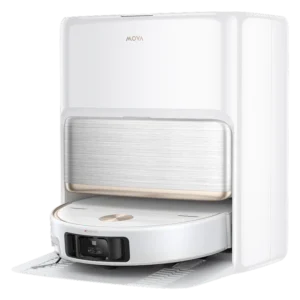
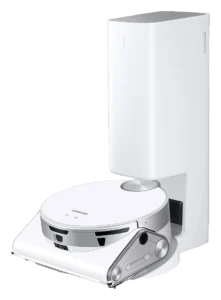
MOVA V70 Ultra Complete · Samsung Jet Bot AI+
All robot vacuums. Every measure below is plotted against the full class, so a difference can be read against how much the class itself varies.
- MOVA V70 Ultra Complete
- Samsung Jet Bot AI+


Samsung Jet Bot AI+
- Autonomy
- IIIConditional Autonomy
- Score
- 68/100 Capable
- Readiness
- Not assessed
- Price
- $1,299list
Up to three
What each one does on its own.
The Autonomy Ladder is the same five rungs for every robot on the site. A rung describes the conditions a robot handles without you, not how good it is.
Where they actually differ.
The Robovations Score is nine inputs across three pillars, each weighted as shown and each scored so that more is better. A robot can lead on one and trail on another, which is the point of showing them apart. Cost of ownership and data handling are reported on each robot's own page and are never averaged into the score.
Capability
- MOVA V70 Ultra Complete82
- Samsung Jet Bot AI+68
- MOVA V70 Ultra Complete78
- Samsung Jet Bot AI+72
- MOVA V70 Ultra Complete55
- Samsung Jet Bot AI+65
- MOVA V70 Ultra Complete75
- Samsung Jet Bot AI+65
Dependability
- MOVA V70 Ultra Complete70
- Samsung Jet Bot AI+70
- MOVA V70 Ultra Complete65
- Samsung Jet Bot AI+74
- MOVA V70 Ultra Complete60
- Samsung Jet Bot AI+52
Ownership burden
- MOVA V70 Ultra Complete86
- Samsung Jet Bot AI+68
- MOVA V70 Ultra Complete74
- Samsung Jet Bot AI+71
How far apart is a long way?
A number only means something next to the spread it sits in. Each track below is the real range across every classified robot in the class, with the median marked.
- MOVA V70 Ultra Complete$1,299
- Samsung Jet Bot AI+$1,299
- MOVA V70 Ultra Complete3.5 in
- Samsung Jet Bot AI+3.9 in
Not compared, because fewer than two of these robots carry a published figure: Suction, Runtime, Charge time, Noise, Weight.
What the numbers leave out.
The trade-off
What each design gives up to be good at what it is good at.
Reaching arms clean what a round robot circles around, and they add two more moving mechanisms to keep working.
Bagless emptying saves the cost of bags; the price is a loud empty cycle that Gear Diary flagged.
The camera that gives the machine its object recognition is the same camera that gives it a live patrol stream: navigation capability and an in-home surveillance surface arrive on one piece of hardware.
Cloud-based SmartThings scheduling and geofencing enable autonomous routines versus WiFi dependency that blocks fallback to local-only operation.
Who each one is wrong for
Stated by the record itself. A robot being wrong for a household is a fact about fit, not a fault.
- Households sensitive to a loud dock
- Gear Diary found the auto-empty cycle loud, though short.
- Floors with grout lines and dried residue in joints
- Basic Tutorials found dried residue in floor joints needed multiple passes, even though open-surface coffee stains cleared in one.
- Homes with low desk bases and platform furniture
- Basic Tutorials saw obstacle detection that was mostly reliable but once tried to climb a desk base.
- Buyers who want a camera-free robot
- The MOVA app includes remote camera viewing, per Basic Tutorials, so the robot carries a camera through the home.
- Homes without reliable WiFi
- Cloud-dependent SmartThings integration and geofencing fail in low-signal areas, reducing autonomy to manual start-and-monitor behavior.
- Households unwilling to have a steerable camera indoors
- The Jet Live stream is optional, but the camera it uses is also the object-recognition sensor and cannot be removed or blanked without disabling obstacle avoidance.
- Obstacle-sparse, minimalist layouts
- Complex AI object recognition provides limited advantage in bare rooms where basic gyro mapping achieves equivalent coverage at lower cost and maintenance.
- Multi-level homes with frequent layout changes
- LiDAR maps static environments; frequent furniture rearrangement and no-go zone edits require manual app intervention and map retraining.
What stays your job
The upkeep ownership hands back to you, whatever the autonomy level says.
- Weekly: Refill the 4 L clean-water tank and empty the 3.5 L dirty-water tank; Gear Diary got at least three mopping sessions per fill.
- Every 3-6 months: Empty and wash the bagless EcoCyclone dust container, rated for up to 100 days.
- As needed: Refill the two cleaning-solution compartments.
- Monthly: Rinse the dust container filter and wipe the DToF sensor and cliff sensors.
- As needed: Replace mop pads, side brush and main brush as they wear; spares ship in the box.
- After every use: Check dock contact pins for dust buildup to ensure consistent docking alignment and charging.
- Weekly: Remove and detangle brush hair wrap, inspect for cords or debris that impeded the cleaning cycle.
- Monthly: Replace or wash side brush bristles if bent, rinse filter under water and air-dry overnight before reinstalling.
- Every 3-6 months: Update the SmartThings app and robot firmware for object recognition improvements and bug fixes.
- Roughly every 30 emptying cycles: Replace the Clean Station dust bag. The 2.5 L bag is sealed and is replaced, not emptied.
- Annually: Replace main brush only if visible wear reduces suction; inspect the Clean Station air path and dock contacts.
- As needed: Re-establish WiFi connection if geofencing fails, manually adjust no-go zones if furniture rearrangement affects coverage.
How much each of these is standing on.
Classifications rest on different depths of evidence. A pre-release assessment and a verified one are not the same kind of claim.
| Robot | Evidence status | Sources reviewed | Last assessed |
|---|---|---|---|
| MOVA V70 Ultra Complete | Provisional | 7 | Sep 2026 |
| Samsung Jet Bot AI+ | Discontinued | 8 | Sep 2026 |
Add a robot
Comparing across classes is allowed — the page will switch to per-class positioning and tell you it has.