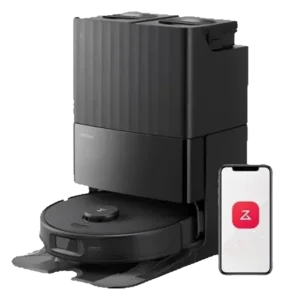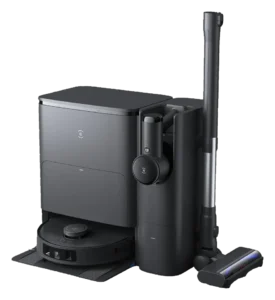
Ecovacs Deebot T30S Pro · Roborock Qrevo Edge S5A
All robot vacuums. Every measure below is plotted against the full class, so a difference can be read against how much the class itself varies.
- Ecovacs Deebot T30S Pro
- Roborock Qrevo Edge S5A
What each one does on its own.
The Autonomy Ladder is the same five rungs for every robot on the site. A rung describes the conditions a robot handles without you, not how good it is.
Where they actually differ.
The Robovations Score is nine inputs across three pillars, each weighted as shown and each scored so that more is better. A robot can lead on one and trail on another, which is the point of showing them apart. Cost of ownership and data handling are reported on each robot's own page and are never averaged into the score.
Capability
- Ecovacs Deebot T30S Pro75
- Roborock Qrevo Edge S5A78
- Ecovacs Deebot T30S Pro70
- Roborock Qrevo Edge S5A75
- Ecovacs Deebot T30S Pro32
- Roborock Qrevo Edge S5A69
- Ecovacs Deebot T30S Pro70
- Roborock Qrevo Edge S5A92
Dependability
- Ecovacs Deebot T30S Pro29
- Roborock Qrevo Edge S5A77
- Ecovacs Deebot T30S Pro82
- Roborock Qrevo Edge S5A92
- Ecovacs Deebot T30S Pro63
- Roborock Qrevo Edge S5A97
Ownership burden
- Ecovacs Deebot T30S Pro81
- Roborock Qrevo Edge S5A100
- Ecovacs Deebot T30S Pro71
- Roborock Qrevo Edge S5A69
How far apart is a long way?
A number only means something next to the spread it sits in. Each track below is the real range across every classified robot in the class, with the median marked.
- Ecovacs Deebot T30S Pro$1,099
- Roborock Qrevo Edge S5A$999.99
- Ecovacs Deebot T30S Pro11,000 Pa
- Roborock Qrevo Edge S5A17,000 Pa
- Ecovacs Deebot T30S Pro263 min
- Roborock Qrevo Edge S5A190 min
- Ecovacs Deebot T30S Pro4.1 in
- Roborock Qrevo Edge S5A3.8 in
Not compared, because fewer than two of these robots carry a published figure: Charge time, Noise, Weight.
What the numbers leave out.
The trade-off
What each design gives up to be good at what it is good at.
Dock self-washes mops but requires active water-tank management; heated cycles consume power and introduce mineral-scale risk absent in air-drying models.
Spinning mops add a dock-dependent subsystem: pads lift 9 mm on carpet detection and wash at the station between runs, so mopping is only as available as the station’s tanks are kept filled and drained.
The Multifunctional Dock 3.0 takes over emptying, washing, drying and refilling, but it is a full-size station that needs a permanent spot near an outlet, and its own clean and waste water tanks are still filled and emptied by hand.
Standard dock requires monthly intervention, yet the robot maps like a $1,200 flagship; capability ceiling is high, but ownership floor is unchanged.
Who each one is wrong for
Stated by the record itself. A robot being wrong for a household is a fact about fit, not a fault.
- Owners avoiding dock maintenance
- Self-washing dock requires regular rinse-cycle operation and tank refill. Mineral deposits in heated-water circuits need seasonal attention.
- Compact apartments under 1,500 sqft needing lowest cost
- MSRP $1,099 positions above entry-tier vacuums. Spinning-mop feature commands premium; simpler models deliver same base cleaning cheaper.
- Homes with no permanent floor space for a full-size station
- The Multifunctional Dock 3.0 holds water tanks, a dust bag and a drying fan. It needs a fixed position on a hard floor next to an outlet and is not a base that gets stowed between runs.
- Owners who want a dock with no disposable consumables
- The station collects into disposable dust bags rated for up to seven weeks. Bags, mop pads and the filter are ongoing purchases rather than washable-forever parts.
- Owners wanting hands-off operation
- Dust runs for weeks unattended and the mop pads are washed and dried automatically, but the station's own clean and waste water tanks are filled and emptied by hand. This is low-touch, not no-touch.
- WiFi-dependent smart-home integrations
- Works over 2.4 GHz Wi-Fi. Homes running 5 GHz-only networks need a separate 2.4 GHz access point for the robot to join and stay connected.
What stays your job
The upkeep ownership hands back to you, whatever the autonomy level says.
- Daily: Empty dust bin if half-full.
- Weekly: Inspect mop pads for debris; rinse dock water tank.
- Monthly: Run dock heating descale cycle; filter replacement if clogged.
- Every 3-6 months: Replace spinning-mop pads (cost pending; estimate $15-30 per set).
- Seasonally: Deep-clean dock heating chamber and valve assemblies.
- Weekly: Check the main brush and side brush for wrapped hair; refill the station’s clean-water tank and empty its waste tank.
- Monthly: Rinse the dust filter and wipe the LiDAR window and cliff sensors with a microfiber cloth.
- Up to every 7 weeks: Replace the dock dust bag when the app reports it full; Roborock rates the bag for up to seven weeks of collection.
- As wear shows: Replace mop pads, filter and brushes. Roborock publishes no fixed interval or price for these parts.
- As needed: Wipe the dock tray if residue builds up between its own hot-water self-clean cycles.
How much each of these is standing on.
Classifications rest on different depths of evidence. A pre-release assessment and a verified one are not the same kind of claim.
| Robot | Evidence status | Sources reviewed | Last assessed |
|---|---|---|---|
| Ecovacs Deebot T30S Pro | Verified | 5 | Aug 2026 |
| Roborock Qrevo Edge S5A | Verified | 6 | Aug 2026 |
Add a robot
Comparing across classes is allowed — the page will switch to per-class positioning and tell you it has.