

Ecovacs
Ecovacs Winbot W2 Omni
- Autonomy
- IIIConditional
- Score
- 68/100Capable
- Readiness
- Not assessed
- Price
- $699list
Ecovacs
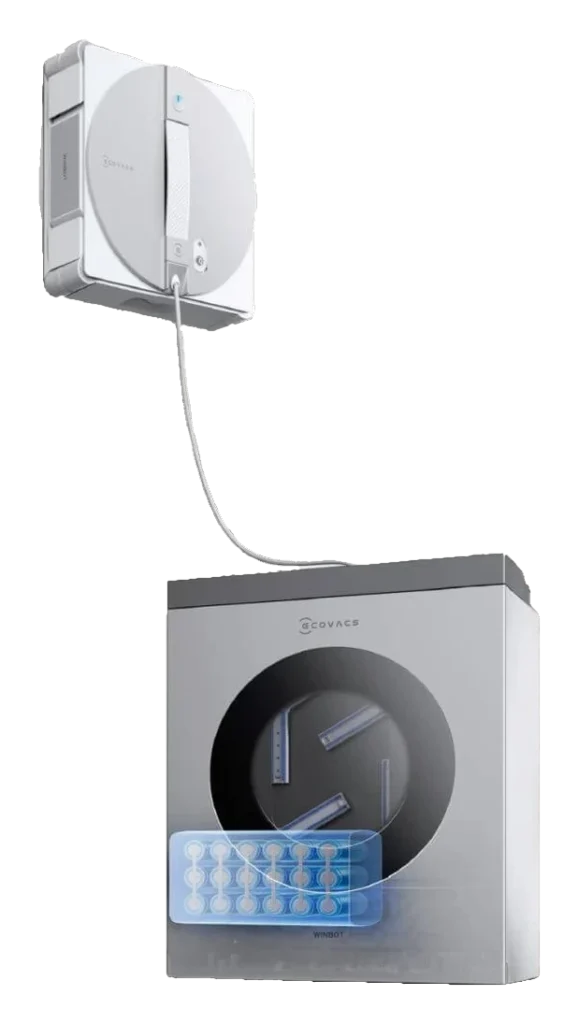
Ecovacs
Up to three
All robot window cleaners. Every figure below is placed against the whole class, so a gap can be read against how much the class itself varies.
The conditions each robot was assessed against, side by side. Rows marked in gold are where these machines genuinely differ.
| Condition | Ecovacs Winbot W2 Omni | Ecovacs Winbot W3 Omni |
|---|---|---|
| Window style | ||
| Standard residential | GoodFlat, smooth glass with minimal framing works optimally. Edge detection excels on standard rectangular windows. | GoodWIN-SLAM 5.0 edge detection optimized for standard framed glass panes. |
| Large panes (8 ft+) | DependsLarge single-pane windows may exceed dock suction radius or require mid-session repositioning on expansive home layouts. | DependsEdge detection may struggle with frameless or oversized panes; test coverage on sample window. |
| Specialty / textured | PoorFrosted, textured, tinted, curved, or decorative glass confuses optical sensors; edge detection fails and manual override required. | PoorHeavy tint, coatings, and specialty glass compromise edge-detection sensor reliability. |
| Frame style | ||
| Frameless / minimalthey differ | GoodFrameless glass presents edge-detection advantages; optical sensors identify perimeter clearly without frame interference. | PoorEdge detection requires framed boundary; frameless glass lacks reference structure for autonomous pathing. |
| Standard mullions | GoodStandard framed windows with aluminium or vinyl trim work well; dock-based edge mapping adapts to frame geometry. | GoodStandard aluminum or vinyl frames suit WIN-SLAM 5.0 calibration and tether management. |
| Heavy bezels | DependsHeavy or ornate framing may interfere with edge-detection calibration or require manual sensor repositioning between cleaning cycles. | DependsOrnate or steel-frame windows may interfere with edge-detection sensor path; manual path tuning recommended. |
| Building height | ||
| Single-story | GoodGround-floor windows align with dock placement in garage or utility room. Wall-mounting and suction-hose reach optimized for single-story deployment. | GoodTether range optimized for ground-floor and patio window coverage without ladders. |
| 2 – 3 storiesthey differ | DependsTwo-story homes possible with dock on upper level, but long hose runs (>5m) may reduce suction pressure and increase runtime drain. | GoodSecond-story windows accessible via tether from ground-level dock; roof anchor point or balcony ledge may extend reach. |
| 4+ stories | PoorSafety rope limited to 5-meter length; high-rise and multi-story buildings exceed rope capacity and create unacceptable fall risk. | PoorTether length and safety constraints cap reach below third-story exterior windows; manual access required. |
| Power preference | ||
| Corded OK | GoodDock operates on standard 120V or 240V outlet depending on region. Corded power enables continuous dock pad-washing without battery drain. | GoodRobot operates on dock-powered water and electrical supply; corded operation is the only mode available. |
| Cordless preferredthey differ | DependsRobot is cordless but dock requires AC power for pad drying and water-pump operation. Dock must be wired; full cordless operation not possible. | PoorProduct is not cordless; auto-clean dock requires mains power and water supply connection. |
| No preference | GoodDock-based architecture requires AC wall outlet, but robot operates cordless during cleaning sessions for up to 35 minutes per charge. | GoodRobot is corded and dock-dependent; consider this when evaluating power and water placement options. |
A robot being poor for a condition is a fact about fit, not a fault. “Depends” means the record names a limit worth reading, not that the answer is unknown.
Nine inputs across three pillars, each weighted as shown and each scored so more is better. A robot can lead on one and trail on another, which is the point of showing them apart.
A number only means something next to the spread it sits in. Each track is the real range across every classified robot in the class, with the median marked.
Written on each record, and the only thing here every robot on the site carries.
What each design gives up to be good at what it is good at.
The portable station needs no installation and travels to the work, and it is also the anchor the fall-protection system loads, so where it is set down matters as much as where the robot goes.
Optocoupler edge sensing with a 0.2 second response gives fast, systematic coverage on flat glass, and it assumes a flat plane; curved and heavily textured surfaces sit outside it.
Washable pads at $29.99 for two keep running costs low, and they are washed and dried by hand between sessions.
The composite safety cable and 1 m backup rope tie the robot to a station that travels with it; every window means moving the station rather than reaching out from a fixed point.
Vortex Wash cleans the pad contact-free in about a minute, with wastewater going to a sealed tray; the 80 ml tank and the station’s 10 kg still move window to window with the work.
Stated by the record itself. A robot being wrong for a household is a fact about fit, not a fault.
The upkeep ownership hands back to you, whatever the autonomy level says.
Classifications rest on different depths of evidence. A pre-release assessment and a verified one are not the same kind of claim.
| Robot | Evidence status | Sources reviewed | Last assessed |
|---|---|---|---|
| Ecovacs Winbot W2 Omni | Discontinued | 9 | Sep 2026 |
| Ecovacs Winbot W3 Omni | Provisional | 5 | Aug 2026 |
Evidence status counts the sources behind a classification, not their kind. A high count can be maker documentation and price coverage, so read it as how much was reviewed rather than as independent testing. How we weigh evidence.
 The full recordEcovacs Winbot W2 OmniSpecifications, evidence, the Fit Check in full, and every tracked change.
 The full recordEcovacs Winbot W3 OmniSpecifications, evidence, the Fit Check in full, and every tracked change.
Robovations classifies robots; it does not rank them. Nothing on this page is a recommendation, and no manufacturer influences a classification or its placement here.
Comparing across classes is allowed — the page will switch to per-class positioning and tell you it has.