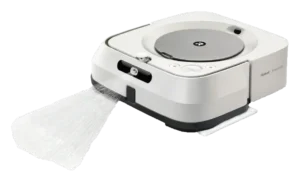
Dreame L10 Pro · iRobot Braava Jet m6
All robot vacuums. Every measure below is plotted against the full class, so a difference can be read against how much the class itself varies.
- Dreame L10 Pro
- iRobot Braava Jet m6
What each one does on its own.
The Autonomy Ladder is the same five rungs for every robot on the site. A rung describes the conditions a robot handles without you, not how good it is.
Where they actually differ.
The Robovations Score is nine inputs across three pillars, each weighted as shown and each scored so that more is better. A robot can lead on one and trail on another, which is the point of showing them apart. Cost of ownership and data handling are reported on each robot's own page and are never averaged into the score.
Capability
- Dreame L10 Pro58
- iRobot Braava Jet m655
- Dreame L10 Pro75
- iRobot Braava Jet m670
- Dreame L10 Pro46
- iRobot Braava Jet m674
- Dreame L10 Pro56
- iRobot Braava Jet m666
Dependability
- Dreame L10 Pro91
- iRobot Braava Jet m685
- Dreame L10 Pro37
- iRobot Braava Jet m681
- Dreame L10 Pro52
- iRobot Braava Jet m655
Ownership burden
- Dreame L10 Pro28
- iRobot Braava Jet m635
- Dreame L10 Pro43
- iRobot Braava Jet m661
How far apart is a long way?
A number only means something next to the spread it sits in. Each track below is the real range across every classified robot in the class, with the median marked.
- Dreame L10 Pro$450
- iRobot Braava Jet m6$499
- Dreame L10 Pro150 min
- iRobot Braava Jet m6150 min
- Dreame L10 Pro310 min
- iRobot Braava Jet m690 min
- Dreame L10 Pro67 dB
- iRobot Braava Jet m668 dB
- Dreame L10 Pro8.2 lbs
- iRobot Braava Jet m64.9 lbs
- Dreame L10 Pro3.8 in
- iRobot Braava Jet m63.5 in
Not compared, because fewer than two of these robots carry a published figure: Suction.
What the numbers leave out.
The trade-off
What each design gives up to be good at what it is good at.
The L10 Pro adds 3D obstacle avoidance the D9 does not have, and rated suction rises from 3,000 Pa to 4,000 Pa. Mopping hardware is unchanged: the same flat pad, no lift, no dock washing.
The premium over the D9 buys obstacle avoidance and a third more rated suction. It buys nothing on the mop side; the pad, the 270 ml tank and the manual rinse are identical.
No pad auto-swap or solution auto-refill. The operator seats a pad and fills the tank by hand before each run; the dock charges the robot and does nothing else.
Imprint Link needs a compatible Roomba. Mapping and room-by-room scheduling are the m6’s own and work unpaired; what pairing adds is sequencing, so the mop starts when the vacuum finishes.
Who each one is wrong for
Stated by the record itself. A robot being wrong for a household is a fact about fit, not a fault.
- High-pile carpet or homes with extensive area rugs
- There is no mop lift, so the pad and tank have to be taken off before a run that crosses rugs. Owner reports document reduced pickup on shag and deep pile.
- Multi-story homes requiring cross-floor consistency
- Moving between floors means carrying the robot and relocating the dock by hand on this generation, as with the D9. The added obstacle sensor changes nothing about that.
- Owners prioritizing autonomous mopping over vacuuming
- The pad wets the floor as the robot vacuums, but everything around it is manual: fill the 270 ml tank, fit the pad, rinse it afterward. There is no mop lift, no dock washing and no pad drying.
- Homes that are mostly carpet
- The m6 mops hard floors only and has no pad-lift mechanism. Carpet detection keeps it off the carpet rather than wetting it, but a largely carpeted home leaves it with little floor to clean.
- Homes wanting one robot to vacuum and mop
- The m6 mops only. Something still has to vacuum first, by hand or with a separate robot, and Imprint Link automates that handoff only if the vacuum is a compatible Roomba.
- Owners wanting hands-off water management
- Manual pad loading, solution refill, and dock drying setup required before each run. No auto-dispense or closed-loop refill.
What stays your job
The upkeep ownership hands back to you, whatever the autonomy level says.
- Weekly: Side brush cleaning and sensor wipe-down to maintain dual-laser accuracy.
- Every 3-6 months: Dust bag replacement (~$15 per bag); filter wash and replacement (~$22).
- Every 3-4 months: Mop pad replacement or deep wash (~$18 per set).
- Every 6-12 months: Dual-laser sensor cleaning and calibration check via app.
- Annually: Dock connector inspection; power cord integrity check.
- After every use: Remove the pad by hand. Rinse and machine wash reusable pads and let them dry; discard single-use pads.
- Weekly: Empty any solution left standing in the tank and refill before the next run. Plain water is a supported fill.
- Monthly: Needle-clean the jet nozzle if the spray pattern is uneven; wipe the charging contacts and the dock tray.
- Every few months: Replace reusable pads once they stop holding water evenly, and check the tank and nozzle for mineral buildup if you fill with hard tap water.
How much each of these is standing on.
Classifications rest on different depths of evidence. A pre-release assessment and a verified one are not the same kind of claim.
| Robot | Evidence status | Sources reviewed | Last assessed |
|---|---|---|---|
| Dreame L10 Pro | Verified | 6 | Aug 2026 |
| iRobot Braava Jet m6 | Provisional | 7 | Apr 2026 |
Add a robot
Comparing across classes is allowed — the page will switch to per-class positioning and tell you it has.