Why do most consumer robots land at Level III on the Autonomy Ladder?
Consumer robotics sells machines that think for themselves, and 583 classified robots let that claim be checked against a record. Fifty-nine percent sit at the same rung: Conditional Autonomy, a promise that holds only inside a space mapped, taught, or walled in advance. The gap between the rung and the marketing photograph is the story.
On this page4 sections
Sort the 583 consumer robots on the Autonomy Ladder by rung, and they do not spread across the five levels. They stack onto one. Level III, Conditional Autonomy, holds 345 of them, a little under 59 percent. Level II holds 176, Level IV only 56, and Level I just 6. The top rung, Level V, holds nothing at all.
A rung is not a grade of intelligence. Level III describes a specific arrangement: the machine finishes its job with no human in the loop, but only inside an environment that was defined for it in advance. Level IV describes what the marketing photography quietly implies every one of these robots already does, working through a space that was never mapped, arranged, or bounded on its behalf.
The two middle rungs together hold 521 of the 583 records, just under nine in ten. The Ladder was built to span from a machine a person drives by hand to one that needs no instruction at all, and almost the entire consumer market has settled into the two rungs in the middle of it.
What each rung requires, and where the corpus sits
| Rung | What the rung requires | The kind of space it needs | Share of the corpus |
|---|---|---|---|
| IManual | Manual Automation | Direct operation on every run | 1 percent |
| IIAssisted | Assisted Autonomy | A person sets it up or takes over on hard cases | 30 percent |
| IIIConditional | Conditional Autonomy | A bounded, pre-defined space it can finish alone | 59 percent |
| IVEnvironmental | Environmental Autonomy | A variable, unmapped space it was not set up for | 10 percent |
| VGeneralized | Generalized Autonomy | Any space and any task | 0 percent |
For anyone choosing one of these machines, the rung is a promise about where it will cope and where it will stop. A Level III vacuum runs a mapped apartment unattended for months, then stalls the week the couch moves.
The concentration at that rung is not marketing restraint or a shortage of ambition. The step from Level III to Level IV takes away the single condition every Level III machine is built around, and the distribution is a record of how few products can survive that step.
What conditional autonomy needs to work
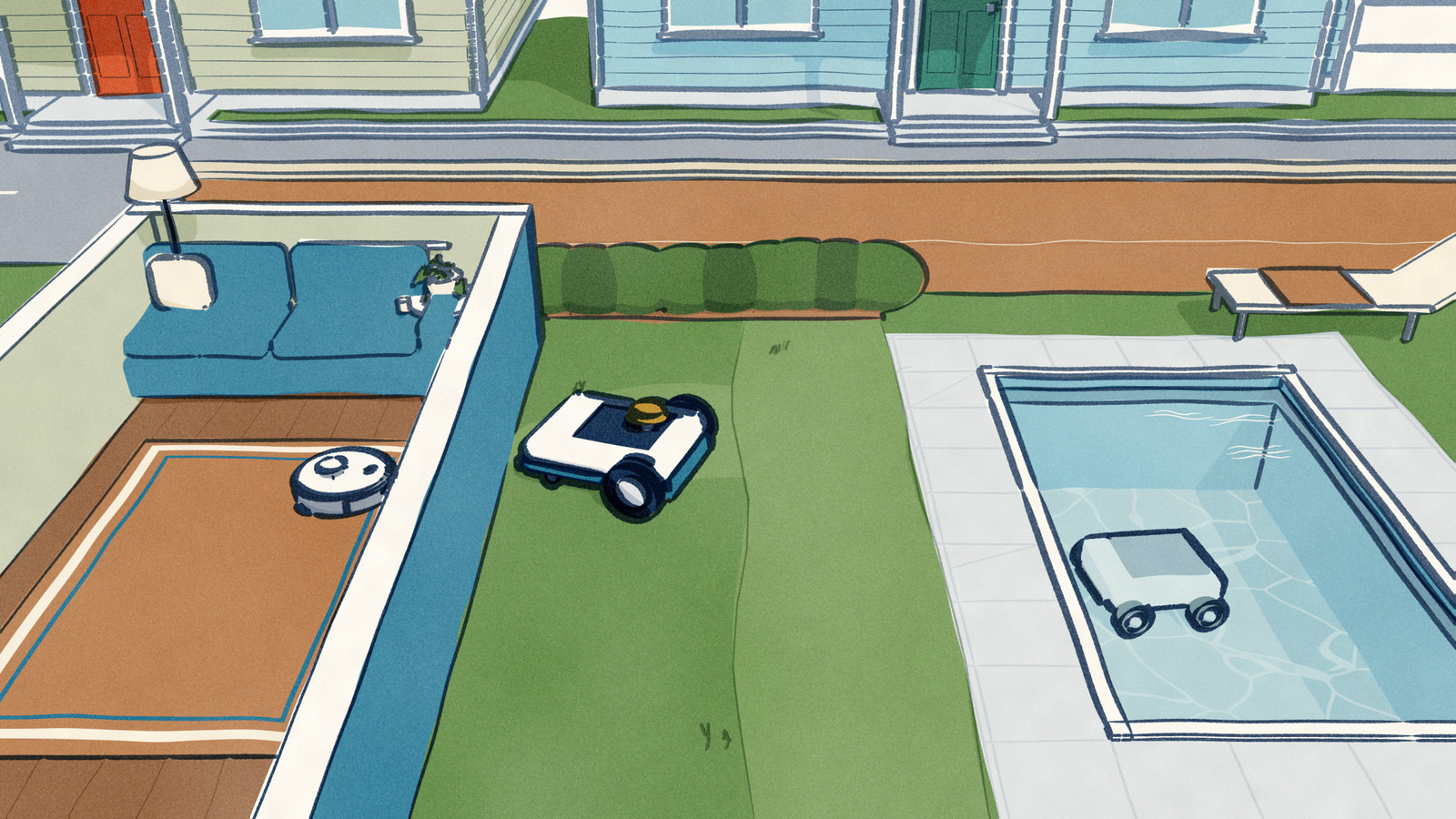
Three classes account for 446 of the 583 records: robot vacuums at 243, robot lawn mowers at 128, and robot pool cleaners at 75. Each of the three reaches autonomy the same way, by fixing its environment before the first run and refusing to leave it.
A laser-guided vacuum builds a map of the home on an early pass, then navigates against that stored map rather than the room in front of it. Advanced models “store multiple floor maps and resume cleaning after recharging,” Ecovacs writes in its own guide to navigation types.
Camera-based navigation “performs best only in well-lit environments,” the same guide notes, while a laser scanner “works equally well in the dark.” What the robot trusts is the map, rather than the scene it is standing in.
Term
Operational design domainBorrowed from automated driving, an operational design domain is the set of conditions a machine is built to work inside: the surfaces, the lighting, the boundaries, and the layout it was told to expect. Inside its domain the machine can run fully on its own. The word autonomous carries that domain as its fine print.The mower learns its domain by hand. The owner walks it around the lawn on a phone app while it “logs these GPS coordinates, creating a precise digital map,” one mower maker’s setup guide describes, after which it “constantly checks its current position against this map.”
The pool cleaner has the most forgiving domain of the three, an enclosed basin of fixed shape and no exits. It needs no map at all. An explainer of underwater navigation describes cleaners that manage “systematic coverage without needing a detailed visual map,” estimating the layout “gradually as the cleaner reaches boundaries.” Four walls do the work a map would otherwise have to.
The pattern under all three is a division of labor. The person does the part that requires reading an open, ambiguous world once, at setup: which areas count, where the flowerbeds are, what a no-go zone means. The machine then does the repetitive part inside those lines, indefinitely, without help.
This is not a lesser achievement than the word autonomy suggests. A machine that cleans an entire floor plan or an entire lawn with nobody watching is doing something genuinely hard. Conditional is simply the accurate adjective: the autonomy holds on the condition that the world stays the shape it was handed.
The wall between Level III and Level IV
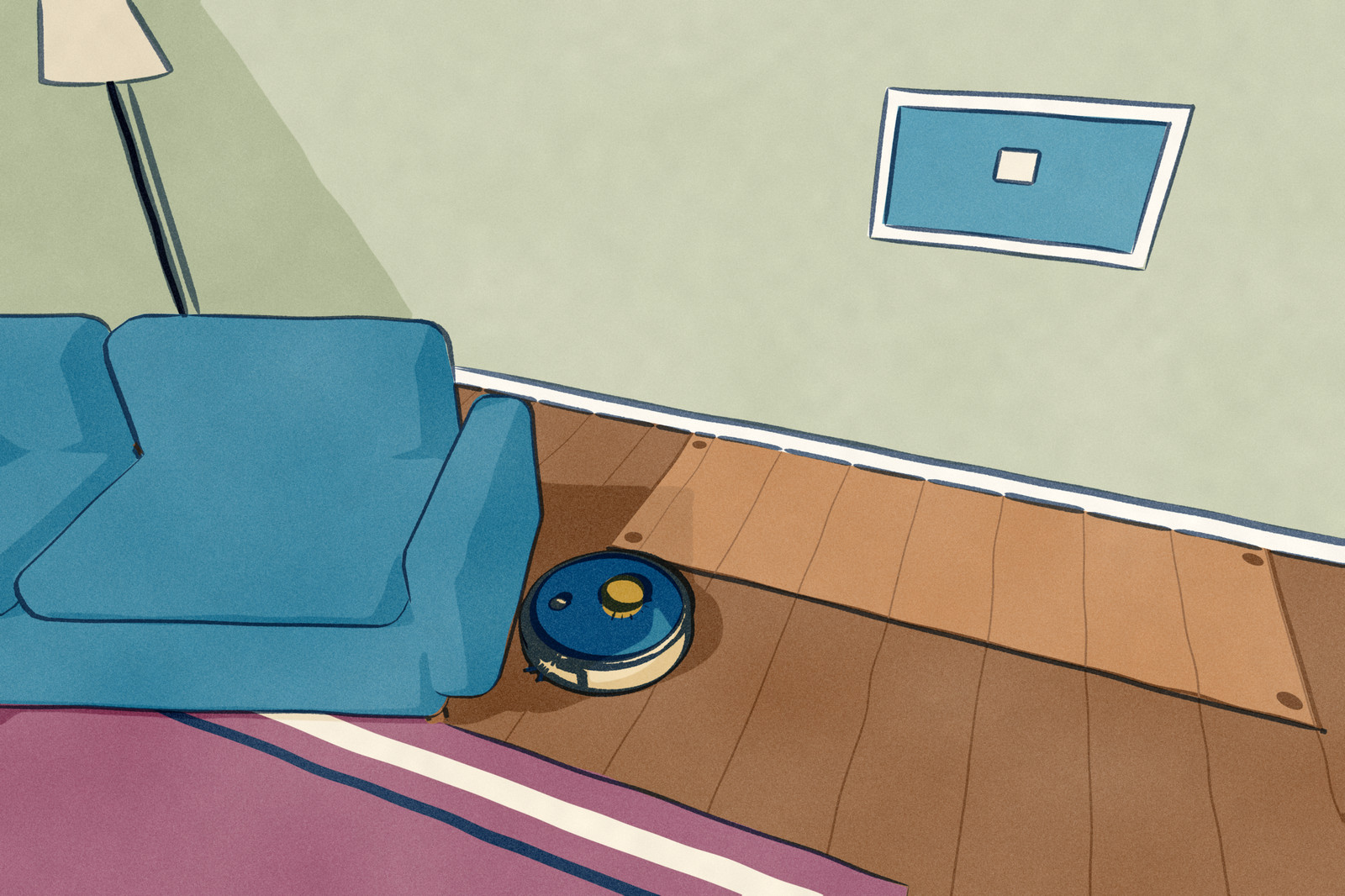
Everything that makes a bounded domain tractable is exactly what disappears when the domain opens up. The map goes stale the moment the furniture moves. The taught perimeter means nothing on a lawn the machine was never walked around. The four walls are gone.
A 2026 analysis of robot capabilities traced this line across warehouse, kitchen, and household deployments and found it sitting wherever the environment stops being controllable. Warehouse picking works, it observed, because the space “can be designed around the robot,” while household tasks demand adaptation to “constantly changing” settings that no design can pin down in advance.
autonomy works where the environment is controlled or forgiving, and struggles where it is not
The failure has a name in the research. A survey of the reality gap between simulation and the physical world catalogs why a control policy that works in one setting collapses in another. The causes: lighting it never trained under, backgrounds and clutter it never saw, and the physics of contact and soft, deformable materials that no simulator reproduces faithfully.
A robot tuned for one domain does not carry that tuning into the next. The same capability analysis described transfer, the ability to move a skill from the setting it was learned in to a different one, as the bottleneck that separates a working demonstration from a shipped product.
The vacuum shows the smaller version of the same wall. Its map handles the apartment it learned, but a genuinely new object, a cable, a sock, a puddle, sits outside what it was set up to expect. Camera navigation that depends “heavily on consistent lighting,” by Ecovacs’ own account, fails in a way a stored map cannot repair. The domain held; the contents of it changed.
The mower’s wall is literal. Inside the taught perimeter with a clear view of the sky it holds a centimeter-level fix; under a tree canopy or beside a tall wall the correction signal degrades and the position drifts.
Dense tree cover “can partially block satellite signals, reducing positioning accuracy,” the same maker’s guide warns. The machine has not become less capable; the domain it was promised stopped being the domain it was standing in.
Term
Reality gapThe difference between how a robot performs in the controlled setting it was developed and tested in, and how it performs in the uncontrolled world it is sold into. A capability proven in one domain does not automatically carry into another: the same control software that finishes a task in a lab or a mapped apartment can fail on lighting, clutter, or textures it was never shown during training.The 56 records at Level IV are mostly machines with documented behavior in conditions they were not arranged for: an obstacle that was not there yesterday, a recovery after being wedged or stranded. Even these operate inside a yard or a home of known extent. No record in the corpus describes a machine that walks into an unfamiliar building and simply works.
The humanoids and the empty top rung
The 60 humanoid records are the sharpest test of the pattern, because a humanoid is sold as the one machine that needs no bounded domain: the general worker that walks into any room.
Most of them are classified at Level II, the rung where dependence on a human teleoperator caps a robot. The class also includes the 1X NEO, the model most often named as a candidate for the top of the Ladder.
The Ladder caps any robot whose fallback is a human operator at Level II, and current humanoids lean on remote pilots for the cases they cannot finish alone. Deployed mobile robots outside the home show the same dependence: the 2026 capability analysis documents a real-world trash-removal service where “many edge cases required teleoperation,” and a warehouse picking system built to call for human help on the items it cannot classify.
For a buyer, the practical reading is that a humanoid’s published demo describes what it does inside a prepared domain, not what it does in an unprepared one. A staged demonstration runs inside a setting as controlled as any vacuum’s stored map. The home and the unfamiliar workplace are not staged, and the operator on the console is what fills what the autonomy cannot.
The remaining classes tell the same story from their edges. The 44 specialty robots and 6 multi-task machines scatter across rungs rather than cluster, because a single-purpose arm can be locked to one controlled task while a multi-task machine inherits the open-world problem in full.
The 27 window cleaners sit at the opposite extreme, pure bounded-domain devices: one pane of glass, held on by suction, with nowhere to wander and little to misread. A finite surface is the easiest domain of all to guarantee, and the machines built for the smallest worlds are the ones whose autonomy is least disputed.
Level V, generalized autonomy across any space and any task, has no occupant at all, and why the top rung stays empty is examined separately through the machine most often held up as its candidate.
Figure
The five rungs
Why the market settles at Level III
A bounded domain is the only place autonomy currently ships and keeps working, so the products that reach buyers are the ones that draw a boundary first and stay inside it.
A vacuum that owns a floor plan, a mower that owns a taught perimeter, and a pool cleaner that owns four walls of water are each genuinely autonomous, and each is autonomous because someone first told it precisely where its world ends.
The advertising and the rung describe two different machines. One sells generality, a helper that slots into a life already in motion. The rung certifies something narrower and more useful to know: a reliable worker inside a box whose walls the owner, or a setup wizard, drew on the first day.
The reading for someone comparing machines is direct. A Level III rating is a strong promise about a defined space and says nothing about an undefined one. The questions worth putting to a maker are about the domain: how the boundary is set, what happens when it is crossed, and how the machine behaves when the space changes under it.
Level IV is the rung that asks a machine to work where no one has set it up first, and 527 of the 583 records have not reached it.
The marketing photograph and the rung disagree on one thing. The picture shows a machine at ease in a room it has never seen. The rung records a machine that spent its first afternoon being led around the edges of the one place it will ever work.