How do robot vacuum cliff sensors work, and why do falls still happen?
The same sensor that keeps a robot vacuum off the stairs can mistake a dark rug for a drop. Some owners tape it over.
On this page4 sections
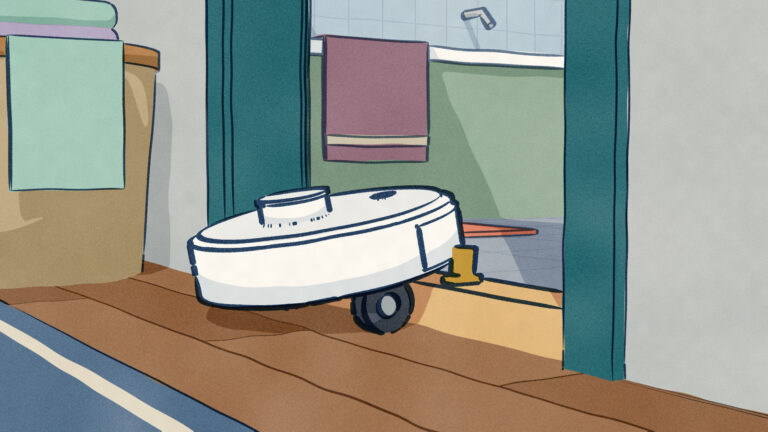
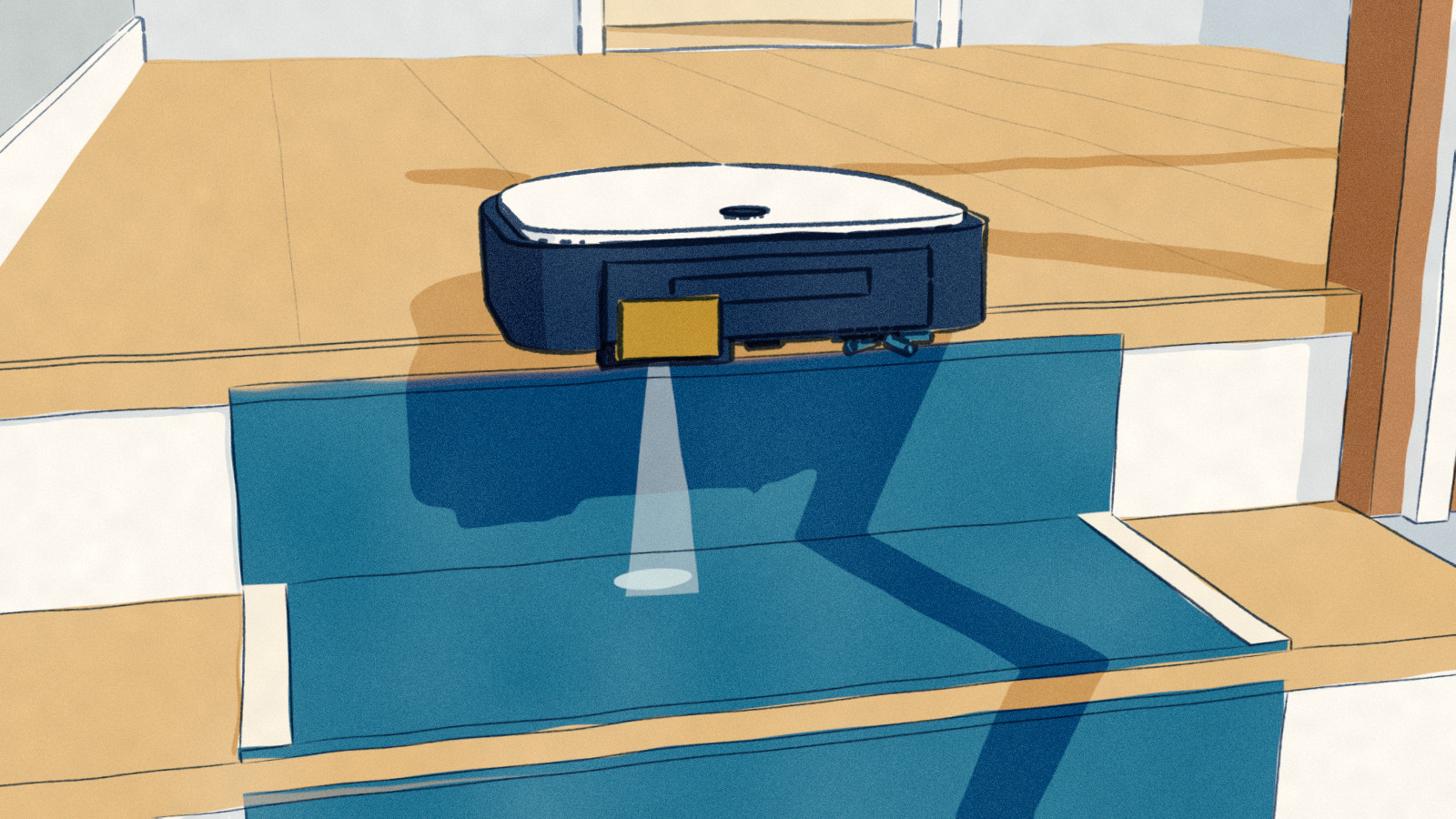
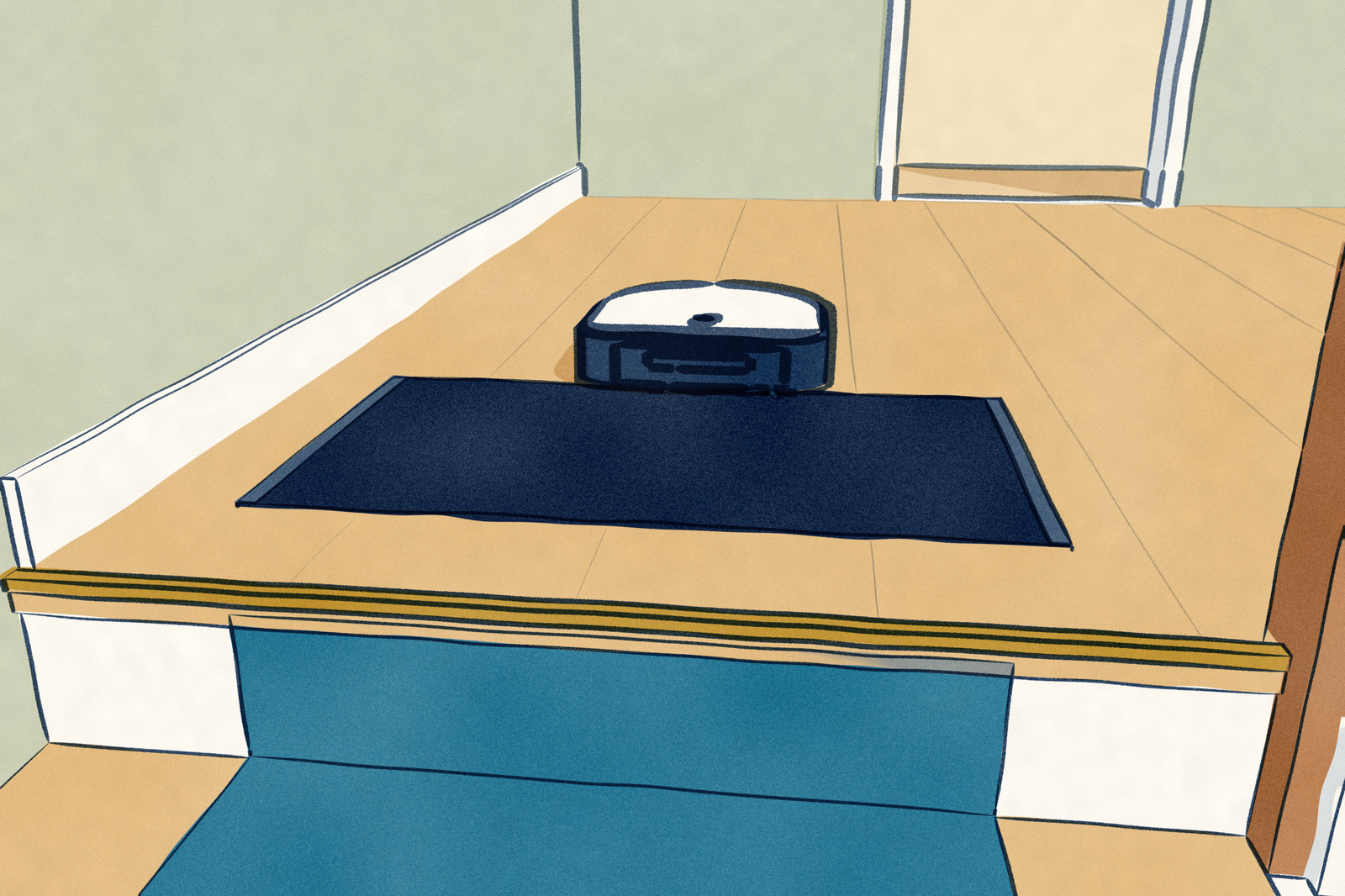
A robot vacuum can stop in the middle of a dark rug as if it had reached the top of the stairs. The same robot, at the top of a real staircase, can roll straight off. Both mistakes come from a small part on its underside, and they point in opposite directions.
That part is the cliff sensor. If your home has stairs, it is what keeps the robot off them, along with any gate or no-go line you add. If your floors are dark and the house has no stairs at all, the same sensor can strand the robot mid-room. So how does it tell a drop from a floor?
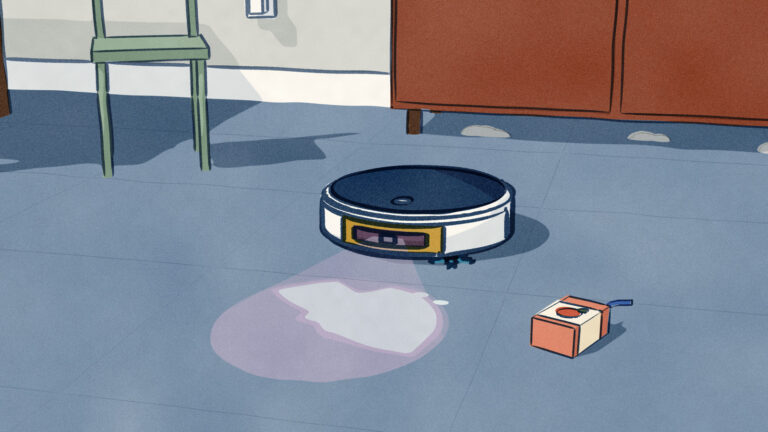
Most of the answer is in a patent iRobot filed in January 2001 for a robot obstacle detection system, credited to Joseph L. Jones. It puts two parts on the underside of a cleaning robot: an emitter that sends a beam of infrared light at the floor, and a detector aimed at the same patch.
The two are angled 60 degrees apart, so the beam and the detector’s view overlap fully only when the floor sits at its normal distance below. Roll toward a drop and the overlap shrinks. Less light reaches the detector, and once it falls below a set threshold, the robot’s cliff avoidance kicks in.
Today’s robots work the same way. eufy’s guide to stairs says “each cliff sensor consists of an IR emitter and an IR receiver working together,” with the beams angled down near the front and sides. In ECOVACS’s version, the signal “bounces back when the vacuum moves over flat ground” and fails to return at an edge.
Here is the catch. The robot needs to know how far below it the floor is. The sensor reports how much light came back, and a floor’s color and finish change that number along with its distance.
Dark floors and bright edges
Any sensor like this needs a cutoff. iRobot’s patent puts it at the darkest floor the designers expected: “The detector threshold is then set so that the darkest available floor material is detected when the beam and the field of view fully overlap.”
A rug or floorboard darker than anything the designers planned for returns too little light even with the robot sitting squarely on it. The robot reads a drop that isn’t there, in the middle of your living room, and turns away from floor it could drive straight across.
The reverse mistake is the one that sends a robot down the stairs. A bright surface far below an edge can send back as much light as a dark floor right underneath, so the detector sees floor where the floor has ended.
With a simpler layout, the patent warns, the difference between “a white or highly reflective surface a long distance away” and “a black or non-reflective surface closer” to the sensor “cannot be easily detected.” So iRobot set the two parts at equal angles, which lets the detector work “regardless of whether the floor material is specular or diffuse,” mirror-like or matte.
Term
Angle of incidenceThe angle at which a beam of light strikes a surface is its angle of incidence, and the angle at which it leaves is its angle of reflection. A mirror-like surface sends the beam off at the same angle it arrived, in one direction, while a matte surface spreads it in every direction. A detector aimed at the matching angle sits in the path of the mirror-like reflection and still catches some of the matte one.Shine still makes the makers’ lists of hazards. eufy warns that “shiny or highly reflective surfaces can scatter the IR beam unpredictably,” ECOVACS lists “highly reflective flooring” too, and Narwal’s guide says “shiny floors or dark surfaces can confuse the sensors.”
Owners who switch them off
The dark-floor mistake is the one that fills owner forums, because it strands a robot in the middle of a room. In a house without stairs, the cliff sensor starts to look like the fault.
In November 2020 a Wyze user asked the company, in a thread on its forum, for a way to turn cliff detection off in single-story homes. The complaint: a “dark rug or a dark pattern in a rug was a cliff since it absorbed the ir light instead of reflecting it.”
Others in the thread had a quicker fix: cover the sensors with tape. Then the robot stops seeing cliffs anywhere, real ones included. The request sits in the forum’s wishlist, filed as “Maybe Later.”
An independent repair guide goes further. It points to disassembly instructions for the Roomba 655 Pet Series and shows how to modify the cliff sensors so they never signal a cliff. Its author’s dark, knotty vinyl plank floor set them off “right in the middle of the floor” and “cleaning the sensors made no difference.”
He lives in the country “with Dogs, Cats, Dirt, Mud and no cliffs,” and adds: “I will not be adding stairs to my dirty house.” A robot altered this way has no drop detection left.
What makers say about falls
Move the robot to a house with stairs, and the other mistake is the one that matters. ECOVACS’s guide concedes that “while it’s rare, falls can still happen in certain situations.” eufy’s allows that “occasional falls can still occur due to malfunctions, dirty sensors, or unusual environments.”
Narwal’s guide calls falls rare but possible, and none of the three puts a number on rare. All three blame dust, hair or dirt over the sensor. eufy adds that “direct sunlight can overwhelm the sensors altogether,” and ECOVACS and Narwal both mention poor lighting.
From the makers’ own guides
What three stair guides say about falls
| Maker | On falls | Causes it names | Wiping the sensors |
|---|---|---|---|
| ECOVACS | Rare, but they can still happen | Dust, hair or dirt on the sensor, poor lighting | No interval given |
| eufy | Occasional falls can still occur | Dust, hair or dirt on the sensor, direct sunlight | Weekly |
| Narwal | Rare, and possible | Dust, hair or dirt on the sensor, poor lighting | Every two weeks |
If your wooden stairs have a runner at the top, eufy’s guide has a warning. “Avoid placing carpet runners or rugs directly at the edge of wooden stairs,” it says. “These soft or elevated materials can tilt the robot slightly, block part of the cliff sensors, or create irregular reflections that confuse the robot into thinking the floor continues.”
Every guide backs the sensor up with something else. All three want you to draw no-go zones along stair edges in your app and put a baby gate or other barrier near the stairs. ECOVACS adds magnetic boundary strips, and ECOVACS and Narwal both say to keep the dock away from the stairs, Narwal by three to four feet.
Term
No-go zoneAn area the owner marks on the robot’s map in its companion app. The robot plans its routes to stay out of it, using the map and its own position on that map. Only robots that build a map of the home offer one.So falls still happen because the sensor reads light as distance. A floor dark enough looks like a drop, a bright surface far enough below can look like floor, and dust, hair or sunlight on the sensor make both mistakes easier. The gate and the no-go line are there for the times it guesses wrong.
Timing the light
LG Electronics took another route. A patent it filed in January 2018 describes a cliff sensor that measures the distance by timing the light, from the emitter to the floor and back to the receiver. At a step down, “a time to receive reflected light is drastically increased.”
LG’s stated reason was cost and size. Its design also uses the cliff sensor to register the bumper being pushed in, so the robot can do without a separate collision sensor. The granted patent was published in September 2023, and it doesn’t name the LG robots, if any, that carry the design.
Why would timing help? The delay depends on how far the light traveled. A dark floor changes how much light comes back without changing when it arrives, as long as enough returns to be timed. On that dark, knotty vinyl in the country, a robot built this way could cross the room with its drop detection still switched on.