Boston Dynamics’ new CEO has never run a robotics company
Rohit Prasad spent twelve years building Amazon’s Alexa. Boston Dynamics just put him in charge of Atlas, Spot and Stretch.
Boston Dynamics named Rohit Prasad as its third chief executive on October 7, 2026, the company announced. Marc Raibert founded the company in 1992 and led it for almost three decades.
Prasad succeeds Robert Playter, who left in February 2026 after six years as chief executive and more than thirty years at the company. Amanda McMaster, the chief financial officer, ran Boston Dynamics on an interim basis for the eight months between them.
Prasad spent twelve years at Amazon as senior vice president and head scientist for Alexa and Artificial General Intelligence, helping build the voice assistant and later leading its Nova family of foundation models. He left at the end of 2025.
Before Amazon, he led machine-learning research at Raytheon BBN Technologies for nearly fourteen years, serving government and commercial clients.
Boston Dynamics is uniquely positioned to advance Physical AI through its world-class robotics expertise. I am honored to join the company at such a pivotal moment for the industry.
Rohit Prasad, in Boston Dynamics’ announcement of his appointment
Boston Dynamics sells two machines today: Spot, a four-legged robot used for industrial inspection, and Stretch, a robot that moves boxes in warehouses. Neither is built for a household.
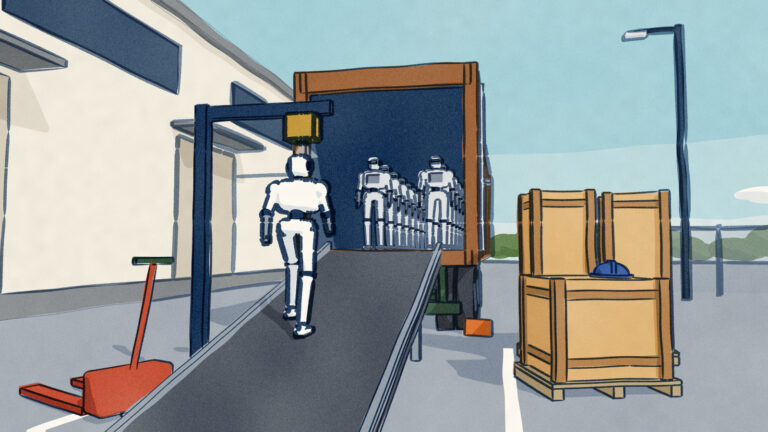
Atlas, the company’s humanoid, is not for sale. Hyundai, which owns Boston Dynamics, is training it at a plant outside Savannah, Georgia, toward a planned deployment of 25,000 units across its factories, the company said in September. Every mention of that work so far has stayed in factory terms, with no home version named.
Boston Dynamics called the hire a strategic move, saying it would speed up what it calls Physical AI, pairing its machines with AI systems built for commercial scale. No new product, price, or timeline appeared in the announcement or the coverage around it.
Prasad has never run a hardware or robotics company. His years at Amazon were spent on a voice assistant and language models that live in software. Boston Dynamics did not say how that experience transfers to a machine that has to balance, carry a box, or survive a factory floor.
Hyundai’s board chair, Jaehoon Chang, called the appointment a foundation to “build and scale Physical AI.” Neither Boston Dynamics nor Hyundai said when, or whether, that strategy reaches a machine a household could buy.