Are humanoid robot demos teleoperated or autonomous?
Humanoid makers sell their robots with videos of chores done in real kitchens. A video never shows who else was in the room, or at the controls.

On this page3 sections
An Optimus robot folds a shirt at a table in a video Elon Musk posted in January 2024. Viewers soon spotted a hand at the lower right edge of the frame, moving in and out and “echoing movements” of the robot. It was the operator’s, in a telepresence control glove.
Most of what the public sees of humanoid robots arrives as short clips like that one. A clip of a robot loading a dishwasher records nothing about how many takes came before it, how the room was arranged, or whether someone in a headset was moving the robot’s hands from off camera.
Since 2024 that last question has several times had the answer yes. Household humanoids are now taking orders, and if you are weighing one, the videos are most of what you have to judge it by. So how can you tell a robot doing a chore from a person doing it through the robot?
Tesla’s operators were out of frame

Twenty-three minutes after the first post, Musk added: “Important note: Optimus cannot yet do this autonomously, but certainly will be able to do this fully autonomously and in an arbitrary environment.” The setup was a fixed table and a box holding a single shirt.
At Tesla’s We, Robot event that October, Optimus units walked among guests, mixed drinks and chatted, and Musk said the robot would “be able to do anything you want,” babysitting included. Employees stationed remotely oversaw many of the interactions, and Tesla did not respond to a request to explain. Tesla, Figure and 1X have each described that handoff differently since.
The Autonomy Ladder™ puts this arrangement on its lowest rung. When a person generates each movement and the robot reproduces it, the system is Level I, Manual Automation, however fluid the motion.
A shirt folded that way is still evidence about the hardware: the fingers had the dexterity and the arms the reach. What the footage cannot show is whether the robot could have picked up the shirt and chosen each fold by itself.
1X sells the remote operator as part of the robot
1X Technologies disclosed its operators at launch. When orders opened for NEO, a household humanoid, on October 28, 2025, the announcement described a feature built on remote control: “For any chore that NEO doesn’t yet know, owners can schedule a 1X Expert to guide it through unknown tasks.”
The feature is called Scheduled Expert Mode. On its own, NEO arrives with a basic set of skills, which launch reports listed as opening doors, fetching items and controlling lights. Anything past that is a job for the Expert, working the robot from somewhere else.
Reporters who tried NEO around the launch saw the Expert doing the work. The operators wear Quest 3 headsets, and in one hands-on review’s demonstration every action was under human control. Even so, NEO nearly toppled over closing the dishwasher, took two minutes to fold a shirt and twisted its arm attempting the Macarena.
Oh, did I mention Neo had a human puppet master, controlling it with a VR headset?
Bernt Børnich, 1X’s chief executive, said NEO would do “most of the things in your home autonomously” at launch, with quality that would “vary and will improve drastically quite fast as we get data.” He also acknowledged that teleoperators would do much of the work at first.
The remote sessions are also how the robot learns. “If we don’t have your data, we can’t make the product better,” Børnich said. In return, you can blur people out of the operator’s view, set zones a remote operator cannot enter, and approve each handover of control.
The Ladder has a fixed rule for this arrangement. A robot that does some work by itself and hands the rest to a remote pilot sits no higher than Level II, Assisted Autonomy, because a person is still part of normal operation. NEO’s current classification is Level II, Assisted Autonomy.
What a demo clip leaves out
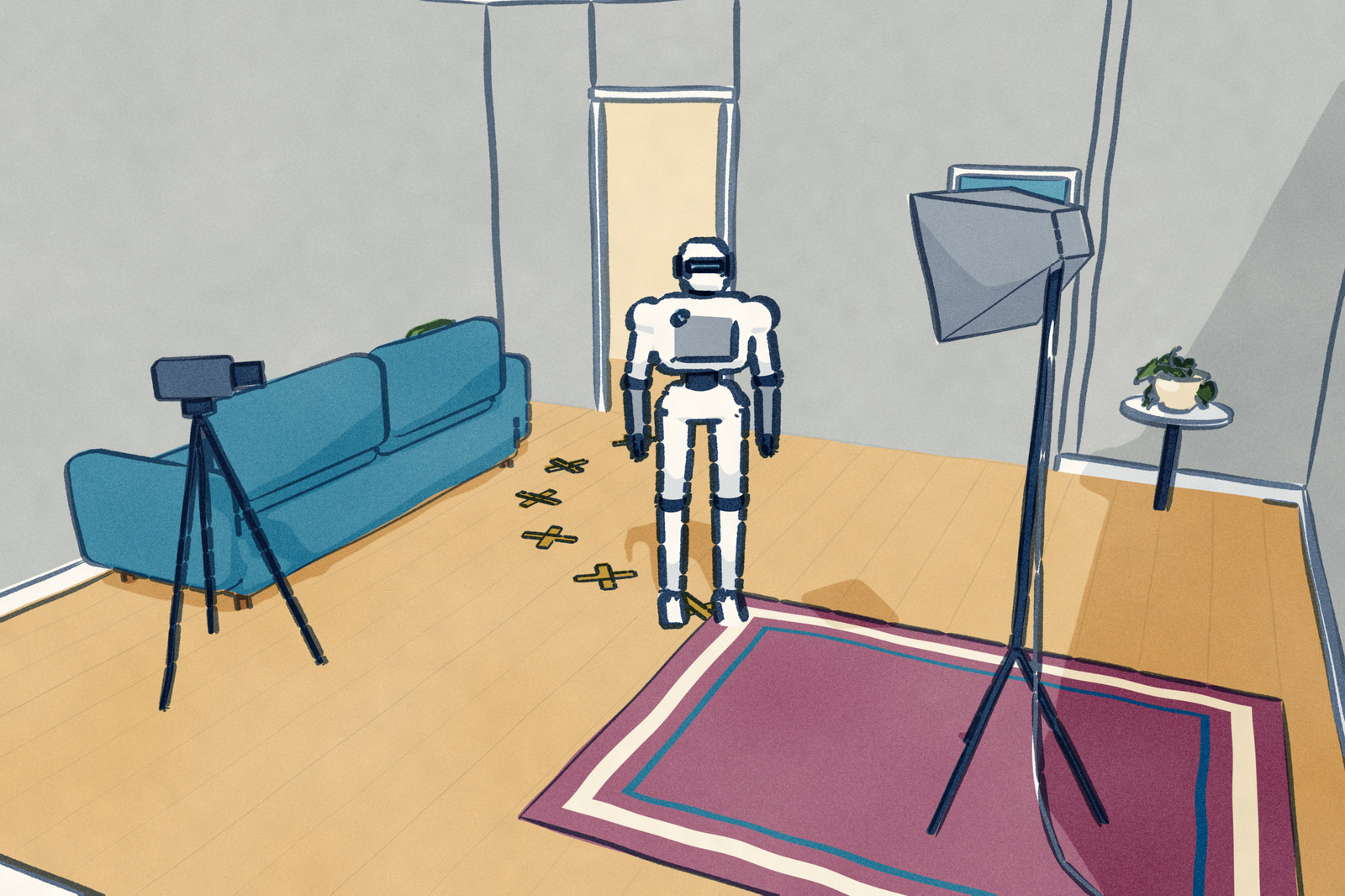
A clip with no operator in it can still be arranged. The room may be a real kitchen while the objects on the floor were placed beforehand, the lighting set and the route run several times before the take that was published.
Research robots show another way to publish. Stanford’s Mobile ALOHA project trains its robot on demonstrations collected by teleoperation, and its project page sorts the videos under separate “Teleoperation” and “Autonomous Skills” headings. You can see which ones a person was driving.
Figure’s September test was built around the questions a clip leaves open. It sent robots running its Helix 2.5 software into 30 Bay Area homes where it had collected no data, to tidy a living room, fold towels and make a bed. Each trial began from a unique arrangement.
The scoring was strict. A trial counted only if every item was tidied, every towel folded or the whole bed made. Any run in which a person had to step in for safety was aborted and marked as a failure. The robot still succeeded on 56% of trials, against 9% for a version trained from scratch.
Figure credits the jump to pretraining on Index, its “global-scale dataset of human behavior.” But Figure designed and scored the test itself, named no outside observer and gave no count of trials per task. The three chores were fine-tuned on data gathered elsewhere, and the post does not say whether any of it came from teleoperation.
Training data
Where the training data came from
| System and source | Training data, as described | What the source says about teleoperation |
|---|---|---|
| Mobile ALOHA, Stanford project page | 50 demonstrations per task, collected with a whole-body teleoperation system, plus co-training on existing datasets | Sorts its videos under separate “Teleoperation” and “Autonomous Skills” headings |
| Helix, Figure announcement, February 2025 | About 500 hours of teleoperated behaviors from multiple robots and operators | Describes the whole dataset as teleoperated behaviors |
| Helix 2.5, Figure’s September evaluation post | Pretraining on Index, which Figure calls a “global-scale dataset of human behavior,” plus fine-tuning data gathered elsewhere | Does not say how the fine-tuning data was collected or whether any of it came from teleoperation |
Some of the most watched humanoid demos were teleoperated, and the footage never said so. Tesla’s operators came to light by accident at the edge of a frame, and through reporting after We, Robot. The clips you can sort are the ones whose makers did the sorting: Stanford’s two headings, 1X’s scheduled Expert, and Figure’s rule that a safety step-in fails the run.
Still, the two kinds of clip are linked. The Mobile ALOHA robot that sautéed and served a piece of shrimp with nobody at the controls learned it from 50 demonstrations a person drove, plus existing datasets. Figure’s first Helix model started from about 500 hours of people driving robots.