
- Changes
- 4
- Tracking since
- Aug 2023
- Latest
- Jan 1, 2026
- Net movement
- Classification stable
- 2026
-
Security researchers disclose Go2 firmware remote access vulnerabilities
Security research published in 2024 documented vulnerabilities in Unitree Go2's firmware that allowed unauthenticated command execution over the robot's local Wi-Fi network.
ReliabilityFull assessment4 claims · 4 technical notes · 2 sources
Where it standsAutonomy LadderIIIIIIIVVLevel IIAssisted AutonomyHuman ReadinessReady NowNew to MarketWaitKnown IssuesRobovations Score↓ moved by this entry04055708549LimitedWhat happenedThe research demonstrated that an attacker within network range could issue movement commands without authorization. Unitree's patch response timeline remained unclear; buyers operating Go2 in shared network environments should treat this as an active risk until a confirmed firmware update with documented remediation ships.
Bottom lineThe disclosure is a setback for Go2's enterprise and institutional readiness; hobbyist single-network deployments carry lower exposure but the patch gap remains an open question.
ImpactOn autonomy
- Vulnerability enables unauthorized movement commands bypassing operator intent
- No autonomous safety stop documented for unauthorized command injection scenarios
- Level II classification maintained: vulnerability affects control plane, not autonomy architecture
- Operator cannot verify command provenance at the gait execution layer
On readiness
- Shared-network deployments carry documented unauthorized control risk
- No confirmed patch release with public changelog at time of disclosure
- Field operators and research institutions advised to isolate Go2 on dedicated networks
- Buyers in enterprise or multi-user environments face higher exposure than single-user home labs
Claim check4 maker claims checked against the record. Open one to read the finding.
Developer-friendly open platform
Documented findingOpen API architecture that enables developer access also expanded the attack surface; unauthenticated command paths documented by researchersSecure Wi-Fi operation for field deployments
Documented findingResearchers demonstrated unauthenticated command execution over Wi-Fi; secure operation requires network isolation not documented in standard setup guidanceManufacturer response to security findings
Documented findingUnitree acknowledged the disclosure; a fully patched firmware release with public changelog confirming remediation was not documented within the initial disclosure windowSuitable for research institution deployment
Documented findingInstitutional IT security review requirements raised by disclosure; network isolation is a prerequisite for compliant deployment per standard institutional policiesEvidence2 sources · 0 linked
12Apr 2024Jan 2026filed 1 Jan 2026
- 1Cybereason Security Research Blog29 Apr 2024named, not linked
- 2The Register2 May 2024named, not linked
Technical notes4 sections
Vulnerability Scope
Published research documented unauthenticated remote command execution paths accessible via Go2’s Wi-Fi interface. The vulnerabilities allowed an attacker on the same network segment to send movement commands to the robot without valid credentials. The research covered the Go2 firmware version available at time of disclosure; specific version numbers were referenced in the original research but are not reproduced here to avoid fabrication of version strings.
Attack Surface
Go2’s developer-accessible Wi-Fi API, designed to enable SDK connectivity, was identified as the primary attack surface. The open architecture that makes Go2 valuable for research and custom integration also means authentication controls on that interface are critical. Researchers demonstrated movement command injection; potential for sensor data interception was noted as an additional risk vector.
Remediation Status at Disclosure
Unitree acknowledged the security findings. A patched firmware with documented remediation of the specific vulnerabilities was not confirmed as shipped within the reporting window following the disclosure. Operators should verify current firmware release notes against the disclosed vulnerability identifiers before field deployment.
Operational Guidance
Network isolation on a dedicated SSID or VLAN, not shared with other devices or users, reduces exposure. Remote operation over public or semi-public networks should be suspended pending confirmed patch deployment.
- 2024
-
Unitree Go2-W wheeled variant announced, expanding platform lineup
Unitree announced the Go2-W, a wheeled derivative sharing the Go2 body and compute stack but substituting a wheeled base for the quadruped leg assembly.
Full assessment4 claims · 4 technical notes · 2 sources
Where it standsAutonomy LadderIIIIIIIVVLevel IIAssisted AutonomyHuman ReadinessReady NowNew to MarketWaitKnown IssuesRobovations Score04055708549LimitedWhat happenedThe announcement documents a platform expansion, not a capability advance for the Go2 itself. The Go2-W is a distinct product; its indoor mobility trade-off against the Go2's rough-terrain capability reflects different deployment contexts rather than iterative improvement.
Bottom lineThe Go2-W announcement signals platform versatility strategy from Unitree; it does not document progress in the Go2 quadruped's own capability or commercial trajectory.
ImpactOn autonomy
- Go2 (legged) autonomy level and architecture unchanged by this announcement
- Go2-W uses wheeled locomotion; rough-terrain capability of the legged Go2 is not replicated
- Shared compute stack between variants enables software portability for developers
- Level II classification applies to the Go2; Go2-W classification is a separate assessment
On readiness
- Go2 readiness status unchanged; announcement concerns a separate product
- Developer investment in Go2 SDK transferable to Go2-W given shared architecture
- Go2-W targets different deployment surface than the legged Go2; not a substitute
- Availability timeline and pricing for Go2-W not confirmed at announcement
Claim check4 maker claims checked against the record. Open one to read the finding.
Go2 platform expanded for more use cases
Documented findingAccurate in the sense of a variant product; the Go2 (legged) itself is unchanged. The Go2-W is a different locomotion architecture, not an enhancement of the originalWheeled variant improves indoor performance
Documented findingWheels reduce complexity and cost for smooth-surface operation; the tradeoff is loss of the legged Go2's rough-terrain and stair navigation capability, however limitedSame powerful compute platform
Documented findingShared body and compute stack documented; locomotion controller software differs substantially between legged and wheeled configurationsMore accessible price point expected
Documented findingPricing not confirmed at announcement; wheeled locomotion typically reduces component cost but Unitree did not publish Go2-W pricing at the announcement stageEvidence2 sources · 1 linked
12Aug 2024Sep 2024filed 2 Aug 2024- 1Unitree Robotics Official Announcement28 Aug 2024
- 2IEEE Spectrum3 Sep 2024named, not linked
Technical notes4 sectionsGo2-W Platform Relationship
The Go2-W retains the Go2’s upper body structure, payload rail, and compute architecture while replacing the four-leg assembly with a wheeled base. This approach reduces the mechanical complexity of locomotion and eliminates the gait control demands of legged navigation, trading outdoor terrain capability for smoother and more predictable indoor mobility.
Locomotion Differences
The Go2 (legged) navigates rough terrain, slopes, and unstructured outdoor environments via its proprietary gait stack. The Go2-W operates on smooth and semi-smooth surfaces with conventional wheeled navigation. Stair climbing, which the legged Go2 handles with difficulty, is not a design target for the wheeled variant. Obstacle traversal capability of the wheeled platform is lower than the legged version on uneven terrain.
Developer Implications
Software developed for Go2 using ROS2 and Unitree’s SDK has partial portability to the Go2-W due to shared compute hardware. Locomotion-specific code must be rewritten for the wheeled controller. Sensor and payload integrations built on the shared payload rail architecture transfer without modification.
Classification Note
This entry documents the announcement as it relates to the Go2 product history. The Go2-W is a separate product requiring its own Robovations classification assessment.
- 2023
-
Unitree Go2 GPT integration enables voice-commanded locomotion demos
Unitree published demonstration footage of Go2 executing locomotion commands issued via natural language, routed through a GPT API integration layer.
Full assessment4 claims · 4 technical notes · 2 sources
Where it standsAutonomy LadderIIIIIIIVVLevel IIAssisted AutonomyHuman ReadinessReady NowNew to MarketWaitKnown IssuesRobovations Score04055708549LimitedWhat happenedThe demo showed the robot responding to verbal instructions with corresponding gait changes on flat indoor terrain. The integration relies on external cloud inference; latency and offline reliability are not documented for field use.
Bottom lineThe integration demonstrates how developer-accessible APIs can layer new interaction modes onto Go2; it does not document a capability advance in autonomous operation.
ImpactOn autonomy
- Natural language to gait translation demonstrated; requires cloud API connectivity
- Command interpretation adds software layer above existing gait controller
- Level II classification unchanged: a human issues every command, cloud or otherwise
- No onboard language model; demonstrated capability is cloud-dependent
On readiness
- Feature not released as stable SDK component; developer experimentation only
- Cloud dependency limits use cases requiring offline or low-latency operation
- Community implementation examples shared on GitHub; not officially supported
Claim check4 maker claims checked against the record. Open one to read the finding.
Go2 understands and responds to human speech
Documented findingDemonstrated via external GPT API call; robot itself has no onboard language processing per available documentationNatural language commands enable intuitive control
Documented findingDemo footage shows controlled indoor environment; real-time latency and robustness in outdoor or noisy conditions not documentedAI-powered locomotion control
Documented findingAI component is the cloud language model, not an onboard system; gait execution remains the existing scripted controllerSignificant advance in robot-human interaction
Documented findingLateral addition: existing locomotion capability accessed through a new input modality; underlying autonomy level unchangedEvidence2 sources · 1 linked
1214 Nov 202322 Nov 2023filed 20 Nov 2023- 1Unitree Robotics YouTube Channel14 Nov 2023
- 2The Robot Report22 Nov 2023named, not linked
Technical notes4 sectionsIntegration Architecture
Demonstration used Go2’s Wi-Fi connectivity and onboard compute to relay speech input to an external GPT API endpoint. The language model parsed the command and returned a structured instruction that the Go2 SDK translated into gait parameters. The full pipeline introduced cloud round-trip latency between spoken command and movement execution.
Locomotion Commands Demonstrated
Published footage included directional movement, sit and stand transitions, and gait speed changes issued via spoken phrases. All demonstrated behaviors were already within Go2’s existing SDK-accessible gait library; the novelty was the input modality, not the underlying motion capability.
Autonomy Classification Impact
The integration does not alter Go2’s Level II classification. Every movement command originates from a human operator; the natural language layer is a translation step, not an autonomous decision-making system. Level II: Assisted Autonomy, confirmed. The dependency on cloud inference latency also introduces a failure mode not present in direct SDK control.
Developer Availability
Third-party community implementations circulated on GitHub following the demonstration. Unitree did not ship this as an official SDK feature in the period following the demo. Developers replicating the integration reported variable latency depending on network conditions and API response time.
-
Unitree Go2 launches commercially at $1,600 starting price
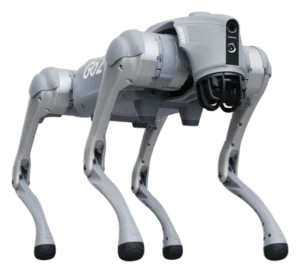
Unitree began fulfilling Go2 orders in July 2023 at a $1,600 starting price, making legged quadruped hardware commercially available outside laboratory procurement channels for the first time in this price range.
Full assessment4 claims · 4 technical notes · 2 sources
Where it standsAutonomy LadderIIIIIIIVVLevel IIAssisted AutonomyHuman ReadinessReady NowNew to MarketWaitKnown IssuesRobovations Score04055708549LimitedWhat happenedThe Air, Pro, and Edu tiers each ship with varying compute and sensor configurations.
WatchingFor shipping lead times and warranty support coverage outside China.
Bottom lineGo2's launch price expanded access to legged robotics research hardware; the developer dependency narrows the practical audience compared to marketing scope.
ImpactOn autonomy
- Preprogrammed gait routines ship ready; custom behavior requires SDK development
- Onboard sensors and API documented for third-party computer vision integration
- Level II classification confirmed at launch: locomotion scripts, no end-to-end task autonomy
On readiness
- Direct sales channel established; no third-party retail distribution at launch
- Shipping from China documented at 2-4 weeks; no North American service center
- Developer-oriented setup; not plug-and-play for non-technical buyers
Claim check4 maker claims checked against the record. Open one to read the finding.
Consumer-ready quadruped starting at $1,600
Documented findingPriced accessibly for hobbyists but requires developer skills for meaningful operation; not consumer-grade plug-and-play per community reportsCapable of autonomous outdoor navigation
Documented findingOut-of-the-box autonomy limited to preprogrammed gaits; outdoor mission autonomy requires custom SDK implementationMulti-tier options for all use cases
Documented findingAir, Pro, and Edu tiers differ in compute and sensors; Air tier lacks the onboard Jetson compute present in Pro and Edu configurationsRough terrain locomotion without operator input
Documented findingTerrain adaptation is gait-scripted; dynamic obstacle avoidance requires developer-coded behavior per Unitree SDK documentationEvidence2 sources · 1 linked
12Jul 2023Aug 2023filed 15 Aug 2023- 1Unitree Robotics Official Store1 Jul 2023
- 2IEEE Spectrum18 Jul 2023named, not linked
Technical notes4 sections
Tier Configuration at Launch
Go2 launched with three configurations: Air (base locomotion, no Jetson compute), Pro (onboard Jetson compute, upgraded sensor suite), and Edu (research-focused, full SDK and ROS2 support). Price range $1,600 to approximately $2,500 depending on tier and configuration.
Locomotion Architecture
Go2 uses Unitree’s proprietary gait control stack with preprogrammed locomotion routines for trot, bound, and crawl gaits. Terrain adaptation relies on IMU and leg-mounted sensors feeding the gait controller. The SDK exposes APIs for custom gait parameterization and external sensor integration via ROS2.
Physical Specifications
Dimensions at launch: approximately 27.6 in length, 11.2 in width, 15 in standing height. Weight reported at 26.5 lbs. Battery: 144 Wh Li-ion, rated approximately 40-60 minutes runtime depending on terrain and payload. Modular payload rail on top deck supports custom sensor and compute attachments up to documented payload limits.
Connectivity
Wi-Fi and Bluetooth. Remote control available via app; SDK connectivity over Wi-Fi for development workflows. No cellular module in base configuration.