
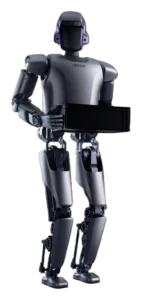
- Changes
- 4
- Tracking since
- Oct 2024
- Latest
- Sep 10, 2026
- Net movement
- Classification stable
- 2026
-
UBTech H1 2026: humanoid sales up 1,445%, $139M raised, shares down 40%
UBTech's interim results, released 28 Aug 2026, show total revenue up 104.2% year over year to RMB 1.27 billion, with full-size humanoid robot revenue up 1,445% to RMB 590.3 million on 921 units sold (up 1,946.7% in volume), now 46.5% of group revenue.
Full assessment2 claims · 3 technical notes · 2 sources
Where it standsAutonomy LadderIIIIIIIVVLevel IIAssisted AutonomyHuman ReadinessReady NowNew to MarketWaitKnown IssuesNot ratedPre-Consumer Assessment03050717675PromisingWhat happenedGross margin rose 9.7 percentage points to 44.7%. UBTech separately raised about $139 million in a post-IPO round to expand production and AI development. Despite the growth, UBTech shares remain down roughly 40% year to date.
WatchingWhether the delivered fleet's reported 30-50% of human productivity at deployments like BYD and Foxconn improves as the installed base grows.
Bottom lineReported sales and revenue growth for a new product line are real and documented, alongside a stock price and reported productivity data the same growth has not resolved.
ImpactOn autonomy
- No autonomy change tied to this financial report
- Reported unit growth reflects UBTech's full-size humanoid line broadly, including Walker S2 deployments; the reported 921-unit figure is not broken out by individual model
On readiness
- Full-size humanoid revenue is now UBTech's largest single business line at 46.5% of group revenue
- Walker robots deployed at contract manufacturers are reported operating at 30-50% of human productivity
Claim check2 maker claims checked against the record. Open one to read the finding.
Coverage frames the results as validating UBTech's humanoid strategy
Documented findingThe same period's share price fell roughly 40% year to date, and independent reporting notes deployed Walker units run at 30-50% of human productivity at customer sites, a gap the sales figures alone do not addressGrowth percentages (1,445% revenue, 1,946.7% volume) read as dramatic
Documented findingBoth figures compare against a small H1 2025 base for a new product line; the underlying absolute numbers are 921 units and RMB 590.3 million in revenueEvidence2 sources · all linked
12Aug 2026Sep 2026filed 10 Sep 2026- 1KrAsia29 Aug 2026
- 2Ad-Hoc-News10 Sep 2026
Technical notes3 sectionsInterim Results
UBTech released its 2026 interim results 28 Aug 2026. Total revenue rose 104.2% year over year to RMB 1.27 billion (approximately USD 188.5 million). Revenue from full-size embodied humanoid robot products and services rose 1,445% to RMB 590.3 million (approximately USD 87.6 million), 46.5% of group revenue, with unit sales volume of 921, up 1,946.7% year over year. Gross profit rose 160.9% to RMB 566.9 million, with gross margin up 9.7 percentage points to 44.7%.
Funding and Deployment
UBTech separately raised approximately $139 million in a post-IPO equity round to expand production capacity, new robot models, and AI systems, including data collection and simulation infrastructure. UBTech has delivered its 1,000th Walker S2 unit from its Liuzhou facility and secured multi-million-dollar orders from automotive customers including BYD, Geely Auto and FAW-Volkswagen. Independent reporting describes Walker units deployed at contract manufacturers such as BYD and Foxconn as currently operating at 30-50% of human productivity.
Market Reaction
Despite the reported growth, UBTech shares are down approximately 40% year to date as of early September 2026.
- 2025
-
UBTECH demonstrates Walker S1 swarm coordination at automotive industry showcase
UBTECH staged a public demonstration of Walker S1 units operating under BrainNet swarm coordination at a mid-2025 automotive industry event, presenting parallel task execution across a simulated assembly environment.
Full assessment4 claims · 4 technical notes · 2 sources
Where it standsAutonomy LadderIIIIIIIVVLevel IIAssisted AutonomyHuman ReadinessReady NowNew to MarketWaitKnown IssuesNot ratedPre-Consumer Assessment03050717675PromisingWhat happenedThe demo provided more detailed visibility into the BrainNet task-assignment architecture than factory pilot press coverage had previously offered.
WatchingWhether demonstration conditions (controlled environment, staged layout) translate to documented performance claims from live factory deployments.
Bottom lineThe demonstration advanced public understanding of BrainNet's architecture; the gap between showcase conditions and live factory performance remains unquantified.
ImpactOn autonomy
- BrainNet task-assignment logic publicly demonstrated across multiple concurrent Walker S1 units
- Parallel execution of distinct tasks (transport, staging, inspection support) shown in single coordinated session
- Demonstration environment structured; dynamic-obstacle response in uncontrolled settings not shown
On readiness
- Public demonstration increases visibility for industrial buyers evaluating fleet deployment
- No change to commercial availability or consumer access pathway following demo
- Pilot customer qualification process and lead times not disclosed at event
Claim check4 maker claims checked against the record. Open one to read the finding.
BrainNet enables dynamic real-time multi-robot task optimization
Documented findingDemonstration showed task assignment across parallel units in a structured environment; how the system reoptimizes under real factory variability (equipment downtime, staffing changes) was not addressed in available reportingWalker S1 performs reliably across diverse factory task types
Documented findingDemo covered transport, staging, and inspection support in sequence; each task segment used pre-defined waypoints and handoff logic consistent with scripted Level II operationSwarm coordination reduces idle time between task transitions
Documented findingDemonstration presented smooth sequential handoffs; quantified idle-time reduction relative to non-coordinated operation was not published in coverage of the eventWalker S1 ready for scaled fleet deployment in automotive factories
Documented findingManufacturer materials indicate active pilot programs; publicly documented evidence of scaled deployment (beyond small-lot pilots) is not available in coverage through mid-2025Evidence2 sources · 1 linked
129 Jul 202514 Jul 2025filed 9 Jul 2025- 1UBTECH Robotics Press Release9 Jul 2025
- 2Automotive Manufacturing Solutions14 Jul 2025named, not linked
Technical notes4 sectionsDemonstration Structure
The mid-2025 showcase involved multiple Walker S1 units operating concurrently on a simulated factory floor, with BrainNet assigning transport, bin-staging, and inspection-support tasks in sequence. The demonstration used pre-programmed waypoints consistent with the platform’s documented factory routing architecture.
BrainNet Task-Assignment Logic
UBTECH presented BrainNet’s centralized planning layer managing fleet-level task queues, prioritizing handoff timing across units, and adjusting workstation assignments based on completion state. The system’s handling of simulated task-transition edge cases was included in the demonstration sequence.
Autonomy Scope Shown
Demonstration conditions confirm the Walker S1 operates at Level II: scripted routes handle routine task segments, BrainNet provides fleet-level coordination, and teleoperation infrastructure (ROSA 2) remains available for off-script transitions. Unscripted dynamic-environment performance was not demonstrated publicly.
Relationship to Factory Pilots
UBTECH representatives referenced the ongoing BYD, Foxconn, and Zeekr pilot deployments as the operational context that informed the demonstration scenario. The showcase task layout was described as representative of parts-transport and inspection-staging workflows active in those pilots.
-
Walker S1 Foxconn pilot deployment reported in factory automation press
Factory automation press reported Walker S1 units operating at Foxconn facilities in early 2025, providing the first external coverage of the BrainNet multi-robot coordination layer in a production-adjacent setting.
Full assessment4 claims · 4 technical notes · 2 sources
Where it standsAutonomy LadderIIIIIIIVVLevel IIAssisted AutonomyHuman ReadinessReady NowNew to MarketWaitKnown IssuesNot ratedPre-Consumer Assessment03050717675PromisingWhat happenedReports described multiple units handling parallel inspection tasks under operator supervision, consistent with the Level II operational model UBTECH disclosed at launch.
WatchingWhether Foxconn expands from pilot to scaled deployment and whether throughput data from the pilot is released.
Bottom lineThird-party press corroborates the Foxconn deployment as a real pilot, though scale and performance data remain proprietary at this stage.
ImpactOn autonomy
- Multi-robot BrainNet coordination reported in production-adjacent inspection tasks
- Parallel workstation handling across multiple Walker S1 units documented in press coverage
- Operator supervision confirmed as standard for task transitions in pilot operations
On readiness
- Third-party press corroborates factory deployment claims from manufacturer announcements
- Foxconn pilot scope (inspection) adds a second documented task category alongside logistics
- No commercial availability or pricing data disclosed; industrial pilot access only
Claim check4 maker claims checked against the record. Open one to read the finding.
BrainNet enables real-time swarm coordination across factory floors
Documented findingPress coverage describes multi-unit operation at parallel workstations; real-time responsiveness to dynamic events not independently benchmarked in available reportingWalker S1 operates autonomously across inspection workflows
Documented findingOperator supervision documented as standard procedure for task transitions; scripted routes handle routine segments of the inspection cycleFoxconn deployment demonstrates production-scale viability
Documented findingThird-party reporting confirms pilot deployment; scale of units deployed and production-line integration depth not disclosed in available press coverageWalker S1 reduces reliance on human labor in inspection tasks
Documented findingPlatform handles parallel task staging under supervision; labor displacement or efficiency metrics not published in press coverage reviewedEvidence2 sources · 1 linked
1210 Mar 202517 Mar 2025filed 14 Mar 2025- 1The Robot Report10 Mar 2025
- 2Robotics Business Review17 Mar 2025named, not linked
Technical notes4 sectionsDeployment Context
Factory automation press in early 2025 described Walker S1 units at Foxconn operating in inspection-adjacent roles, with BrainNet assigning tasks to multiple units at parallel workstations. The coverage aligned with UBTECH’s launch-time description of Foxconn as a pilot partner for inspection operations.
BrainNet in Operation
Third-party reporting described centralized task assignment across multiple Walker S1 units, with BrainNet managing handoff timing and workstation sequencing. Operator intervention for edge cases (obstacle avoidance, unscripted task variants) was described as part of the standard pilot workflow.
Operational Model Consistent with Level II
Press descriptions of the Foxconn pilot align with the Walker S1’s Level II classification: scripted routing handles routine loops, ROSA 2 teleoperation remains available for complex transitions, and on-site technician teams manage shift scheduling and exception handling.
Zeekr Coverage Overlap
Some press coverage from this period also referenced Zeekr (an electric vehicle brand) as a Walker S1 pilot site for parts handling tasks. The Zeekr and Foxconn pilots appear to have proceeded in parallel, both under the BrainNet coordination platform.
- 2024
-
UBTECH Walker S1 industrial humanoid unveiled at October 2024 event
UBTECH formally introduced the Walker S1 as its first purpose-built industrial bipedal humanoid in October 2024, disclosing specifications for the 76 kg platform and confirming pilot deployments at BYD and Foxconn manufacturing facilities.
Full assessment4 claims · 4 technical notes · 2 sources
Where it standsAutonomy LadderIIIIIIIVVLevel IIAssisted AutonomyHuman ReadinessReady NowNew to MarketWaitKnown IssuesNot ratedPre-Consumer Assessment03050717675PromisingWhat happenedThe announcement established the Walker S1 as distinct from earlier Walker prototype series.
WatchingWhether disclosed pilot scope translates into multi-site contract announcements within the following 12 months.
Bottom lineThe October 2024 announcement established a credible industrial positioning but left key performance evidence to be demonstrated through pilot outcomes.
ImpactOn autonomy
- Bipedal mobility with dexterous arms disclosed for structured factory routing
- ROSA 2 and BrainNet coordination layer announced as autonomy infrastructure
- Scripted waypoint navigation and docking sequences documented as initial autonomy scope
On readiness
- Industrial pilot access confirmed at BYD and Foxconn; no consumer path announced
- Platform positioned exclusively for capital-intensive factory integration
- Requires on-site technician team; individual or SME deployment not yet viable
Claim check4 maker claims checked against the record. Open one to read the finding.
General-purpose industrial humanoid ready for factory deployment
Documented findingManufacturer announcements document pilots at specific automotive facilities; general industrial applicability across sectors not yet independently verifiedBrainNet enables seamless multi-robot swarm coordination
Documented findingBrainNet architecture described in manufacturer materials; field performance metrics and scalability limits not yet reported by third partiesWalker S1 represents a breakthrough in industrial humanoid capability
Documented findingPlatform delivers bipedal mobility with scripted task execution; teleoperation remains available for complex transitions, capping autonomy at Level II per documented operationFactory pilots at BYD and Foxconn confirm production-readiness
Documented findingPilot deployments confirmed in manufacturer announcements; production throughput data and multi-site contract details not publicly disclosed at launchEvidence2 sources · 1 linked
1218 Oct 202422 Oct 2024filed 18 Oct 2024- 1UBTECH Robotics Press Release18 Oct 2024named, not linked
- 2IEEE Spectrum22 Oct 2024
Technical notes4 sections
Platform Specifications
UBTECH disclosed the Walker S1 as a 76 kg bipedal humanoid standing 1.72 m tall with a reported runtime of approximately 5 hours per charge cycle. The platform uses semantic VSLAM for navigation alongside the ROSA 2 control system.
BrainNet Architecture
BrainNet is UBTECH’s multi-robot orchestration layer, announced alongside the Walker S1 unveiling. The system assigns parallel tasks to multiple Walker S1 units and adjusts handoff points based on factory floor state. Centralized task planning handles fleet scheduling.
Autonomy Scope at Launch
At announcement, the Walker S1 operated via pre-programmed waypoints and docking sequences within structured factory environments. Task transitions involving loading or dynamic obstacle avoidance required operator intervention through BrainNet or ROSA 2 teleoperation. End-to-end unscripted task completion was not claimed at this stage.
Pilot Partners Confirmed
Manufacturer materials at launch named BYD (parts logistics) and Foxconn (assembly inspection) as pilot sites. Zeekr pilot partnership was referenced in subsequent press coverage but was not foregrounded in the October announcement itself.