
- Changes
- 2
- Tracking since
- Aug 2024
- Latest
- Nov 20, 2024
- Net movement
- Classification stable
- 2024
-
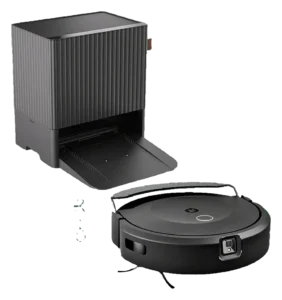
iRobot firmware update addresses Combo 10 Max dock wash-jet and drain issues
iRobot pushed firmware updates to the Combo 10 Max in late 2024 addressing dock pressure-sensor calibration and drain-port water-clearance behavior, in response to early owner-reported wash-jet clogging and pooled water in the dock wash chamber.
Full assessment3 claims · 3 technical notes · 2 sources
Where it standsAutonomy LadderIIIIIIIVVLevel IIIConditional AutonomyHuman ReadinessReady NowNew to MarketWaitKnown IssuesNot ratedRobovations Score04055708559CapableWhat happenedThe updates adjusted jet-cycle timing and drain-port flush duration. Whether the patches fully resolve mineral-deposit accumulation over longer usage periods remains the primary variable to monitor.
Bottom lineThe firmware update addresses documented dock-cycle timing issues and represents a standard early-production iteration; it does not reclassify the dock as maintenance-free.
ImpactOn autonomy
- Dock wash-cycle reliability improvement reduces mid-schedule interruptions from clogged jets.
- vSLAM navigation behavior and obstacle detection unchanged by this update.
On readiness
- Reduced frequency of dock-jet clogging events lowers reactive maintenance burden for early adopters.
- Monthly vinegar-flush maintenance requirement remains in place per updated iRobot support documentation.
- Owners already experiencing jet clogging still require manual cleaning before firmware improvement takes effect.
Claim check3 maker claims checked against the record. Open one to read the finding.
Firmware update resolves dock clogging
Documented findingiRobot firmware release notes describe pressure-sensor calibration and drain-port timing changes; whether this eliminates or reduces clogging frequency in hard-water households is not quantified in official documentationAutoWash dock is self-maintaining
Documented findingUpdated iRobot support documentation continues to specify weekly tap-water rinse and monthly diluted-vinegar flush as required maintenance steps; the firmware does not replace physical maintenanceOver-the-air update requires no owner action
Documented findingFirmware updates deliver via Wi-Fi automatically when the robot is docked; owner must ensure dock is powered and robot is connected to the home network, per iRobot support guidanceEvidence2 sources · 0 linked
1215 Nov 202422 Nov 2024filed 20 Nov 2024
- 1iRobot Support Documentation15 Nov 2024named, not linked
- 2Reddit r/roomba22 Nov 2024named, not linked
Technical notes3 sections
Dock Pressure-Sensor Calibration
iRobot firmware release notes from late 2024 describe adjustments to the dock’s wash-chamber pressure-sensor calibration. Prior firmware allowed the jet cycle to proceed even when sensor readings indicated low flow, masking partial clogs until they became complete blockages. The update adds a flow-rate threshold check that halts the cycle and triggers an app alert on sub-threshold readings.
Drain-Port Flush Duration
Drain-port flush timing was extended to improve complete water clearance after the wash cycle. Early units showed residual standing water in the wash chamber on rapid-schedule cleaning (multiple runs per day), which accelerated mineral deposit formation. Extended flush duration reduces standing-water dwell time between cycles.
Delivery Method
Update delivered over-the-air via iRobot Home app. Robot must be docked and connected to Wi-Fi. No hardware replacement required. iRobot support documentation updated to reflect revised maintenance guidance alongside the firmware release.
-
iRobot Roomba Combo 10 Max launches commercially with AutoWash dock
iRobot released the Combo 10 Max in September 2024 at $1,399, pairing the j-series vacuum platform with an AutoWash dock that washes and heat-dries the mop pad automatically after each run.
Full assessment5 claims · 3 technical notes · 2 sources
Where it standsAutonomy LadderIIIIIIIVVLevel IIIConditional AutonomyHuman ReadinessReady NowNew to MarketWaitKnown IssuesNot ratedRobovations Score04055708559CapableWhat happenedThe dock system is the most significant hardware addition to iRobot's consumer vacuum-mop line since the Combo j9+.
WatchingFor early owner reports on dock wash-cycle reliability and mineral-deposit accumulation over the first three to six months of use.
Bottom lineThe dock automation is a real and documented convenience upgrade; the headline constraints are water logistics on larger floors and dock maintenance demands that become apparent after the first two to three months.
ImpactOn autonomy
- AutoWash dock enables continuous mop schedules without manual pad-washing between sessions.
- Camera-based obstacle detection and vSLAM navigation carry over from proven j-series platform.
- Mop-pad auto-lift on carpet detection reduces operator mode-switching for mixed-floor households.
On readiness
- Self-wash dock reduces between-cycle owner effort versus all prior iRobot Combo models.
- Retail availability through iRobot direct, Best Buy, and Amazon at launch lowers acquisition friction.
- Ongoing dock maintenance (weekly rinse, monthly vinegar flush) remains a required owner commitment.
Claim check5 maker claims checked against the record. Open one to read the finding.
AutoWash dock eliminates mop-pad maintenance entirely
Documented findingDock automates between-cycle pad washing; owner must still replace pads every two to three months and perform weekly jet-rinse to prevent mineral clogging, per iRobot user guideCleans up to 1,000 sq ft per charge
Documented findingManufacturer specification lists 175-minute runtime; owner reports confirm water-tank capacity, not battery, limits continuous mop coverage to approximately 800-1,000 sq ft before dock return for refillIntelligently adapts cleaning to surface type
Documented findingFloor-type sensor triggers mop-pad lift on carpet; mop-pad rotation speed is fixed and does not adapt to surface soiling level, per product documentation and early owner reportsSame Level III navigation as j-series flagship
Documented findingvSLAM camera navigation and room-level scheduling carry over from j-series; no new navigation hardware introduced for this modelDock auto-refill means no water-tank management
Documented findingDock refills tank between runs; owners must keep dock water reservoir filled manually, typically requiring a weekly top-off for daily-use householdsEvidence2 sources · 1 linked
12Aug 2024Sep 2024filed 1 Aug 2024- 1iRobot Press Release10 Sep 2024
- 2TechRadar18 Sep 2024named, not linked
Technical notes3 sections
Vacuum and Navigation Platform
The Combo 10 Max uses the j-series vSLAM navigation stack with front-facing camera and IMU. Suction is rated at 4,500 Pa. Dimensions are 13.3 in diameter by 3.6 in height, with a weight of approximately 11 lbs. Battery capacity is 60 Wh with a rated 175-minute runtime and 180-minute charge time.
AutoWash Dock System
The AutoWash dock performs three functions: auto-empty of the dustbin into a sealed bag, auto-fill of the robot water tank before mop runs, and wash-plus-heated-dry of the mop pad after each run. Wash jets dispense water across the pad surface; a heating element dries the pad before the next scheduled session. iRobot documentation identifies the dock as model X085020 paired hardware.
Connectivity and Control
Wi-Fi connectivity with iRobot Home app. Compatible with Amazon Alexa and Google Home voice control. Multi-floor persistent maps supported. Room-level scheduling allows vacuum-only and mop-only zone assignments per floor.