
- Changes
- 4
- Tracking since
- Mar 2025
- Latest
- Aug 24, 2026
- Net movement
- Classification stable
- 2026
-
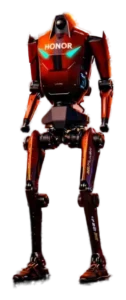
Honor D1 Lightning humanoid runs 100m in 9.47 seconds at World Humanoid Robot Games
At the World Humanoid Robot Games in Beijing, Honor's Lightning humanoid ran the 100m in 9.47 seconds during an official heat, faster than Usain Bolt's 9.58-second human record.
Full assessment4 claims · 4 technical notes · 3 sources
Where it standsAutonomy LadderIIIIIIIVVLevel IIIConditional AutonomyHuman ReadinessReady NowNew to MarketWaitKnown IssuesNot ratedPre-Consumer Assessment03050717662PlausibleWhat happenedIt struck a padded wall after crossing the line, echoing the stopping-control issue from its April half-marathon. Whether Honor resolves deceleration control, not sprint speed, is what future runs should show.
Bottom lineThe competition sprint time is documented and faster than the human record, but the same run again exposed unresolved stopping control.
ImpactOn autonomy
- Official 100m time of 9.47 seconds confirms sustained high-speed bipedal locomotion under competition conditions
- Post-finish collision with a padded wall shows deceleration and stopping control remain unresolved
- Unofficial 9.32-second practice run, reaching about 14.5 m/s, is not a competition result
- No manipulation, hands, or unprepared-environment operation demonstrated in this sprint event
On readiness
- Event took place on a prepared competition track, not an unstructured consumer environment
- No ship date, price, or distribution plan was disclosed alongside this demonstration
- Post-finish wall collision repeats the recovery pattern from the April half-marathon assistance
Claim check4 maker claims checked against the record. Open one to read the finding.
Coverage described the run as surpassing Usain Bolt's 100m record
Documented findingThe Verge, Interesting Engineering, and Gizmodo report an official heat time of 9.47 seconds, 0.11 seconds faster than Bolt's 9.58-second record set in 2009A widely cited 9.32-second time for the robot
Documented findingThat figure was an unofficial pre-competition practice run reaching a peak speed of about 14.5 m/s, not the sanctioned competition resultCoverage implies a clean, complete run
Documented findingThe robot collided with a padded wall after crossing the finish line in the competition heat, consistent with a stopping-control issue documented in its April 2026 half-marathonFraming suggests Lightning was the fastest machine at WHRG
Documented findingTiangong Ultra, a separate humanoid built by the Beijing Humanoid Robot Innovation Center, posted a faster preliminary heat time of 9.39 secondsEvidence3 sources · all linked
21322 Aug 202624 Aug 2026filed 24 Aug 2026- 1The Verge23 Aug 2026
- 2Interesting Engineering22 Aug 2026
- 3Gizmodo24 Aug 2026
Technical notes4 sectionsCompetition Result
In an official heat at the World Humanoid Robot Games (WHRG) in Beijing, Honor’s Lightning humanoid recorded a 100m time of 9.47 seconds. That is 0.11 seconds faster than Usain Bolt’s 9.58-second 100m world record, set in 2009. The result came from a sanctioned competition heat, not a head-to-head race against a human runner.
Unofficial Practice Run
Before the competition, an earlier trial run reportedly clocked 9.32 seconds, with a peak speed of about 14.5 m/s. That figure was recorded outside official competition and has not been verified to the same standard as the heat time; it is a practice data point, not the competition result.
Post-Finish Collision
After crossing the finish line in the competition run, the robot collided with a padded wall positioned beyond the track. The event mirrors an April 2026 half-marathon run (50:26) in which the same robot required handler assistance after striking a railing near the finish, pointing to a recurring deceleration and stopping-control limitation rather than an isolated incident.
Event Context
Tiangong Ultra, built by the Beijing Humanoid Robot Innovation Center and not a Robovations-tracked product, posted a faster preliminary heat time of 9.39 seconds, the fastest humanoid time recorded at WHRG.
-
Honor D1 Lightning completes Beijing E-Town half-marathon autonomously in 50:26
Honor D1 Lightning completed the Beijing E-Town half-marathon course autonomously in a reported 50:26, covering 21 km on a marked course with safety personnel and power infrastructure in place.
Full assessment5 claims · 4 technical notes · 2 sources
Where it standsAutonomy LadderIIIIIIIVVLevel IIIConditional AutonomyHuman ReadinessReady NowNew to MarketWaitKnown IssuesNot ratedPre-Consumer Assessment↑ moved by this entry03050717662PlausibleWhat happenedXinhua News Agency documented the event as an autonomous run without remote-pilot intervention.
WatchingWhether Honor publishes navigation logs, sensor architecture, or a follow-on demo in an uncontrolled environment.
ImpactOn autonomy
- End-to-end autonomous navigation sustained over 21 km on a prepared course confirmed
- Dynamic balance and gait control at running pace documented without teleoperator intervention
- Longest documented continuous autonomous run by a bipedal humanoid at time of event
- Generalization to unstructured or dynamic environments remains undemonstrated
On readiness
- Pre-release status unchanged; no pricing, ship date, or consumer channel announced alongside event
- Demo framing (controlled course, safety personnel) limits direct consumer-readiness inference
- Locomotion achievement credibility strengthens investor and research interest, not retail pathway
Claim check5 maker claims checked against the record. Open one to read the finding.
Honor D1 Lightning ran the half-marathon autonomously
Documented findingXinhua News Agency reported no teleoperator intervention during the 21 km run; the course was marked and safety personnel were present throughout50:26 finish time demonstrated competitive-pace locomotion
Documented findingTime was reported by Xinhua; no independent race timing or sensor data log was published alongside the eventMarathon performance shows real-world capability
Documented findingThe event used a prepared, known-layout course with race infrastructure; generalization to novel unstructured environments was not demonstratedHonor D1 Lightning is ready for deployment
Documented findingHonor made no deployment or commercial claims at the event; the run was framed as an engineering demonstration under the Alpha StrategyLocomotion capability sets Lightning apart from other humanoids
Documented findingNo other bipedal humanoid has a publicly documented autonomous half-marathon run at time of event; comparison on manipulation or task autonomy remains incompleteEvidence2 sources · all linked
1219 Apr 202621 Apr 2026filed 19 Apr 2026- 1Xinhua News Agency19 Apr 2026
- 2IEEE Spectrum21 Apr 2026
Technical notes4 sectionsEvent Details
The Beijing E-Town half-marathon took place on a closed or marshalled course in the E-Town (Economic and Technological Development Zone) district of Beijing. The robot completed the 21 km route under on-board autonomous navigation control. Safety personnel and a support team were present; power supply arrangements during the run were not detailed in public coverage.
Locomotion Architecture
Honor has not disclosed the sensor stack enabling the marathon run. Bipedal gait at running pace requires minimum IMU-based balance feedback and vision or LiDAR-assisted path following. The specific sensor combination, processing hardware, and gait-control algorithm remain proprietary.
Performance Parameters
Reported finish time: 50:26 for 21 km. Pace and stride metrics were not published. Battery consumption per kilometre and any rest or charging stops during the event were not documented in available coverage.
Autonomy Scope
The event qualifies as Level III (Conditional Autonomy): end-to-end autonomous execution within a defined, prepared environment. Extension to unstructured navigation without a marked course and support infrastructure has not been demonstrated.
-
Honor D1 Lightning returns to MWC 2026 with agility demonstrations on stage
Honor brought Lightning to MWC 2026 in Barcelona for live agility demonstrations on stage, one year after the initial Alpha Strategy reveal at MWC 2025.
Full assessment4 claims · 4 technical notes · 2 sources
Where it standsAutonomy LadderIIIIIIIVVLevel IIIConditional AutonomyHuman ReadinessReady NowNew to MarketWaitKnown IssuesNot ratedPre-Consumer Assessment03050717662PlausibleWhat happenedThe demos showed dynamic motion sequences but were not accompanied by a hardware specification release, autonomy benchmark, or commercial timeline announcement.
WatchingWhether Honor follows MWC 2026 with a specification disclosure, given the April 2026 marathon demo raised the expectation.
ImpactOn autonomy
- Live stage agility sequences shown in Barcelona; teleop status for demo not confirmed
- No new autonomy benchmarks or navigation metrics published alongside MWC 2026 demos
- Dynamic motion repertoire visible but scope of on-board autonomous control not disclosed
On readiness
- Pre-release designation continues unchanged through MWC 2026
- No commercial pathway, pricing, or ship-date announcement made at the event
- Public demo cadence (two consecutive MWC appearances) signals sustained programme investment
Claim check4 maker claims checked against the record. Open one to read the finding.
MWC 2026 demos show advanced agility capability
Documented findingLive stage motion sequences were observed; whether sequences were fully autonomous or choreographed with operator cuing was not disclosed by HonorHonor D1 Lightning represents a year of development progress
Documented findingTwelve months elapsed between MWC 2025 and MWC 2026 appearances; no specification delta or version changelog was published to document engineering progressContinued MWC presence signals commercial seriousness
Documented findingTwo consecutive MWC demos establish programme continuity; a commercial commitment or distribution announcement was not made at either eventAlpha Strategy is delivering on its roadmap
Documented findingHonor has not published an Alpha Strategy roadmap with milestones; strategic framing continues without a publicly measurable scheduleEvidence2 sources · 1 linked
123 Mar 20266 Mar 2026filed 5 Mar 2026- 1GSMA / MWC 2026 Official Programme3 Mar 2026
- 2The Robot Report6 Mar 2026named, not linked
Technical notes4 sectionsDemo Format
Honor staged live on-floor or on-stage demonstrations of Lightning at MWC 2026, Barcelona. The specific agility sequences shown (running, jumping, object interaction, or combined gait patterns) were reported in trade press coverage but Honor released no formal demo specification or technical briefing document.
Hardware Revision Status
Honor did not announce a hardware revision designation or model number at MWC 2026. Whether the unit shown represented the same hardware platform as the MWC 2025 reveal or an updated prototype was not disclosed.
Alpha Strategy Continuity
The Alpha Strategy framing introduced in 2025 continued without a published milestone or timeline update. Honor’s MWC 2026 communications maintained the same positioning: robotics as a long-term strategic programme under the Huawei ecosystem umbrella, with commercial specifics deferred.
Specification Gaps
Sensor architecture, actuator count, joint specifications, battery runtime, and manipulation capability all remained undisclosed through MWC 2026. The marathon event in April 2026 (one month post-MWC) subsequently provided the most substantive public evidence of autonomy scope to date.
- 2025
-
Honor D1 Lightning unveiled at MWC 2025 under Alpha Strategy
Honor introduced the Lightning humanoid at MWC 2025 as the first public reveal under its Alpha Strategy robotics programme.
Full assessment4 claims · 3 technical notes · 2 sources
Where it standsAutonomy LadderIIIIIIIVVLevel IIIConditional AutonomyHuman ReadinessReady NowNew to MarketWaitKnown IssuesNot ratedPre-Consumer Assessment03050717662PlausibleWhat happenedThe announcement confirmed bipedal form factor and Huawei Mobile Services AI integration, but no sensor architecture, price, or delivery timeline was published.
WatchingWhether the Alpha Strategy framing resolves into a concrete development roadmap.
ImpactOn autonomy
- Bipedal form factor and AI processing integration publicly confirmed for the first time
- Huawei HMS AI stack announced as the onboard processing platform
- Autonomous locomotion scope not quantified in launch materials
On readiness
- Pre-release designation established; no consumer pathway announced at reveal
- No pricing or ship-date commitment made alongside the announcement
- Alpha Strategy language signals multi-year timeline before any commercial availability
Claim check4 maker claims checked against the record. Open one to read the finding.
Alpha Strategy positions Honor as a humanoid robotics contender
Documented findingLaunch materials described strategic intent; no prototype specs or autonomy benchmarks were published alongside the revealHuawei AI integration enables advanced onboard processing
Documented findingHMS AI stack was named as the platform; specific processing benchmarks and sensor pairing were not disclosedBipedal humanoid designed for real-world interaction
Documented findingForm factor was confirmed; manipulation capability, gripper specs, and real-world task envelope were not demonstrated at MWC 2025Honor signals serious robotics programme
Documented findingAnnouncement established the programme exists; engineering milestones and development schedule were not publishedEvidence2 sources · 1 linked
123 Mar 20257 Mar 2025filed 7 Mar 2025- 1GSMA / MWC 2025 Official Programme3 Mar 2025named, not linked
- 2South China Morning Post7 Mar 2025
Technical notes3 sections
Form Factor and Platform
Honor D1 Lightning was publicly confirmed as a full-body bipedal humanoid at MWC 2025. Huawei Mobile Services AI was named as the onboard AI processing layer. No sensor suite, actuator specifications, joint count, or structural materials were disclosed in launch materials.
Alpha Strategy Context
The Alpha Strategy framing positions Lightning as the first in a planned series of robotics announcements rather than a near-commercial product. Honor explicitly declined to publish a development timeline or hardware specification sheet at the MWC 2025 reveal.
Open Architecture Questions
Locomotion architecture, navigation sensor stack, battery system, and manipulator specs were all undisclosed. The reveal established product existence and strategic framing; technical depth was deferred to subsequent announcements.