
- Changes
- 4
- Tracking since
- Jun 2024
- Latest
- Apr 3, 2026
- Net movement
- Classification stable
- 2026
-
Foundation secures $24 million Pentagon contract portfolio with SBIR Phase III designation
Foundation disclosed a $24 million contract portfolio spanning the US Army, Navy, and Air Force in April 2026, including an SBIR Phase III designation that opens a commercialization pathway for federally funded technology.
Full assessment
AutonomyLII confirmedReadinessPromising progress strengthenedScore+5 overallOne contract element was inherited via Foundation's acquisition of Boardwalk, which held a US Air Force SBIR award valued at approximately $1.8 million.
WatchingWhether the Pentagon relationship expands beyond the two-year research window into procurement, and how oversight scrutiny over Eric Trump's involvement as strategic adviser shapes the contract's political durability.
Impact on autonomy
- Pentagon contracts fund testing of Phantom in breaching scenarios not covered by earlier automotive factory pilots
- SBIR Phase III pathway formalizes a commercialization route from government research into military procurement
- Autonomy classification unchanged; teleoperation-dependent operating model remains integral to military use case
- Army, Navy, and Air Force involvement suggests multi-service evaluation of the platform's operating envelope
Impact on readiness
- SBIR Phase III designation qualifies Foundation as an approved military vendor, opening a distinct procurement channel
- $24 million contract portfolio represents largest confirmed external validation of the platform to date
- No commercial consumer or industrial retail channel created; defense-contractor pathway distinct from lease model
- Contracts inherited through Boardwalk acquisition partially account for the portfolio total, per The Next Web
Claim check4 claims reviewed
$24 million in Pentagon contracts validates Foundation as a credible defense supplierSBIR contracts are research agreements, not procurement contracts. The SBIR Phase III designation opens a commercialization pathway; it does not guarantee procurement volume. Semafor noted the April 2026 context of the Pentagon broadly testing multiple humanoid startups.Foundation received $24 million in new government fundingThe portfolio includes a contract inherited via acquisition of Boardwalk (approximately $1.8 million Air Force SBIR), per The Next Web. The headline figure aggregates prior awards with new agreements.Eric Trump's strategic adviser role demonstrates strong government confidenceTrump's role began by March 2026 per TIME reporting. Congressional members characterized the contracts as a conflict of interest given the adviser's family connection to the administration; the Pentagon contract's political context drew scrutiny from multiple oversight-focused outlets.Contracts fund robots designed to breach enemy positionsContract scope for breaching scenarios confirmed across Army, Navy, and Air Force by The Next Web and Semafor. Testing underway in Ukraine as of April 2026.Bottom lineThe $24 million portfolio is the largest confirmed external validation of the Phantom platform; the SBIR Phase III designation creates a genuine procurement pathway, but the political scrutiny and inherited-contract composition complicate the headline figure.
Technical notes4 sections
- Contract Portfolio Composition
-
The $24 million total spans research contracts with the US Army, Navy, and Air Force. One component, an Air Force SBIR award valued at approximately $1.8 million, was inherited through Foundation’s acquisition of Boardwalk rather than awarded directly to Foundation, per The Next Web’s April 2026 reporting.
- SBIR Phase III Designation
-
The SBIR Phase III pathway allows a federally funded technology to move from research and development into commercialization without additional competitive procurement barriers. The designation qualifies Foundation as an approved military vendor, a status distinct from the company’s existing industrial lease model. Contract duration reported as two years by Semafor.
- Eric Trump Involvement
-
TIME described Eric Trump as an investor and newly appointed chief strategic adviser to Foundation by March 2026, shortly before the Pentagon contract disclosure. Congressional oversight attention to the contract was documented by Democracy Now and other outlets in April 2026. The political context does not alter the SBIR classification or the technical scope of the contracts.
- Ukraine Connection
-
Pentagon testing confirmed as concurrent with the two Phantom MK1 units deployed to Ukraine in February 2026. The Semafor and Next Web April 2026 reporting framed the contract announcement and Ukraine deployment as connected elements of the same military testing program.
-
Two Phantom MK1 units deployed to Ukraine for frontline logistics and reconnaissance testing
Two Phantom MK1 units arrived in Ukraine in February 2026 for supervised testing in logistics and reconnaissance roles, representing the first reported deployment of a humanoid robot to an active front line.
Full assessment
AutonomyLII confirmedReadinessPromising progress strengthenedScoreScores unchangedUkrainian testing disclosed four significant operational constraints: approximately 20 kg payload ceiling, no waterproofing, estimated 2-3 hour battery runtime, and vulnerability to signal jamming.
WatchingWhether MK2, which Foundation described as having doubled payload capacity, addresses the limitations identified in the Ukraine trials.
Impact on autonomy
- Supervised teleoperation confirmed as active operating mode in live deployment, consistent with Level II classification
- Camera-only perception tested in debris-strewn outdoor environments, conditions not represented in earlier factory pilots
- LLM-plus-physics stack evaluated under conditions outside controlled industrial settings for the first time
- No autonomous task completion without human operator documented in deployment reporting
Impact on readiness
- First real-world deployment outside controlled factory context confirmed by multiple press reports
- Four operational constraints documented: 20 kg payload cap, no waterproofing, 2-3 hour battery, signal-jamming vulnerability
- Deployment limited to two units at logistics and reconnaissance support roles, not combat operations
- Foundation CEO stated tests demonstrated potential while acknowledging technology remains far from autonomous soldier capability
Claim check4 claims reviewed
Phantom MK1 suited for frontline combat roles and breaching enemy positionsUkraine tests used the robots in logistics and reconnaissance support, not combat. CEO Sankaet Pathak acknowledged technology is far from the concept of autonomous soldiers, per Militarnyi reporting (May 2026).Robots navigated debris-strewn paths and delivered supplies under fireFoundation and press sources corroborate logistics and reconnaissance tasks; human teleoperators remained active during operations per consistent reporting on the operating model.Platform designed for harsh outdoor environmentsFoundation has publicly acknowledged the Phantom MK1 is not waterproof. Battery runtime of approximately 2-3 hours constrains sustained outdoor operation.Humanoid form factor provides operational advantage over conventional robotsUkrainian testing documented reliability concerns with approximately 20 motors requiring simultaneous flawless function, and signal-jamming and spoofing vulnerability in contested RF environments.Bottom lineThe deployment advanced proof-of-concept in a live conflict environment; documented hardware limitations and the teleoperation dependency kept the robots in a support role rather than the autonomous combat capability the company's public framing suggested.
Technical notes4 sections
- Deployment Scope
-
Two Phantom MK1 units transferred to Ukraine in February 2026. Tasks included logistics runs and reconnaissance sweeps in hazardous forward areas. The deployment was described by multiple outlets as the first known instance of a humanoid robot tested on the front lines of the Russia-Ukraine war.
- Documented Limitations from Field Testing
-
Testing in Ukraine surfaced four hardware constraints reported by Militarnyi (May 2026): (1) payload capacity limited to approximately 20 kg, insufficient for many logistics loads; (2) no waterproofing, restricting wet-environment and outdoor rainfall operation; (3) battery runtime of approximately 2-3 hours, requiring coordinated charge scheduling in field conditions; (4) approximately 20 motors requiring simultaneous reliable function, creating failure-surface concerns in sustained deployment.
- Operating Model
-
Human operators retained active teleoperator authority throughout the Ukraine trials. Foundation’s stated philosophy keeps a human in the loop for lethal decisions. VR headset and supervised remote control modes confirmed as active in deployment, consistent with the Level II classification cap under the Autonomy Ladder framework.
- MK2 Timeline
-
Foundation CEO Sankaet Pathak described an upgraded Phantom 2 with approximately double the payload capacity as planned for 2026 deployment, addressing the payload constraint identified in Ukraine. No specific delivery date was confirmed.
- 2025
-
Foundation publicly reveals Phantom humanoid targeting industrial and defense markets
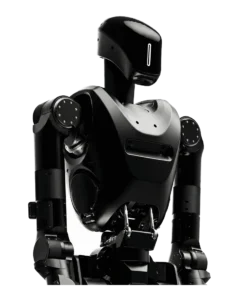
Foundation came out of stealth on April 23, 2025, disclosing the Phantom MK1 as a 175 cm, 80 kg bipedal humanoid built around proprietary cycloidal (rolling contact) gearboxes rather than harmonic drives.
Full assessment
AutonomyLII confirmedReadinessPromising progress strengthenedScoreScores unchangedThe reveal confirmed a dual industrial-and-defense commercial strategy, with first customer deliveries targeted for April or May 2025.
WatchingWhether the actuator efficiency claims (90-95% versus a stated 50-60% for harmonic drives) hold under sustained factory load, and whether the 40-unit 2025 shipping target is met.
Impact on autonomy
- Camera-only perception (no LiDAR) disclosed as deliberate architecture decision for reliability
- Hybrid LLM-plus-physics AI stack confirmed for locomotion and task execution
- VR teleoperation retained as primary intervention model, capping autonomous classification at Level II
- Reinforcement learning gait system disclosed alongside physics-based state models
Impact on readiness
- First customer deliveries targeted April-May 2025 via lease model at approximately $100,000 per year
- Automotive manufacturing and logistics named as primary deployment verticals
- Initial units planned as tethered power, constraining untethered shift-length operation
- No retail or direct-purchase channel disclosed; access limited to industrial and defense partners
Claim check4 claims reviewed
Rolling contact gearboxes deliver 90-95% energy efficiency versus 50-60% for competitorsManufacturer-stated figures; no independent benchmarks published at announcement date. Harmonic drive comparison baseline not sourced to a third-party test.Phantom targets 40 units shipped in 2025, scaling to 10,000 in 2026Company raised approximately $12 million seed funding at announcement; no independent production verification exists. The 250x scale jump has not been substantiated by factory capacity disclosures.Camera-only perception simplifies data integration and improves reliability in harsh environmentsEight-camera architecture confirmed by manufacturer; reliability advantage over LiDAR in industrial dust environments has not been independently validated at the time of the reveal.Phantom suitable for automotive manufacturing, logistics, defense, and space constructionTarget verticals stated by manufacturer at reveal. Automotive pilot deployments were described as upcoming; no completed deployments were documented at announcement.Bottom lineThe reveal established genuine hardware differentiation at the actuator level, but commercial and efficiency claims remained manufacturer-only at time of announcement.
Technical notes4 sections
- Actuator Architecture
-
Foundation disclosed proprietary cycloidal (rolling contact) gearboxes as the Phantom MK1’s primary differentiator. The company claims 90-95% energy efficiency and improved torque density versus harmonic drive alternatives, targeting approximately 20 kg payload capacity with compliance suited for human-proximate operation. No third-party verification of these figures was available at announcement.
- Perception System
-
Eight cameras, no LiDAR. Foundation framed the camera-only approach as a deliberate reliability decision for harsh industrial environments, pairing it with a hybrid AI stack combining imitation learning with physics-based state models and large language model reasoning layers.
- Form Factor
-
175 cm height, approximately 80 kg. Titanium rod frame. Designed to fit existing assembly line geometries built around human workers, reducing facility retrofit requirements. Initial units required tethered power; battery-powered variants were planned but not shipped at reveal.
- AI Architecture
-
Hybrid system combining LLM reasoning with a Deep Variational Bayes Filter locomotion controller and reinforcement learning gait generation. VR teleoperation and supervised remote control retained as primary intervention modes for tasks outside the robot’s autonomous operating domain.
- 2024
-
CNBC reports Foundation fundraising materials contained exaggerated GM partnership claims
CNBC reported on June 12, 2024, that Foundation's investor pitch deck claimed GM had committed to invest and placed a targeted $300 million purchase order; GM flatly denied both claims.
Full assessment
AutonomyLII unchangedReadinessPromising progress strengthenedScoreScores unchangedFoundation cofounder Mike LeBlanc confirmed the denial publicly and said he was embarrassed the materials existed. The incident introduced a credibility deficit that subsequent reporting continued to reference alongside the company's Pentagon contract disclosures two years later.
Impact on autonomy
- No autonomy classification impact; incident relates to commercial credibility, not technical capability
- Teleoperation-dependent operating model remained unchanged post-disclosure
Impact on readiness
- Investor credibility gap disclosed during active seed fundraising round
- No commercial partnership with GM verified; automotive pilot pipeline unconfirmed at time of report
- Lease-only distribution model under scrutiny given seed-stage capitalization
Claim check4 claims reviewed
GM committed to invest in Foundation (stated in investor pitch materials)GM denied any investment commitment. Reported by CNBC June 12, 2024.GM placed a targeted $300 million purchase order for Foundation robots (investor pitch)GM denied any such order. Foundation cofounder LeBlanc confirmed the denial and described the materials as embarrassing.Tribe Capital had committed to invest (stated in pitch materials alongside GM claim)CNBC's reporting did not confirm or deny the Tribe Capital claim; primary focus was the GM denial.Foundation was seeking the last $1 million of an $11 million seed roundSeed round size and status corroborated by CNBC's reporting; the fundraising context in which the GM claims appeared was documented.Bottom lineThe GM claims were exaggerated or fabricated in Foundation's pitch deck; a company cofounder acknowledged the error publicly, introducing a credibility gap that persisted into the company's subsequent Pentagon contract and Ukraine deployment coverage.
Technical notes3 sections
- Commercial Context
-
As of June 2024, Foundation was seeking the final $1 million to close an $11 million seed round. The company had been founded in April 2024 by Sankaet Pathak (previously CEO of Synapse, a banking services startup that filed for bankruptcy the same year), Arjun Sethi, and Mike LeBlanc.
- Disputed Claims
-
Investor pitch materials contained two specific assertions about General Motors: (1) that GM had committed to invest in Foundation, and (2) that GM had placed a targeted $300 million purchase order. GM denied both. Cofounder LeBlanc stated publicly he was embarrassed the materials existed, per CNBC’s reporting.
- Operational Impact
-
The incident did not alter the Phantom’s technical roadmap or autonomy classification. Foundation continued development and later disclosed the Phantom publicly in April 2025. Subsequent press coverage of Foundation’s Pentagon contracts and Ukraine deployment consistently referenced the 2024 GM incident as background.