
- Changes
- 4
- Tracking since
- Apr 2024
- Latest
- Jan 9, 2026
- Net movement
- Classification stable
- 2026
-
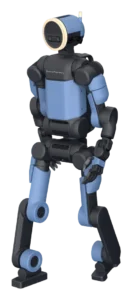
Electric Atlas CES 2026 Appearance Marks First Major Public Trade Show Debut
Boston Dynamics unveiled the production-ready electric Atlas at CES 2026 on January 5, during Hyundai's global media day.
Full assessment
AutonomyL2 unchangedReadinessWait status unchangedScoreScores unchangedThe event included announcement of a Google DeepMind AI partnership to integrate foundation models into Atlas, and confirmation that all 2026 Atlas deployments are committed to Hyundai's Robotics Metaplant Application Center (RMAC) and Google DeepMind. This marked Atlas's first public appearance as a production-configured platform rather than a research demonstrator.
Impact on autonomy
- No new autonomy capability announced at CES appearance; existing motion library demonstrated
- Close-access press interaction showed obstacle navigation in controlled convention floor environment
- Operator supervision present throughout all public demonstrations
- Level II classification unchanged; demonstration context consistent with prior partner-facing showings
Impact on readiness
- CES appearance increases public awareness but does not alter availability status
- No pricing, partner program expansion, or consumer product announcement made
- Press coverage extends the industrial partner evaluation pipeline's public credibility
- Platform remains exclusively accessible via Boston Dynamics direct partnership agreement
Claim check
Marketing ClaimDocumented RealityAtlas at CES signals it is ready for wider deploymentBoston Dynamics confirmed production-ready configuration and disclosed all 2026 units are committed to Hyundai RMAC and Google DeepMind; no open-market or expanded partner access was announcedGoogle DeepMind partnership means Atlas gains general AI capabilityPartnership announcement describes integration of DeepMind foundation models; specific capability benchmarks, timelines, and integration milestones were not disclosed at CESHyundai deployment proves Atlas is industrially matureHyundai RMAC deployment is committed for 2026; the stated roadmap targets repetitive sequencing tasks by 2028 and complex assembly by 2030, indicating capability ramp rather than current full readinessAtlas is now competing with other humanoids at CESMultiple humanoid platforms appeared at CES 2026; Boston Dynamics did not position Atlas against competitors and made no comparative claims in documented press statementsBottom LineThe CES 2026 event was a substantive announcement: production configuration, a confirmed AI partnership, and committed first deployments. It does not alter the existing industrial-partnership access model or indicate near-term consumer availability.Technical notes1 section
- Notes
- CES 2026 Announcement ScopeBoston Dynamics presented the production-ready electric Atlas at CES 2026 in Las Vegas on January 5, 2026, during Hyundai Motor Group’s global media day. The event was a capability and partnership announcement rather than a demonstration-only appearance. Published press accounts confirm a live stage demonstration of the prototype alongside disclosure of the production unit.Google DeepMind PartnershipBoston Dynamics announced a collaboration with Google DeepMind to integrate Google DeepMind foundation models into Atlas. The stated goal is to augment Atlas’s cognitive capabilities by combining Boston Dynamics’ locomotion and manipulation expertise with DeepMind’s robot AI foundation models. No specific model versions or integration timelines were disclosed.Hyundai RMAC Deployment CommitmentAll 2026 Atlas units are committed to two destinations: Hyundai’s Robotics Metaplant Application Center (RMAC), scheduled to open in 2026, and Google DeepMind. Hyundai’s published roadmap targets RMAC-trained Atlas robots performing repetitive sequencing tasks by 2028 and complex assembly by 2030. No consumer or open-market access was announced.Production ConfigurationThe production Atlas specification includes 56 degrees of freedom, human-scale hands with tactile sensing, and a documented lift capacity of 110 pounds. These figures were disclosed as part of the CES announcement and differ from earlier research-prototype configurations.
SourcesCNET 2026-01-09 -
Google Gemini Integration with Electric Atlas Demonstrated for Research
Boston Dynamics and Google DeepMind demonstrated Gemini language model integration with the electric Atlas in 2025, allowing natural-language instructions to be interpreted and translated into task sequences.
Full assessment
AutonomyL2; language interface addedReadinessWait status unchangedScoreSoftware score basis updatedThe research demo does not change the platform's operator-supervised classification.
Impact on autonomy
- Natural-language instruction parsing added as an interface layer above existing motion primitive stack
- Gemini model interprets task commands and maps them to pre-existing motion library entries
- Autonomous task planning or novel environment reasoning not demonstrated in published research
- Level II classification unchanged; human operator still required to issue instructions and supervise execution
Impact on readiness
- Research-only framing; no deployment product or commercial offering announced alongside demo
- Language interface lowers technical barrier for operator instruction, but engineering support still required
- Partnership-only access unchanged; capability expansion does not alter consumer availability status
- Google partnership adds long-term AI integration pathway that may affect future platform iterations
Claim check4 claims reviewed
Atlas can now understand and follow spoken instructionsThe demonstrated system parses text-form natural language commands and maps them to pre-programmed motion sequences; real-time voice command execution in unstructured environments is not confirmedGemini enables Atlas to reason about its environmentPublished research describes language model as a high-level task planner that selects from a fixed motion library; autonomous environmental reasoning beyond the defined task space is not demonstratedThe Google partnership transforms Atlas into an AI-native robotThe integration adds a language interface layer; the underlying motion execution and operator supervision model is unchanged from pre-integration deploymentsThis brings Atlas closer to general-purpose autonomyThe research extends the command interface, not the autonomous capability range; novel tasks not represented in the motion library still require engineering developmentBottom lineGemini integration is a meaningful research step toward more natural human-robot instruction; it does not change Atlas's fundamental dependence on pre-programmed motion primitives and operator oversight.
Technical notes4 sections
- Integration Architecture
-
The Boston Dynamics and Google DeepMind research describes a system where Gemini processes natural-language task instructions and outputs a sequence of calls to Atlas’s existing motion primitive library. The language model acts as a high-level planner, not a low-level controller. Motion execution is handled by Atlas’s existing control stack.
- Task Scope in Demonstration
-
Published demonstration tasks included object retrieval and placement based on natural-language prompts (e.g., “pick up the box and put it on the shelf”). Task success depended on the object and environment matching the motion library’s operational assumptions. Out-of-distribution objects or unexpected environment states were not part of the published demonstration scope.
- Research vs. Product Status
-
The Gemini integration was published as joint research. Boston Dynamics did not announce a product update or firmware release associated with this work at the time of publication. Access to the integrated system is not described as available to existing Atlas partners through any announced update channel.
- Relation to Prior AI Work
-
Boston Dynamics has previously integrated reinforcement learning for motion generation (publicly documented for Spot and Atlas locomotion). The Gemini work extends this with a language interface; it is not the first AI integration on the platform, but it represents the first public large-language-model task planning integration for Atlas.
SourcesWIRED 2025-08-07 - 2024
-
Hydraulic Atlas Retired as Electric Successor Unveiled
Boston Dynamics retired the hydraulic Atlas and announced an electric replacement in April 2024.
Full assessment
AutonomyL2 classification maintainedReadinessWait status unchangedScoreScores pending new dataThe platform transition signals a shift from research-only demonstrations toward structured industrial partnership deployments.
Impact on autonomy
- Electric actuation enables finer joint-torque control than hydraulic predecessor
- Sensor suite retained with camera arrays, IMU, and force-torque feedback at joints
- Operator-directed task model unchanged; Level II classification holds for new variant
- Elimination of hydraulic system removes fluid-leak failure mode from operation profile
Impact on readiness
- New variant targets industrial partners, not consumer market; readiness status unchanged
- Electric platform requires updated operator training protocols for partner teams
- Simplified maintenance stack relative to hydraulic predecessor reduces per-deployment overhead
- Partnership-access model retained; no path to open commercial availability announced
Claim check4 claims reviewed
New Atlas" is a revolutionary leap forwardActuator technology changed; task model, operator requirement, and partnership-only access are unchanged from hydraulic eraElectric actuation enables more human-like movementBoston Dynamics demonstration footage shows improved range of motion; claims of human parity in dexterity are manufacturer characterizations not independently verifiedAtlas is ready for industrial deploymentAt announcement, Boston Dynamics described a pilot program with Hyundai; no general commercial availability announcedHydraulic Atlas was retired to make way for a better platformAccurate; Boston Dynamics confirmed the hydraulic platform's end of life and published a farewell video acknowledging its research roleBottom lineThe electric Atlas is a meaningful hardware generational change, but the platform's supervised, partnership-only operational model carries forward unchanged.
Technical notes4 sections
- Actuator Architecture Change
-
The hydraulic Atlas used Boston Dynamics’ custom hydraulic actuators across 28 joints. The 2024 electric Atlas replaces this with electric rotary actuators at each joint, eliminating hydraulic fluid lines and the associated sealing maintenance. Manufacturer documentation describes the electric system as enabling higher repeatability and quieter operation.
- Physical Specifications (Electric Atlas, 2024)
-
The electric Atlas stands approximately 1.5 m tall and weighs approximately 89 kg, lighter than the hydraulic predecessor. Width is listed at approximately 0.8 m. Boston Dynamics confirmed battery-powered operation with runtime varying by duty cycle.
- Sensor Continuity
-
Camera-based perception, IMU, and joint force-torque sensing carried forward from late hydraulic variants. Stereo vision for spatial awareness retained. Operator-in-the-loop control architecture unchanged.
- End of Hydraulic Line
-
The hydraulic Atlas operated from approximately 2013 through April 2024. Its retirement closes a decade-long research platform that produced locomotion, parkour, and manipulation demonstrations. The electric platform inherits the Atlas brand but represents a distinct hardware generation.
-
Boston Dynamics Atlas transitions to fully electric platform for industrial deployment
Boston Dynamics revealed a fully electric Atlas, replacing hydraulic generation with a system engineered for industrial and factory deployment.
Full assessment
AutonomyL4 environmental autonomy sustained, efficiency improvedReadinessNew to Market to Ready Now trajectoryScoreHardware reliability +15, commercial trajectory +10Impact on autonomy
- Mobile manipulation in factory environments enhanced by electric actuation efficiency
- Perception-to-action cycle improved through native electric control integration
- Dexterity capabilities expanded for precision industrial task execution
Impact on readiness
- Industrial factory deployment scenarios now within technical scope
- Electric platform reduces operational complexity versus hydraulic thermal management
- Commercial viability enhanced for structured factory environments
Claim check4 claims reviewed
All-electric Atlas targets industrial deploymentBoston Dynamics positioned the platform for factory and manufacturing environments, confirmed via announcement materialsViral demo video demonstrates new capabilitiesVideo published showing mobility and manipulation tasks; actual task autonomy level and failure modes not independently verifiedFully electric system replaces hydraulic generationElectrical actuation confirmed; previous hydraulic constraints no longer apply, enabling continuous operation in temperature-controlled factoriesReady for immediate industrial deploymentAnnounced as targeting deployment; actual commercial rollout timeline and customer trials not yet detailedBottom lineThe transition to electric actuation represents a hardware milestone enabling factory deployment, though timeline to actual customer installations remains unspecified.
Technical notes4 sections
- Platform Transition
-
Boston Dynamics transitioned Atlas from hydraulic actuation to a fully electric drivetrain and manipulation system. The electric platform eliminates hydraulic fluid circulation, thermal management, and associated noise constraints.
- Target Environment
-
The redesigned Atlas targets structured industrial environments including manufacturing floors, logistics hubs, and factory assembly lines. Electric operation enables sustained multi-hour shifts without thermal dissipation requirements.
- Capability Profile
-
The new Atlas maintains mobile manipulation capabilities documented in prior generations. Demonstration video showcased locomotion across factory terrain and precision object handling tasks typical of industrial assembly workflows.
- Development Status
-
The announcement positions Atlas as industrial-ready; specific firmware versions, API release dates, and customer trial timelines not yet disclosed. Previous generation experience with task planning and failure recovery carries forward into electric platform development.