
- Changes
- 3
- Tracking since
- Aug 2024
- Latest
- Jul 20, 2025
- Net movement
- Classification stable
- 2025
-
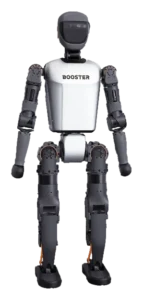
Booster T1 deployed across multiple RoboCup humanoid league teams
Multiple RoboCup humanoid league teams competed using the Booster T1 platform, establishing the robot's first significant multi-team showing at a sanctioned international competition.
Full assessment4 claims · 3 technical notes · 2 sources
Where it standsAutonomy LadderIIIIIIIVVLevel IIAssisted AutonomyHuman ReadinessReady NowNew to MarketWaitKnown IssuesNot ratedPre-Consumer Assessment03050717662PlausibleWhat happenedCross-team deployment confirms the platform's institutional uptake beyond single early-adopter programs. How gait strategies and locomotion reliability compare across independent teams over subsequent competition seasons is the next observable data point.
Bottom lineMulti-team RoboCup deployment is the strongest form of public demonstration available for this platform class; detailed reliability data remains unpublished.
ImpactOn autonomy
- Multi-team competition deployment provides parallel real-world gait performance data
- Sanctioned match conditions stress-test dynamic balance under unpredictable contact scenarios
- Cross-team variation in outcomes isolates software and tuning contributions to performance
- Competition confirms autonomous locomotion within structured RoboCup field ODD
On readiness
- RoboCup deployment confirms institutional readiness for developer-market use case
- Competition stress conditions expose joint durability and battery runtime limits at scale
- No evidence of consumer-context readiness; developer-only positioning unchanged
Claim check4 maker claims checked against the record. Open one to read the finding.
Designed for RoboCup competition performance
Documented findingConfirmed: multi-team deployment at a sanctioned RoboCup event is direct evidence of fit-for-purposeRepeatable bipedal locomotion across competition conditions
Documented findingMulti-team deployment provides partial confirmation; joint wear and multi-day reliability across a full competition schedule was not publicly reported in detailPlatform supports independent team software customization
Documented findingSupported by fact that different teams fielded the same hardware with independent gait stacks; comparative outcome data not publishedSuitable for high-dynamic interaction scenarios
Documented findingSoccer competition involves player contact and ball interaction; published post-competition technical analysis was not available at time of entryEvidence2 sources · 1 linked
1218 Jul 202522 Jul 2025filed 20 Jul 2025- 1RoboCup 2025 Official Results18 Jul 2025
- 2IEEE Robotics and Automation Society Coverage22 Jul 2025named, not linked
Technical notes3 sectionsCompetition Context
RoboCup humanoid league competition involves fully autonomous operation: no teleoperation permitted during matches. Teams are responsible for their own software stacks running on standardized or approved hardware. The Booster T1’s appearance across multiple competing teams at the same event is notable because it shifts the platform from a single-team experiment to a repeatable institutional tool.
Operational Design Domain
RoboCup soccer fields are flat, bounded, and standardized. The competition ODD is structured and well-defined, consistent with Level II (Assisted Autonomy) classification. Autonomous locomotion, ball detection, and teammate coordination operate within this constrained domain.
Open Questions After Deployment
Post-competition joint inspection data, battery runtime under full match load, and fall-recovery performance statistics were not published in accessible sources following the event. These are the primary hardware validation gaps for prospective institutional buyers.
- 2024
-
Booster Robotics T1 made available to RoboCup teams and academic institutions
Booster Robotics transitioned the T1 from internal development to institutional availability, offering the platform to RoboCup programs and university robotics departments.
Full assessment4 claims · 4 technical notes · 2 sources
Where it standsAutonomy LadderIIIIIIIVVLevel IIAssisted AutonomyHuman ReadinessReady NowNew to MarketWaitKnown IssuesNot ratedPre-Consumer Assessment03050717662PlausibleWhat happenedThis formalized a developer-market release without a consumer channel. Whether after-sales support and parts supply keep pace with growing adoption is the key variable to monitor.
Bottom lineThe institutional release is a genuine commercial step; the support infrastructure behind it has not been independently verified.
ImpactOn autonomy
- Platform availability exposes gait stack to broader academic iteration
- Multiple institutional teams can now run parallel firmware and gait experiments
- Competitive deployment context accelerates real-world bipedal locomotion data collection
On readiness
- Institutional purchase path established; no consumer retail channel opened
- Academic buyer prerequisite means technical staff and lab infrastructure required
- No SLA or published warranty documentation confirmed at launch
Claim check4 maker claims checked against the record. Open one to read the finding.
Purpose-built for RoboCup competition performance
Documented findingConfirmed by manufacturer positioning and RoboCup team adoption; locomotion scope is narrowAvailable to academic and research institutions
Documented findingInstitutional channel confirmed; no consumer or broad commercial availability announcedModular software stack supports custom gait research
Documented findingDescribed in manufacturer documentation; depth of modularity not independently benchmarked at launchDesigned for repeatable bipedal performance across competition seasons
Documented findingMulti-season durability data not yet published; joint wear over sustained competition use remains an open questionEvidence2 sources · 1 linked
12Sep 2024Oct 2024filed 1 Oct 2024- 1Booster Robotics Official Announcement10 Sep 2024
- 2RoboCup Federation News14 Sep 2024named, not linked
Technical notes4 sectionsPlatform Availability
The T1 became available through institutional purchase channels targeting RoboCup participant teams and university robotics programs. No consumer retail listing was announced. Pricing was not publicly disclosed.
Hardware Configuration
The T1 is a child-size humanoid form factor sized to meet RoboCup Kid-Size or Teen-Size league dimensional rules. Actuator configuration supports bipedal locomotion with dynamic balance. Arm and manipulation capability is minimal relative to locomotion design emphasis.
Software Stack
Manufacturer documentation describes a modular locomotion control stack intended for academic customization. ROS compatibility assumed given academic deployment context; specific middleware integration documentation was not publicly confirmed at the time of this entry.
Support Model
Institutional buyers are expected to provide on-site engineering support. No published service-level agreement or centralized warranty structure was documented at launch. Parts availability for field repair was not confirmed in public sources.
-
Booster Robotics T1 announced as child-size humanoid developer platform
Booster Robotics publicly introduced the T1, a child-size bipedal humanoid designed for RoboCup competition and academic locomotion research.
Full assessment4 claims · 4 technical notes · 2 sources
Where it standsAutonomy LadderIIIIIIIVVLevel IIAssisted AutonomyHuman ReadinessReady NowNew to MarketWaitKnown IssuesNot ratedPre-Consumer Assessment03050717662PlausibleWhat happenedThe announcement established the platform's scope: agility-first, developer-market, no consumer path. Whether the disclosed capabilities translated into competition-ready hardware at institutional scale was the primary question left open at announcement.
Bottom lineAnnouncement established a clear, narrow scope; claims were conservative and developer-focused rather than consumer-aspirational.
ImpactOn autonomy
- Bipedal locomotion autonomy within RoboCup structured field ODD disclosed
- Dynamic balance and gait control described as core design objectives
- Manipulation capability explicitly out of scope at announcement
On readiness
- No consumer availability announced; institutional-only channel stated from launch
- Academic and RoboCup-team buyer profile defined explicitly in product positioning
- No consumer support infrastructure or retail pricing disclosed
Claim check4 maker claims checked against the record. Open one to read the finding.
Purpose-built for RoboCup humanoid league
Documented findingManufacturer positioning confirmed; RoboCup league eligibility requires independent referee verification of dimensional complianceModular developer platform for academic customization
Documented findingDescribed in announcement materials; modularity depth and SDK maturity were not independently confirmed at announcementChild-size form factor optimized for dynamic balance
Documented findingForm factor claim is physical and verifiable; balance performance at competition speed was not benchmarked in published announcement materialsAvailable to institutions and research labs
Documented findingStated intent at announcement; actual institutional sales channel was not operationally confirmed until later availability noticesEvidence2 sources · 1 linked
12Mar 2024Aug 2024filed 21 Aug 2024- 1Booster Robotics Product Announcement8 Mar 2024
- 2The Robot Report11 Mar 2024named, not linked
Technical notes4 sections
Form Factor
The T1 was announced as a child-size humanoid, a designation referencing the RoboCup humanoid league size classification. Child-size robots in the RoboCup context are bipedal humanoids with a defined height range set by RoboCup Technical Committee rules. The T1’s physical dimensions were not published in detail in accessible announcement sources.
Design Priorities Disclosed
Manufacturer materials at announcement emphasized bipedal locomotion agility and dynamic balance over manipulation capability. The platform was described as targeting locomotion research, balance control, and competition soccer; task manipulation was not a stated design goal at this stage.
Software Environment
A modular locomotion software stack was described at announcement. Specific SDK version, middleware compatibility, and API documentation were not published in accessible sources at the time of announcement. ROS compatibility was implied by the academic deployment context but not confirmed in available materials.
Market Positioning
Booster Robotics explicitly targeted institutional buyers: RoboCup team programs and university robotics departments. No consumer product roadmap was disclosed. Pricing was not announced publicly.