
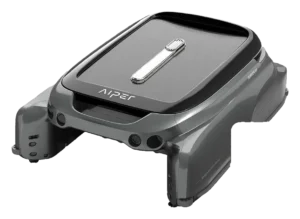
- Changes
- 2
- Tracking since
- Sep 2023
- Latest
- Aug 20, 2026
- Net movement
- Classification stable
- 2026
-
FCC Covered List update places Aiper Surfer S1 under robot import ban
The FCC added foreign-produced advanced robotic devices to its Covered List on 28 Jul 2026, and reporting confirms surface-water pool skimmers fall under that category.
Full assessment
AutonomyL2 unchangedReadinessReady Now heldScoreScores unchangedAiper is headquartered in Atlanta but manufactures its cleaners across Asia, so the Surfer S1's surface-skimming design puts new units in scope unless Aiper secures a conditional exemption or shifts production. Existing owned units are unaffected; watch for Aiper's response on manufacturing or exemption status.
Impact on autonomy
- No autonomy or navigation change reported
- Rule concerns import authorization, not onboard capability
Impact on readiness
- Currently owned units keep normal operation and support
- New unit availability in the US now depends on FCC conditional approval or a manufacturing shift
Claim check2 claims reviewed
Aiper markets itself as a US-headquartered pool robotics companyReporting on the FCC's foreign-robot rule notes Aiper's cleaners are manufactured across Asia, which is the fact that brings the Surfer S1 into scopeNo change announced to sold unitsThe FCC's guidance applies the rule prospectively to new equipment authorizations, not previously authorized products already in US homesBottom lineHeadquarters location does not exempt the Surfer S1 from the rule; manufacturing origin does.
Technical notes3 sections
- Covered List Addition
-
On 28 Jul 2026 the FCC added “foreign-produced advanced robotic devices” and “foreign-produced power inverters” as new equipment categories on its Covered List, the mechanism used to restrict equipment authorizations on national-security grounds.
- Aiper's Exposure
-
Reporting published 20 Aug 2026 states Aiper is headquartered in Atlanta, Georgia, but its robotic pool cleaners are manufactured and assembled across Asia. To avoid the ban on surface-operating devices, the company would need to obtain a conditional exemption from the FCC or move manufacturing onshore.
- Scope
-
The restriction is prospective. It affects whether new equipment authorizations can be granted after the rule’s effective date. The Surfer S1 is a dedicated surface skimmer, the functional trait cited as the qualifying factor for dual-use and surface-only pool robots. Products already authorized and sold are not recalled or disabled.
- 2023
-
Aiper Surfer S1 announced as solar robotic pool skimmer concept
Aiper announced the Surfer S1 solar-powered surface skimmer, the brand's first product targeting pool surface debris rather than floor cleaning.
Full assessment
AutonomyL2 confirmedReadinessReady Now strengthenedScoreScores unchangedThe announcement established a category position for autonomous waterline collection with zero-electricity operation as the headline capability.
WatchingWhether commercial pricing and retail channel details follow within 90 days.
Impact on autonomy
- Floating random-drift navigation confirmed as architecture, establishing Level II classification baseline.
- No mapping, scheduling, or zone-targeting capability disclosed at announcement stage.
- Solar charging extends autonomous operation window without AC dependency.
Impact on readiness
- Pre-retail announcement signals production readiness; no purchase path available at time of disclosure.
- Solar-only charging positions product for seasonal deployment without infrastructure requirements.
- No app or connectivity ecosystem announced; manual-only operation scoped from the outset.
Claim check4 claims reviewed
Solar-powered continuous autonomous operationManufacturer documentation confirms solar charging extends runtime but output depends on sun intensity; cloudy-day runtime drops to 30-50 minutes per subsequent owner reports.Zero setup and zero electricity requiredConfirmed for initial deployment; manual power-on and debris-bag emptying remain user responsibilities throughout ownership.Designed for all residential poolsManufacturer guidance disclosed post-release recommends against saltwater pools; saltwater compatibility testing was not completed at announcement.Long-duration operation for extended pool coverageManufacturer specifications indicate 2-4 hours per full solar charge; coverage is probabilistic due to random-drift navigation, not systematic.Bottom lineAnnouncement claims on solar autonomy held up in broad terms; saltwater and large-pool limitations were not disclosed at this stage.
Technical notes4 sections
- Architecture at Announcement
-
Manufacturer materials described bumper-based random-drift navigation using a single propeller for propulsion and wall-contact detection for redirection. No camera, LiDAR, or GPS integration disclosed.
- Power System
-
Solar panel integrated into the floating chassis; Li-ion battery rated for 2-4 hours continuous operation per full charge. Manufacturer cited solar input as capable of sustaining daytime operation under direct sun without grid power. Thermal cutoff for battery protection in high-temperature conditions noted in technical documentation.
- Form Factor
-
Compact floating chassis at 11.4 x 11.4 x 3.9 in (28.9 x 28.9 x 9.9 cm), weight 12.8 lbs. Debris bag accessible from topside for manual emptying. IP65-rated construction for poolside weatherproofing.
- Connectivity
-
No Wi-Fi, Bluetooth, or app integration included in the announced specification. Operation scoped as manual power-on only from initial disclosure.