
Roborock S8 MaxV Ultra · Roborock Saros Rover
All robot vacuums. Every measure below is plotted against the full class, so a difference can be read against how much the class itself varies.
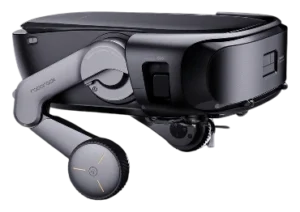
- Roborock S8 MaxV Ultra
- Roborock Saros Rover


Roborock Saros Rover
- Autonomy
- IIAssisted Autonomy
- Score
- 64/100 Plausible
- Readiness
- Not assessed
- Price
- Not tracked
Up to three
What each one does on its own.
The Autonomy Ladder is the same five rungs for every robot on the site. A rung describes the conditions a robot handles without you, not how good it is.
Where they actually differ.
The Robovations Score is nine inputs across three pillars, each weighted as shown and each scored so that more is better. A robot can lead on one and trail on another, which is the point of showing them apart. Cost of ownership and data handling are reported on each robot's own page and are never averaged into the score.
Capability
- Roborock S8 MaxV Ultra75
Not scored: Roborock Saros Rover
- Roborock S8 MaxV Ultra100
Not scored: Roborock Saros Rover
- Roborock S8 MaxV Ultra62
Not scored: Roborock Saros Rover
- Roborock S8 MaxV Ultra75
Not scored: Roborock Saros Rover
Dependability
- Roborock S8 MaxV Ultra91
Not scored: Roborock Saros Rover
- Roborock S8 MaxV Ultra95
Not scored: Roborock Saros Rover
- Roborock S8 MaxV Ultra94
Not scored: Roborock Saros Rover
Ownership burden
- Roborock S8 MaxV Ultra84
Not scored: Roborock Saros Rover
- Roborock S8 MaxV Ultra83
Not scored: Roborock Saros Rover
How far apart is a long way?
A number only means something next to the spread it sits in. Each track below is the real range across every classified robot in the class, with the median marked.
These robots share no measured specification with enough published figures to plot. That is a gap in the record, not a finding about the robots.
What the numbers leave out.
The trade-off
What each design gives up to be good at what it is good at.
Establishment time (30-45 min initial training, room marking) buys hands-off cycles (leave home, returns to dock, scheduled mopping prep).
All-in-one dock adds mopping and hot-water drying but increases weekly maintenance complexity (filter + nozzle + water-tank lifecycle).
The wheel-leg mechanical novelty is the pitch, but pre-release status caps reliability claims; first-generation mechanical systems carry risk that owner data cannot yet quantify.
The stair-cleaning capability is shown in CES demonstrations, where the robot vacuums each tread as it climbs, but owner-home variability remains unknown; demo environments are controlled and scripted, homes are not.
Who each one is wrong for
Stated by the record itself. A robot being wrong for a household is a fact about fit, not a fault.
- Frequent furniture rearrangement or clutter-heavy homes
- Dynamic layouts require map retraining; cluttered rooms with low-profile items confuse camera detection. Manual map updates add 15-20 minutes per change cycle.
- Budget-first or privacy-conscious buyers
- The purchase price is the barrier, not the running cost: official dock bags are about $4.30 each in Roborock's 6-pack, roughly $25 a year. On privacy, the app requires an account and maps and camera images sync to Roborock's cloud servers, with no user-facing local-only mode.
- Hands-off operation without dock maintenance
- Weekly dock filter cleaning, monthly nozzle inspection and periodic bag changes are not optional. Neglected dock maintenance shows up in mopping quality within 2-3 months.
- Homes with only hard floors or minimalist spaces
- Mopping capability adds complexity and dock footprint. Budget L2 vacuums better suited for straightforward hard-floor-only maintenance without wet-cleaning overhead.
- Anyone needing a working vacuum within 12 months
- No release date exists. Roborock has not committed to timeline. Concept stage implies substantial engineering work remains before shipping firmware is ready.
- Households with spiral or unusually narrow stairs
- Roborock names traditional, curved, and carpeted bullnose staircases plus slopes among the geometries it handles, but it does not claim spiral stairs, and it publishes no wheel-leg width, articulation range, or tread-depth figures. Every geometry it does name is a manufacturer claim with no owner data behind it.
- Buyers requiring published reliability data before purchase
- No consumable cadence, failure-recovery procedures, or owner reports exist. First-generation mechanical systems carry risk that demonstration footage cannot quantify.
- Users avoiding early-generation hardware or novel mechanical systems
- The wheel-leg articulation is mechanically unproven. Bearing wear, joint durability, and servo reliability over months of stair use cannot be inferred from prior flat-floor models.
What stays your job
The upkeep ownership hands back to you, whatever the autonomy level says.
- After every use: Empty the mopping water tank, rinse the mop tray, check dock dust cap alignment.
- Weekly: Wash the dock filter, clear hair from the main brush and the FlexiArm side brush, inspect the spray nozzles for clogs.
- Monthly: Wipe the dock spray heads and wash tray with clean water, check suction, wipe the LiDAR window and the front camera. Water only: vinegar and descaling acid attack the dock’s pump and seals.
- Every 3-6 months: Replace main brush bristles (approximately $25 replacement cost).
- Every 60-90 days: Replace the dock’s 2.5 L disposable dust bag. Roborock sells the official 6-pack for $25.59, about $4.30 a bag, so bags run roughly $25 a year.
- Annually: Inspect all seals and water tanks for leakage and calibrate camera focus.
- As needed: Manual tangle removal from the side brush, remapping if furniture moves significantly, unclogging water nozzles. Refill the dock’s detergent reservoir with Roborock’s own solution only.
- As needed: Roborock has published no maintenance schedule, consumable list, or service documentation for the Saros Rover; as of August 2026 it has no announced ship date, price, or model number.
- As needed: Replace the auto-empty dock’s 2.7 L dust bag when full; no fill-rate or bag pricing has been published for this machine.
- As needed: The wheel-leg transmission has not been described, so no belt, servo, bearing, or roller replacement can be scheduled, and the service burden of the articulation system is unknown.
How much each of these is standing on.
Classifications rest on different depths of evidence. A pre-release assessment and a verified one are not the same kind of claim.
| Robot | Evidence status | Sources reviewed | Last assessed |
|---|---|---|---|
| Roborock S8 MaxV Ultra | Provisional | 15 | Aug 2026 |
| Roborock Saros Rover | Pre-Release | 4 | Aug 2026 |
Add a robot
Comparing across classes is allowed — the page will switch to per-class positioning and tell you it has.