Skip to content
Saved
Comparison · 2 robots

Noetix Bumi · UBTECH Walker S1

All humanoid robots. Every measure below is plotted against the full class, so a difference can be read against how much the class itself varies.

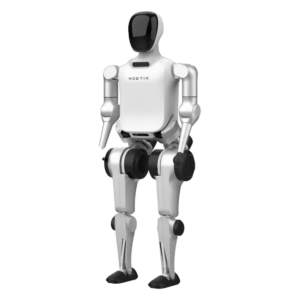
  1. Noetix Bumi
  2. UBTECH Walker S1
Noetix Robotics

Noetix Bumi

Autonomy
II Assisted Autonomy
Score
58/100 Plausible
Readiness
Promising Progress
Price
$1,385list
UBTECH Robotics

UBTECH Walker S1

Autonomy
II Assisted Autonomy
Score
75/100 Promising
Readiness
Promising Progress
Price
Not tracked

Up to three

01 Classification

What each one does on its own.

The Autonomy Ladder is the same five rungs for every robot on the site. A rung describes the conditions a robot handles without you, not how good it is.

V
Generalized
Any task, any setting
IV
Environmental
Handles new obstacles without help
III
Conditional
Finishes familiar jobs on its own
II
Assisted
Runs preset routines, needs rescue
Noetix BumiUBTECH Walker S1
I
Manual
One action, on command
02 Assessment

Where they actually differ.

The Robovations Score is nine inputs across three pillars, each weighted as shown and each scored so that more is better. A robot can lead on one and trail on another, which is the point of showing them apart. Cost of ownership and data handling are reported on each robot's own page and are never averaged into the score.

None of these robots carries a scored assessment yet, so there is nothing to plot here. The classification and evidence below still apply.

03 Measured against the class

How far apart is a long way?

A number only means something next to the spread it sits in. Each track below is the real range across every classified robot in the class, with the median marked.

Weight43 with a published figure
  • Noetix Bumi26.5 lbs
  • UBTECH Walker S1170 lbs
26.5 lbsmedian 143 lbs661.4 lbs
Height46 with a published figure
  • Noetix Bumi37 in
  • UBTECH Walker S167.7 in
37 inmedian 67 in86.6 in

Not compared, because fewer than two of these robots carry a published figure: Price, Suction, Runtime, Charge time, Noise.

04 Ownership

What the numbers leave out.

The trade-off

What each design gives up to be good at what it is good at.

Noetix Bumi

Choreography-optimized locomotion versus adaptive autonomy. Bumi excels at scripted motion sequences; reported terrain adaptation is limited to preprogrammed responses, not real-time environment negotiation.

UBTECH Walker S1

Not recorded for this robot.

Who each one is wrong for

Stated by the record itself. A robot being wrong for a household is a fact about fit, not a fault.

Noetix Bumi
Home and household automation
No manipulation capability, no autonomous task completion, no adaptation for unstructured home environments. Not designed for household chore execution or domestic mobility.
Unsupervised or autonomous operation
Demonstration platform requires operator oversight. No documented end-to-end task completion without human direction or scripted preprogramming.
Commercial service or industrial deployment
12 kg form factor and scripted-motion design unsuited for sustained commercial operation, material handling, or field deployment beyond controlled pilot settings.
Environments beyond demonstration scope
Terrain adaptation is reported for basic scenarios within demonstration contexts. Uncontrolled outdoor environments or complex obstacle landscapes are not documented use cases.
UBTECH Walker S1
Small or medium manufacturers without factory automation infrastructure
Requires capital investment in charging docks, factory-floor network, and on-site technician support. ROI cases depend on high-volume, repetitive material flow.
Environments requiring adaptation to novel layouts or task variations
Walker S1 operates via scripted routes and handoff logic. Ad-hoc task changes or facility reconfigurations require technician reprogramming.
Non-automotive industries without parallel assembly-line workflows
Design targets tier-one automotive suppliers; application to retail, hospitality, or smaller manufacturing uncertain.

What stays your job

The upkeep ownership hands back to you, whatever the autonomy level says.

Noetix Bumi
  • Daily: Visual inspection of motion fidelity during choreography routines; debris and dust removal from joints and leg contacts.
  • Weekly: Sensor array cleaning (cameras and IMU/terrain-detection sensors); check articulation points for binding or debris accumulation.
  • Monthly: Software update checks via programming interface; battery health monitoring and calibration verification.
  • Every 3-6 months: Joint lubrication and recalibration per manufacturer documentation (specific intervals pending).
  • Annually: Comprehensive actuator inspection and wear assessment; thermal stress testing under normal use patterns.
  • As needed: Replacement of damaged joints or sensors; replacement part costs not yet published.
UBTECH Walker S1
  • Daily: Battery state-of-charge verification and charging dock connectivity check; visual inspection of foot contact points for debris or wear.
  • Weekly: Joint torque and range-of-motion tests on all limbs.
  • Monthly: Sensor calibration verification (cameras, IMU, force sensors); firmware patch review and installation coordinated with on-site technician.
  • Periodically: Actuator and bearing wear assessment across shoulders, elbows, wrists, hips and knees; bearing replacement if play is detected. UBTECH publishes no service interval, lubrication schedule or service pricing for the Walker S1.
  • As needed: Cabling or actuator swaps if field damage occurs during pilot operations; UBTECH technician dispatch required for major repairs.
05 Evidence

How much each of these is standing on.

Classifications rest on different depths of evidence. A pre-release assessment and a verified one are not the same kind of claim.

Evidence behind each classification
Robot Evidence status Sources reviewed Last assessed
Noetix Bumi Not Consumer-Ready 10 Jul 2026
UBTECH Walker S1 Not Consumer-Ready 2 Aug 2026

Robovations classifies robots; it does not rank them. Nothing on this page is a recommendation, and no manufacturer influences a classification or its placement here.