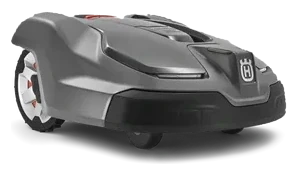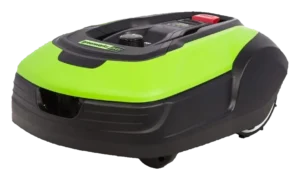
Greenworks Optimow 15 · Husqvarna Automower 430XH
All robot lawn mowers. Every measure below is plotted against the full class, so a difference can be read against how much the class itself varies.
- Greenworks Optimow 15
- Husqvarna Automower 430XH
What each one does on its own.
The Autonomy Ladder is the same five rungs for every robot on the site. A rung describes the conditions a robot handles without you, not how good it is.
Where they actually differ.
The Robovations Score is nine inputs across three pillars, each weighted as shown and each scored so that more is better. A robot can lead on one and trail on another, which is the point of showing them apart. Cost of ownership and data handling are reported on each robot's own page and are never averaged into the score.
Capability
- Greenworks Optimow 1575
- Husqvarna Automower 430XH80
- Greenworks Optimow 1555
- Husqvarna Automower 430XH60
- Greenworks Optimow 1565
- Husqvarna Automower 430XH55
- Greenworks Optimow 1576
- Husqvarna Automower 430XH70
Dependability
- Greenworks Optimow 1564
- Husqvarna Automower 430XH100
- Greenworks Optimow 1582
- Husqvarna Automower 430XH82
- Greenworks Optimow 1558
- Husqvarna Automower 430XH94
Ownership burden
- Greenworks Optimow 1543
- Husqvarna Automower 430XH48
- Greenworks Optimow 1576
- Husqvarna Automower 430XH86
How far apart is a long way?
A number only means something next to the spread it sits in. Each track below is the real range across every classified robot in the class, with the median marked.
- Greenworks Optimow 1570 min
- Husqvarna Automower 430XH145 min
- Greenworks Optimow 1570 min
- Husqvarna Automower 430XH50 min
- Greenworks Optimow 1550 dB
- Husqvarna Automower 430XH58 dB
- Greenworks Optimow 1524.3 lbs
- Husqvarna Automower 430XH32.4 lbs
- Greenworks Optimow 1510.2 in
- Husqvarna Automower 430XH13 in
Not compared, because fewer than two of these robots carry a published figure: Price, Suction.
What the numbers leave out.
The trade-off
What each design gives up to be good at what it is good at.
Wire installation is the price of entry: the Optimow 15 delivers genuine unsupervised mowing, but only after the owner commits several hours to perimeter-wire layout and staking.
Randomized cutting works, but systematic GPS-based mowing completes large areas faster and with more predictable pass distribution; the Optimow 15 trades path efficiency for a lower price tier.
Boundary-wire provides reliable, offline coverage but eliminates adaptive zone optimization in GPS competitors.
Low autonomous-operation burden offset by annual blade replacement and seasonal wire maintenance not needed in fully robotic alternatives.
Who each one is wrong for
Stated by the record itself. A robot being wrong for a household is a fact about fit, not a fault.
- Yards exceeding 1,500 m² (0.37 acres)
- The 1,500 m² coverage ceiling is a documented hard limit. Larger properties require a higher-capacity model; exceeding the rated area results in incomplete coverage cycles.
- Owners who cannot or will not install perimeter wire
- The Optimow 15 requires perimeter wire for all boundary definition. No GPS or camera-based wire-free operation is supported. Wire installation is mandatory, not optional.
- Properties with dense obstacles or numerous internal garden beds
- Randomized-pattern mowers lack systematic zone mapping. Dense obstacle fields or numerous internal garden beds require extensive guide-wire loops, adding installation complexity and wire-break risk.
- Slopes exceeding 35% or areas with loose surface conditions
- The 35% gradient rating is the published hard limit. Steeper sections or slopes with wet clay at the boundary are outside the documented operating envelope.
- Households requiring Wi-Fi or local-network integration
- Connectivity runs over GSM (cellular module), not home Wi-Fi. Smart-home integrations dependent on local Wi-Fi are not supported on this model.
- Small residential yards under 800 square meters
- Unit oversized and expensive for limited area. Purchase cost disproportionate to labor saved; smaller models better suited.
- Yards with frequent obstacles or complex landscaping
- Random cutting pattern and limited obstacle avoidance require very careful boundary planning. Potted plants and garden furniture risk collision.
- Rental properties or frequently reconfigured outdoor spaces
- Boundary-wire relocation is labor-intensive. Properties with seasonal layout changes incur repeated installation and removal costs.
- Owners unwilling to manage seasonal transitions or maintenance
- Requires manual blade replacement annually and weather-driven shutdown decisions. Not truly set-and-forget like position-independent systems.
- Users requiring year-round autonomous operation
- Designed for spring-to-fall mowing in temperate climates. Not rated for snow or ice; winter storage required in freeze-thaw regions.
What stays your job
The upkeep ownership hands back to you, whatever the autonomy level says.
- After every use: Visually inspect blade disc for damage or grass clogging.
- Weekly: Clear accumulated clippings from the chassis underside and blade housing.
- Monthly: Inspect boundary wire and pegs along the full perimeter; re-stake any lifted sections.
- Every 3-6 months: Replace blade disc or individual blades; standard Greenworks Optimow replacement parts.
- Seasonally: Clean charging contacts on dock and mower body; verify boundary wire continuity before mowing season.
- Annually: Full perimeter wire inspection; replace degraded sections; charge battery to storage level before winter.
- After every use: Empty grass chamber if equipped; inspect for debris around wheels.
- Weekly: Inspect boundary wire for visible damage or displacement in high-traffic areas.
- Monthly: Clean charging contacts and dock station of grass and moisture.
- Every 3-6 months: Blade inspection for dullness or damage; replace if cutting quality degrades.
- Annually: Full blade replacement (cost $30-50); seasonal storage and battery conditioning.
- As needed: Boundary-wire repair or relocation due to lawn changes (professional service $150-300).
How much each of these is standing on.
Classifications rest on different depths of evidence. A pre-release assessment and a verified one are not the same kind of claim.
| Robot | Evidence status | Sources reviewed | Last assessed |
|---|---|---|---|
| Greenworks Optimow 15 | Pending | — | Aug 2026 |
| Husqvarna Automower 430XH | Provisional | 5 | Aug 2026 |
Add a robot
Comparing across classes is allowed — the page will switch to per-class positioning and tell you it has.