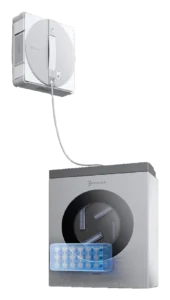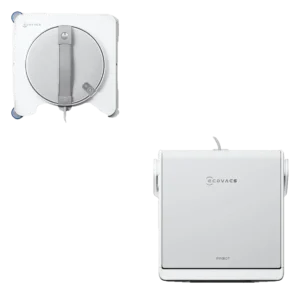
Ecovacs Winbot W2S Omni · Ecovacs Winbot W3 Omni
All robot window cleaners. Every measure below is plotted against the full class, so a difference can be read against how much the class itself varies.
- Ecovacs Winbot W2S Omni
- Ecovacs Winbot W3 Omni
What each one does on its own.
The Autonomy Ladder is the same five rungs for every robot on the site. A rung describes the conditions a robot handles without you, not how good it is.
Where they actually differ.
The Robovations Score is nine inputs across three pillars, each weighted as shown and each scored so that more is better. A robot can lead on one and trail on another, which is the point of showing them apart. Cost of ownership and data handling are reported on each robot's own page and are never averaged into the score.
Capability
- Ecovacs Winbot W2S Omni82
- Ecovacs Winbot W3 Omni75
- Ecovacs Winbot W2S Omni97
- Ecovacs Winbot W3 Omni72
- Ecovacs Winbot W2S Omni100
- Ecovacs Winbot W3 Omni0
- Ecovacs Winbot W2S Omni75
- Ecovacs Winbot W3 Omni62
Dependability
- Ecovacs Winbot W2S Omni56
- Ecovacs Winbot W3 Omni70
- Ecovacs Winbot W2S Omni65
- Ecovacs Winbot W3 Omni0
- Ecovacs Winbot W2S Omni58
- Ecovacs Winbot W3 Omni62
Ownership burden
- Ecovacs Winbot W2S Omni36
- Ecovacs Winbot W3 Omni30
- Ecovacs Winbot W2S Omni71
- Ecovacs Winbot W3 Omni72
How far apart is a long way?
A number only means something next to the spread it sits in. Each track below is the real range across every classified robot in the class, with the median marked.
- Ecovacs Winbot W2S Omni$599.99
- Ecovacs Winbot W3 Omni$699
- Ecovacs Winbot W2S Omni8,000 Pa
- Ecovacs Winbot W3 Omni3,300 Pa
- Ecovacs Winbot W2S Omni110 min
- Ecovacs Winbot W3 Omni130 min
- Ecovacs Winbot W2S Omni180 min
- Ecovacs Winbot W3 Omni120 min
- Ecovacs Winbot W2S Omni68 dB
- Ecovacs Winbot W3 Omni68 dB
- Ecovacs Winbot W2S Omni4.3 lbs
- Ecovacs Winbot W3 Omni4.6 lbs
- Ecovacs Winbot W2S Omni3 in
- Ecovacs Winbot W3 Omni9.4 in
What the numbers leave out.
The trade-off
What each design gives up to be good at what it is good at.
Dual power solves the runtime problem: wired mode removes the battery ceiling, but requires a powered outlet within cord reach of every window in the session.
Per-pane repositioning is the constraint this autonomy tier cannot escape. The Level III coverage within a pane is genuine; the manual transfer between panes is equally genuine.
The composite safety cable and 1 m backup rope tie the robot to a station that travels with it; every window means moving the station rather than reaching out from a fixed point.
Vortex Wash cleans the pad contact-free in about a minute, with wastewater going to a sealed tray; the 80 ml tank and the station’s 10 kg still move window to window with the work.
Who each one is wrong for
Stated by the record itself. A robot being wrong for a household is a fact about fit, not a fault.
- Textured, patterned, or frosted glass surfaces
- Suction adhesion requires an unbroken smooth surface. Textured or patterned glass disrupts the seal, reducing cleaning coverage and raising the risk of adhesion failure. Manufacturer documentation limits operation to smooth flat glass.
- Panes with no surface for the station within about a meter
- The safety rope is integral to the station and the 5.2 kg station is itself the anchor, so it has to sit within roughly a meter of the robot on every pane. Windows with no sill, ledge, or interior surface at that distance fall outside the arrangement Ecovacs specifies. There is no separate tether and no anchor point for the owner to select or install.
- Owners expecting automated pad cleaning or station self-wash
- The 6-in-1 station handles power, storage, cord coiling, and stabilizing the robot. Cleaning pads require owner rinsing after each use and replacement when worn; no automated pad wash or drying function is built into the station.
- Multi-pane runs without manual repositioning
- Each window pane requires individual robot placement by the owner. No automated transfer between panes occurs; total session time scales directly with pane count and repositioning effort.
- High-rise apartments with exterior-only upper-floor windows
- The station sits indoors at the window being cleaned, with the robot inside the reach of its 1 m rope. Panes that can only be worked from the outside leave nowhere to put it. Ecovacs specifies no roof fixture, wall mount, or owner-selected anchor point for this machine.
- Homes with exclusively frameless or specialty glass
- Frameless glass and certain coatings complicate edge detection. Heavy aluminum or ornate frames may interfere with automatic pathing calibration.
- Owners expecting a whole house cleaned without returning to the machine
- The station holds 80 ml of water and prompts when it runs dry, and it moves to whichever window is being cleaned rather than serving the house from one position. Multi-window sessions mean repeated refills and repositioning by the owner.
What stays your job
The upkeep ownership hands back to you, whatever the autonomy level says.
- After every use: Rinse cleaning pads under running water; replace when visibly worn or no longer lifting residue.
- After every use: Refill the spray reservoir with clean water or approved solution before the next session.
- Weekly: Wipe the suction inlet ring and sensor surfaces to maintain seal integrity and edge-detection accuracy.
- Monthly: Inspect the composite safety rope and power cable for fraying, kinks, or crushing where it leaves the station. The rope and the power conductors share one cable, so a degraded cable is a service item rather than a field repair; stop using the robot until it is dealt with.
- Every 3-6 months: Flush or pin-clear the triple spray nozzles to remove mineral buildup from hard water use.
- As needed: Check the wire coiler in the 6-in-1 station for cord binding; uncoil and re-coil if tension is uneven during wired-mode sessions.
- Weekly: Inspect the composite safety rope and power cable for twists, kinks, or debris; 2-3 minutes.
- Monthly: Clean dock inlet filter and suction port; descale if hard water present (~5-10 minutes).
- Every 3-6 months: Replace cleaning pads (~$20-30 per pair, roughly $60-100 in consumables annually).
- Every 3-6 months: Check the 1 m rope at the station base for wear. It is fixed to the station rather than owner-rigged, so there is nothing to retension; a frayed rope or a damaged cable is a service item, not a field repair.
- Before each session: Fill the station’s 80 ml water tank and empty the wastewater tray.
How much each of these is standing on.
Classifications rest on different depths of evidence. A pre-release assessment and a verified one are not the same kind of claim.
| Robot | Evidence status | Sources reviewed | Last assessed |
|---|---|---|---|
| Ecovacs Winbot W2S Omni | Provisional | 6 | Aug 2026 |
| Ecovacs Winbot W3 Omni | Provisional | 4 | Aug 2026 |
Add a robot
Comparing across classes is allowed — the page will switch to per-class positioning and tell you it has.